As individuals navigate the later stages of life, preserving autonomy and quality of existence frequently hinges upon the maintenance of physical mobility and stability. Among the myriad physiological systems contributing to these vital capacities, the ankle joint often receives insufficient attention, despite its pivotal role in everyday movement, equilibrium, and the prevention of debilitating falls. For the rapidly growing demographic of older adults, proactive engagement with ankle health is not merely beneficial; it is a critical investment in sustained independence and reduced vulnerability to injury.
The ankle complex is a sophisticated biomechanical structure, serving as the crucial junction between the lower leg and the foot. Comprising primarily the talocrural joint (formed by the tibia, fibula, and talus bones) and the subtalar joint (between the talus and calcaneus), it facilitates a wide range of movements including plantarflexion (pointing the foot down), dorsiflexion (pointing the foot up), inversion (turning the sole inward), and eversion (turning the sole outward). This intricate arrangement, supported by a network of ligaments, tendons, and muscles, is fundamental for shock absorption, adapting to uneven terrains, and propelling the body forward during ambulation. Functionally, the ankle acts as the initial point of contact and adjustment in the body’s elaborate balance system. According to insights from Terry Tateossian, a certified lifestyle medicine coach and the founder of THOR – The House of Rose, the ankle is not merely a supplementary component but rather the vanguard of our equilibrium mechanisms. Its rapid, subtle compensations within the foot and lower leg musculature are often what prevent a loss of balance from escalating into a more significant destabilization event, often before larger muscle groups in the hips are even activated.
The natural aging process inevitably brings about physiological alterations that can compromise ankle function. Sarcopenia, the age-related decline in muscle mass and strength, disproportionately affects fast-twitch muscle fibers, which are crucial for quick reactions and power. Additionally, proprioception—the body’s inherent sense of its position and movement in space—tends to diminish with age due to reduced nerve sensitivity and slower signal processing. These changes collectively impact an individual’s ability to maintain equilibrium, adapt to environmental challenges, and recover from unexpected stumbles. The consequences of compromised ankle stability are far-reaching, encompassing a reduction in foot clearance during walking, impaired lateral and side-to-side agility, and a shortening of stride length. Each of these factors independently contributes to an elevated risk of falling, with stair navigation becoming particularly hazardous. Falls represent a significant public health concern among older adults, often leading to severe injuries such as hip fractures, head trauma, and prolonged hospital stays, drastically impacting an individual’s quality of life and healthcare costs.
While comprehensive gym regimens certainly offer broad fitness benefits, the specificity and accessibility of certain daily, home-based exercises can be uniquely effective for directly addressing age-related ankle vulnerabilities. These targeted movements can restore specific muscle strengths and proprioceptive awareness more efficiently for this critical area. Integrating these four specific exercises into a daily routine offers a practical and powerful strategy for bolstering ankle resilience, enhancing overall stability, and significantly reducing the likelihood of falls for individuals over sixty.
1. Ascending Heel Lifts (Heel Raises)
This fundamental exercise directly targets the calf muscle group, comprising the gastrocnemius and soleus, which are vital for plantarflexion and propulsion during walking. These muscles are particularly susceptible to atrophy after the age of sixty, making their deliberate strengthening paramount.
- Execution: Begin by standing upright with feet hip-width apart, preferably near a sturdy support like a kitchen counter or chair back for balance assistance. Slowly raise your heels off the ground, lifting your body onto the balls of your feet. Aim to achieve the maximum possible height, feeling the contraction in your calf muscles. Hold this elevated position for a brief moment, then consciously lower your heels back to the starting position in a controlled manner. Avoid rushing the descent.
- Benefits: Consistent performance of heel raises enhances the strength and endurance of the posterior ankle musculature, improving the push-off phase of gait, aiding in stair climbing, and contributing significantly to overall rearfoot stability. Regular practice can counteract the rapid wasting of calf muscles often observed in older adults.
- Progression: As strength improves, gradually reduce reliance on support, or consider performing repetitions on one leg at a time.
2. Forefoot Elevators (Toe Raises)
Often underestimated, this exercise specifically trains the tibialis anterior muscle, located on the front of the shin. This muscle is responsible for dorsiflexion, the action of lifting the foot and toes toward the shin. Its role in walking is critical, ensuring adequate foot clearance to prevent tripping.
- Execution: Stand with your back against a wall or with heels slightly away from a sturdy object for support, keeping your feet flat on the floor. Slowly lift only your toes and the balls of your feet off the ground, pulling them upwards towards your shins, while keeping your heels firmly planted. Focus on engaging the muscles along the front of your lower leg. Hold the peak contraction briefly before gently lowering your forefoot back down.
- Benefits: Strengthening the tibialis anterior directly addresses a common age-related issue: weakened dorsiflexion, which can lead to a slight "foot drop." This condition causes the toes to catch on carpets, curbs, or uneven surfaces, creating significant tripping hazards. As Ms. Tateossian highlights, many falls among older adults could potentially be averted through consistent engagement with this simple yet highly effective movement. It promotes a smoother, safer walking pattern by ensuring adequate foot clearance.
- Progression: Increase the number of repetitions or sets. For an added challenge, perform without back support, focusing on maintaining upright posture.
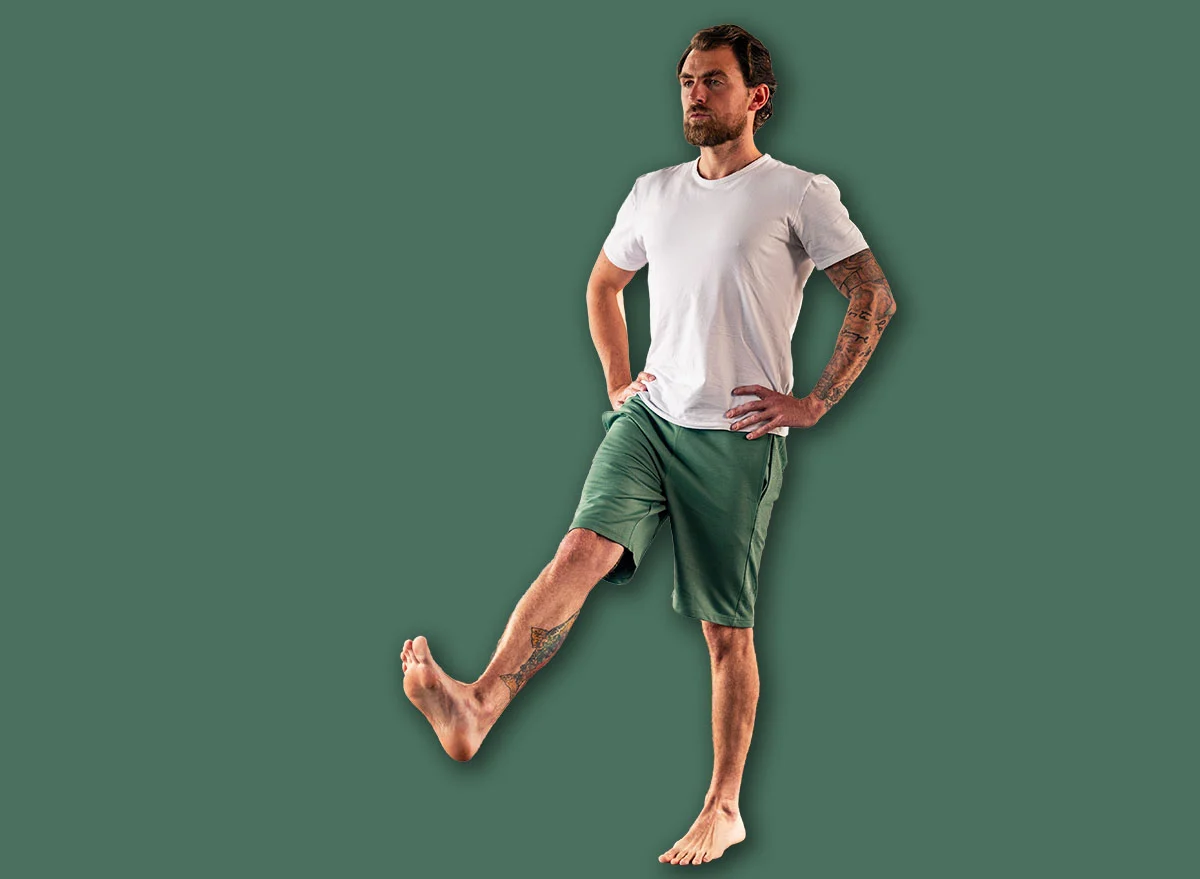
3. Unilateral Stance Challenge (Single-Leg Balance Hold)
This exercise is a direct and potent method for enhancing proprioception, the body’s nuanced awareness of its spatial orientation and the relative positions of its parts. Proprioceptive feedback is crucial for dynamic balance and reactive stability, allowing the body to make instant, unconscious adjustments to maintain equilibrium.
- Execution: Stand tall with your feet hip-width apart. Shift your weight gently onto one leg, and slowly lift the other foot off the ground, bending the knee slightly. Initially, hold onto a stable support (like a counter or wall) with one hand. Focus your gaze on a fixed point in front of you. Aim to hold this position for 20-30 seconds, maintaining a steady posture and engaging your core muscles. Repeat on the opposite leg.
- Benefits: By challenging the body’s sense of balance, this exercise strengthens the numerous small stabilizing muscles around the ankle and knee, while simultaneously refining neural pathways responsible for spatial awareness. Falls represent the leading cause of injury for individuals over 60, and directly training proprioception through single-leg stands significantly reduces this risk by improving the body’s ability to react to unexpected shifts in weight or ground conditions.
- Progression: As balance improves, gradually reduce reliance on support. For an advanced challenge, attempt the exercise with eyes closed (only after mastering it with eyes open and with support), which further intensifies the proprioceptive demand.
4. Ankle Range of Motion Drills (Ankle Alphabets)
This gentle yet comprehensive exercise moves the ankle through its entire available range of motion in multiple directions, promoting joint health and targeting a broad spectrum of stabilizing muscles.
- Execution: Sit comfortably in a chair or on the floor with your leg extended and your ankle free to move. Imagine writing each letter of the alphabet in capital letters using your big toe as a pen. Focus on controlled, deliberate movements, articulating the ankle through dorsiflexion, plantarflexion, inversion, and eversion to form each letter. Complete the entire alphabet with one ankle, then switch to the other.
- Benefits: Performing "ankle alphabets" regularly enhances joint flexibility, stimulates synovial fluid production (which lubricates the joint), and activates the smaller intrinsic muscles that contribute to multi-directional stability. Crucially, this exercise specifically strengthens the muscles responsible for preventing sideways ankle rolls—a common and often severe mechanism of ankle injury in older adults. By improving mobility across all planes, it helps fortify the ankle against sudden, unanticipated twists.
- Progression: Focus on making the movements as large and distinct as possible, ensuring each letter is clearly "drawn" in the air. Increase the speed of execution while maintaining control.
Integrating these four simple, accessible movements into a daily routine provides a robust framework for preserving and enhancing ankle strength, balance, and overall mobility as we age. Consistent engagement with these exercises empowers individuals to proactively address age-related declines, reduce their risk of falls, and sustain a vibrant, independent lifestyle well into their golden years. Beyond specific exercises, attention to appropriate footwear, maintaining a clear and hazard-free living environment, and regular medical check-ups for vision and medication review further contribute to a comprehensive fall prevention strategy. Ultimately, investing in ankle health is investing in the freedom to move through life with confidence and stability.
About the Author