
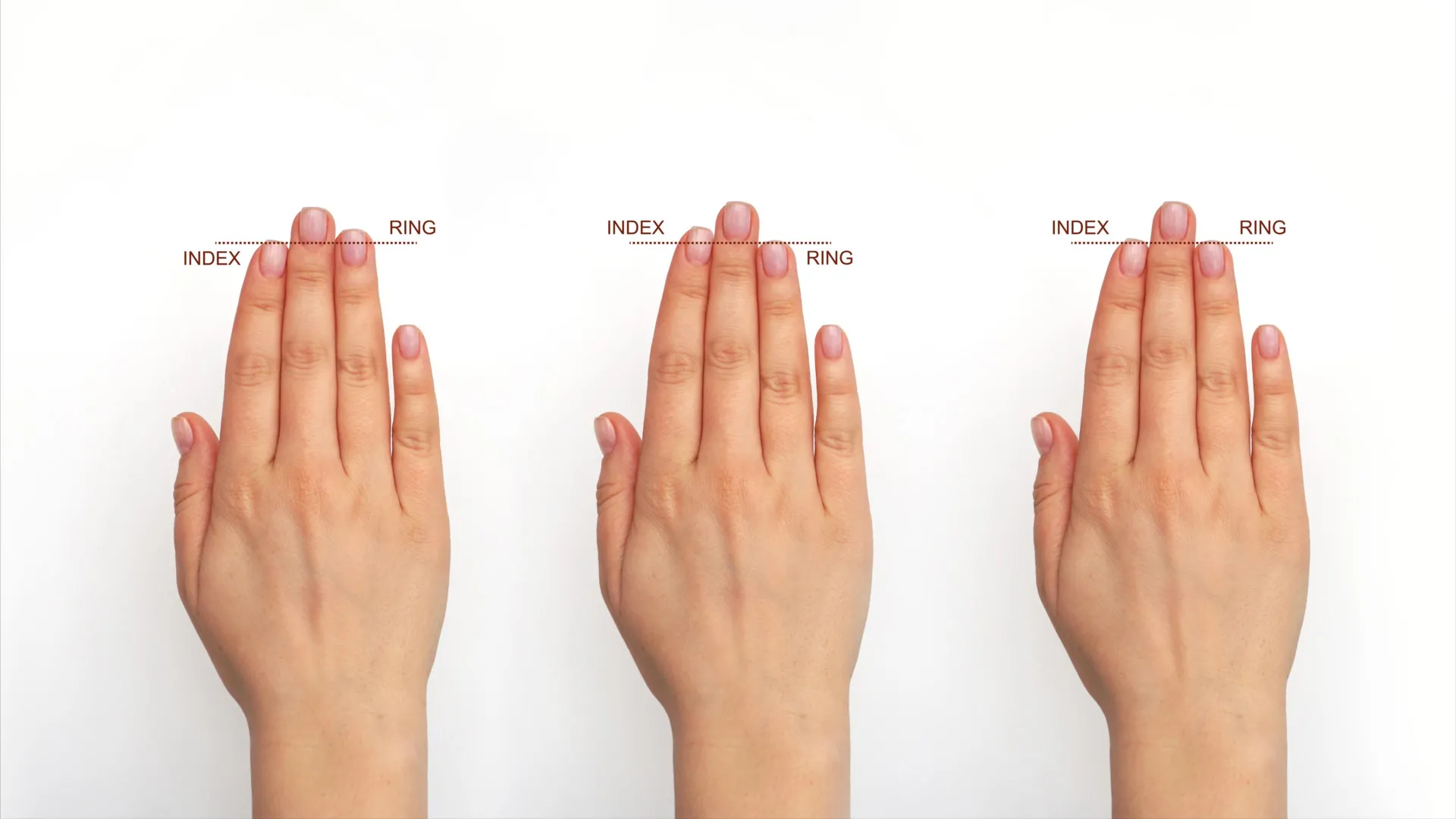
A recent investigation, a collaborative effort between researchers at Swansea University’s Applied Sports, Technology, Exercise and Medicine (A-STEM) group and Istanbul University’s Department of Anthropology, has unearthed compelling evidence suggesting a potential connection between the hormonal milieu experienced by fetuses and the developmental trajectories that may have ultimately shaped human brain evolution. The study, published in the esteemed journal Early Human Development, posits that the relative lengths of a person’s fingers, specifically the ratio between the index and ring finger, could serve as an intriguing, albeit indirect, indicator of early hormonal exposure, which in turn might correlate with cranial growth patterns observed in newborns. This research delves into the intricate interplay of biology and evolution, offering a novel perspective on the factors that contributed to the significant expansion of the human brain over millennia.
At the heart of this scientific inquiry lies the concept of the 2D:4D digit ratio, a measurement derived from comparing the length of the second digit (index finger) to the fourth digit (ring finger). This ratio has been a subject of considerable research, serving as a proxy for the relative levels of prenatal androgens, such as testosterone, and estrogens that a developing fetus encounters. According to established understanding in the field, a lower 2D:4D ratio – meaning a longer ring finger relative to the index finger – is generally associated with higher prenatal exposure to androgens. Conversely, a higher 2D:4D ratio, characterized by a relatively longer index finger, is often interpreted as indicative of greater prenatal exposure to estrogens. It is crucial to note that these are general trends, and individual variations are significant.
The research team meticulously analyzed a cohort of 225 newborns, comprising 100 males and 125 females, to investigate these associations. For each infant, the precise 2D:4D digit ratio was calculated. This measurement was then systematically compared with the circumference of the infant’s head. Head circumference, a readily observable metric in newborns, is widely recognized as a fundamental indicator of cranial size and, by extension, brain volume. This measurement also holds significance as it has been correlated with subsequent assessments of cognitive abilities and intelligence quotients (IQ), although it is understood that a multitude of genetic, environmental, and developmental factors profoundly influence intellectual development throughout life.
The findings from this examination revealed a noteworthy disparity between male and female infants. In boys, a higher 2D:4D digit ratio – suggesting a greater prenatal exposure to estrogen relative to testosterone – was observed to be associated with a larger head circumference. This correlation implies that, in males within this study, the hormonal environment during gestation might have had a discernible impact on cranial development. Intriguingly, this same relationship between the 2D:4D ratio and head circumference was not statistically significant in the female infants studied. This sex-specific observation prompts further questions about differential hormonal sensitivities and developmental pathways between males and females during early gestation.
These findings lend considerable support to a fascinating evolutionary hypothesis known as the "estrogenized ape hypothesis." This theory proposes that the evolutionary trajectory leading to the development of larger, more complex human brains was intricately linked with a broader suite of physiological changes. These changes, according to the hypothesis, included a trend towards a less robust skeletal structure and a general "feminization" of the skeleton when compared to our more ancient hominin ancestors. The current research, by linking prenatal estrogen exposure (as indicated by digit ratio) to cranial size in males, provides a potential biological mechanism that could underpin this evolutionary narrative.
Professor John Manning, a lead researcher on the project and a specialist in digit ratio studies, elaborated on the implications of these results for understanding human evolutionary history. He highlighted that the observed link between higher 2D:4D ratios in males and increased brain size aligns with the proposed "estrogenized ape hypothesis." Historically, research has pointed to potential downsides associated with higher prenatal estrogen exposure in males, such as an increased susceptibility to cardiovascular issues, reduced sperm counts, and a predisposition to conditions like schizophrenia. However, Professor Manning posited that the evolutionary advantage conferred by a larger brain, a hallmark of human development, might have served as a counterbalancing force. In essence, the pursuit of enhanced cognitive capabilities through larger brains may have been intrinsically intertwined with certain biological trade-offs for males, potentially involving a recalibration of other physiological systems.
The researchers posit that while the hormonal conditions conducive to larger brain development might have carried certain biological costs, particularly for males, the overarching evolutionary benefits of increased brain size likely outweighed these drawbacks. The advantages conferred by enhanced cognitive functions, problem-solving abilities, and complex social behaviors associated with larger brains would have been paramount for survival and reproduction in the ever-changing environments faced by our ancestors. This perspective suggests a complex evolutionary landscape where advancements in one area might have necessitated compromises in others, a phenomenon known as evolutionary trade-offs.
It is imperative to clarify that this study does not suggest a direct causal link where finger length dictates brain size. Rather, the digit ratio is interpreted as a retrospective marker, a subtle physiological imprint of the hormonal environment experienced by the fetus during critical developmental windows. The observed association serves as a valuable clue, offering insights into how prenatal hormonal influences might have played a role in shaping the evolutionary path that led to the distinct cognitive capacities of Homo sapiens.
Professor Manning’s prior research has explored the diverse applications of digit ratio analysis, demonstrating its potential as an investigative tool in various biological and medical contexts. His previous work has examined correlations between digit ratio and factors such as alcohol consumption patterns, outcomes following COVID-19 infection, and even indicators of oxygen consumption rates in athletes. This broader body of research underscores the fundamental principle that subtle physiological markers, imprinted during early development, can offer windows into complex biological processes and potential predispositions. The current study on brain evolution represents a significant expansion of this investigative frontier, delving into the deep past of human development.
About the Author












