A groundbreaking investigation has revealed that bumblebees, creatures with comparatively minute neural structures, are capable of performing complex, novel problem-solving tasks that were once thought to be the exclusive domain of animals with significantly larger and more developed brains, including humans and certain vertebrates. This recent discovery directly challenges long-held scientific assumptions regarding the evolutionary boundaries of spontaneous problem-solving and cognitive flexibility.
The genesis of this line of inquiry can be traced back to the seminal work of psychologist Wolfgang Köhler in the early 20th century. Köhler’s famous experiments with chimpanzees provided compelling evidence of what he termed "insight" and "spontaneous problem-solving." He observed chimpanzees exhibiting an ability to overcome unfamiliar obstacles by creatively repurposing and combining objects in their environment. A classic illustration involved chimpanzees stacking crates to access a suspended food reward, a solution that appeared to arise suddenly rather than through a process of gradual trial and error. These observations established a benchmark for advanced cognitive function in the animal kingdom, primarily focusing on species with substantial cerebral capacity.
However, a collaborative effort involving researchers from the University of Oulu, the University of Helsinki, and the University of Turku in Finland has now extended this understanding to the insect world. Their meticulously designed study, documented in the prestigious journal Science, presented bumblebees (Bombus terrestris) with a challenge entirely outside their prior experience, a scenario demanding a level of adaptive reasoning previously unobserved in such small-brained invertebrates.
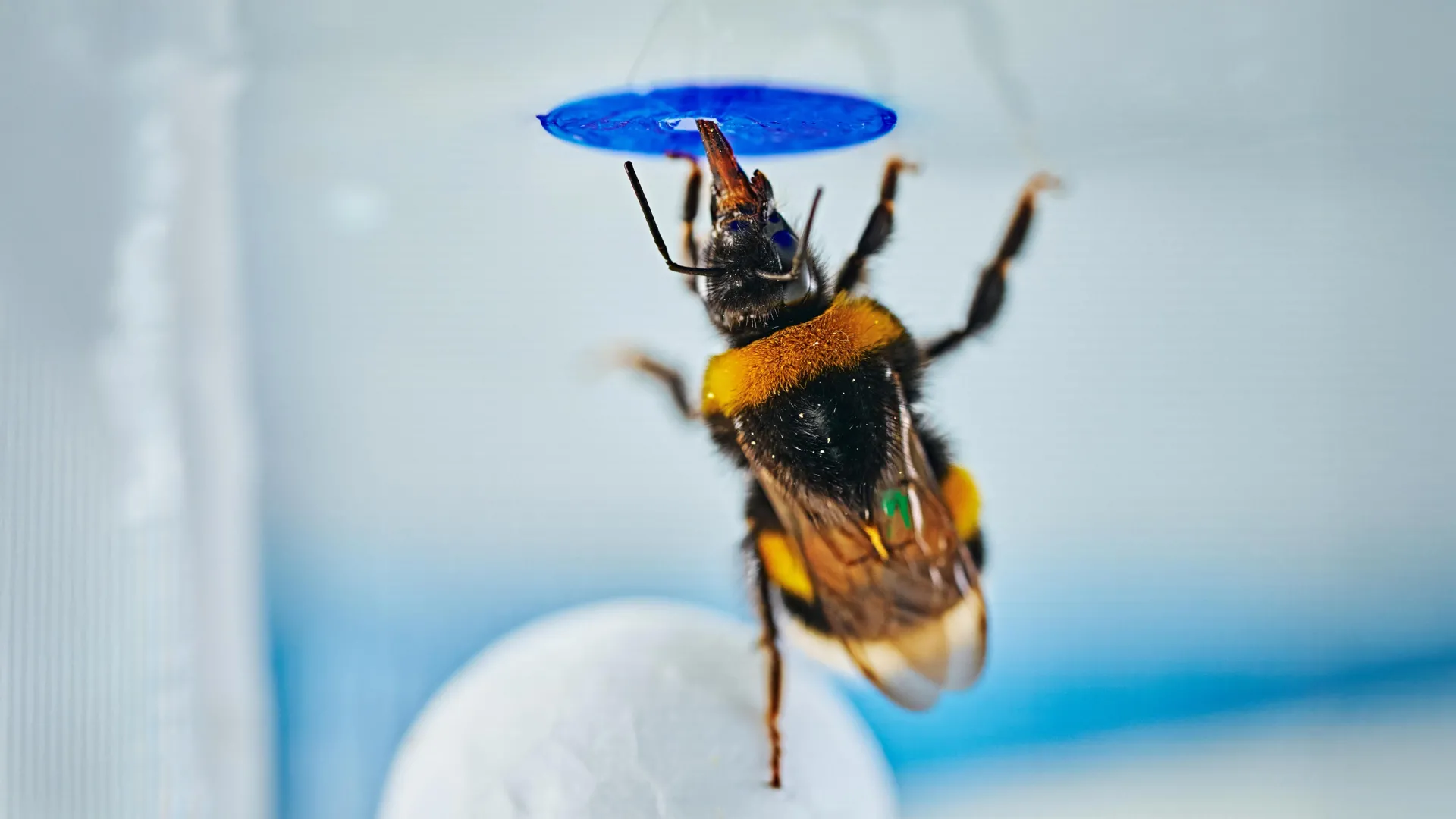
The experimental setup involved a transparent enclosure where bees were initially conditioned to associate a specific blue artificial flower with a nectar reward. Subsequently, this artificial flower was strategically repositioned to the ceiling of the arena, placing it tantalizingly out of the bees’ direct reach. To access the desired reward, the bees were compelled to devise an entirely novel strategy, one that had not been part of their learned behaviors or instinctual repertoire.
Remarkably, a significant proportion of the bees successfully navigated this complex situation by first locating a small, strategically placed ball within the arena. They then proceeded to roll this ball directly beneath the elevated flower. The critical step involved the bees climbing onto the ball, thereby elevating themselves to a height sufficient to reach the nectar reward. This intricate sequence of actions—locating a secondary object, manipulating it to a specific position, and then utilizing it as a platform—represented a departure from any training or prior learning they had undergone.
Dr. Olli Loukola, a senior author on the study and a Docent at the University of Oulu, drew a direct parallel between the bees’ accomplishment and Köhler’s classic "box-and-banana" paradigm. He elaborated that the essence of the task required the animal to comprehend that an external object could be intentionally relocated and subsequently employed as an instrumental tool to achieve an otherwise unattainable objective. The profound significance of this finding, according to Loukola, lies in the demonstration of such sophisticated, spontaneous problem-solving behavior within an insect species.
The lead author, Akshaye Bhambore from the University of Oulu, underscored the exceptional nature of the bees’ response. He emphasized that the bees were not instructed to manipulate the ball in any way related to reaching the flower; their task was a wholly original cognitive hurdle. Bhambore noted that the observed actions appeared to be goal-directed, with successful individuals exhibiting more purposeful and less erratic movements toward the solution.
To ensure the validity of these astonishing results and to rigorously exclude simpler explanations for the bees’ success, the research team implemented a series of stringent control experiments. The bees were provided with only two fundamental pieces of information prior to the main challenge: the blue flower signaled a reward, and the ball was a movable, inert object. When confronted with the elevated flower, many bees demonstrably integrated these disparate pieces of knowledge in a manner that transcended their limited prior learning.
Dr. Loukola highlighted the critical aspect of the bees’ naivety in the experimental design. He contrasted this with many previous studies on problem-solving in animals, where subjects often possessed extensive prior exposure to objects, experimental environments, or a variety of cognitive tasks. In this specific investigation, the bumblebees had no pre-existing training or experience with using the ball as a tool to access the flower, nor any familiarity with this particular problem-solving strategy. The researchers also meticulously designed the experiments to mitigate the influence of accidental success, playful exploration, rudimentary trial-and-error learning, or direct visual cues guiding their actions.
Further reinforcing the robustness of their findings, the researchers conducted several control trials designed to eliminate alternative interpretations. In some of the more challenging variants of the experiment, the flower was intentionally obscured from the bees’ view while they were manipulating the ball. This deliberate measure prevented the bees from simply navigating toward a visible target. Despite this visual handicap, a substantial number of bees still managed to position the ball correctly, a testament to their underlying planning and spatial reasoning.
Bhambore elaborated on the analytical rigor applied to the bees’ behavior, stating that the exhaustive control experiments allowed them to definitively demonstrate that the bees were not merely reacting to visual stimuli or engaging in random ball movements. Their actions were indicative of a more deliberate cognitive process.
The researchers themselves expressed a sense of awe at observing the bees’ problem-solving process. Ece Nur Akmeşe, a co-author from the University of Helsinki, described the experience as genuinely captivating. She noted the remarkable transition from seemingly undirected exploration to a swift, highly efficient sequence of actions that culminated directly in the successful attainment of the reward.
These findings contribute significantly to an expanding body of evidence suggesting that bees possess a surprising degree of cognitive sophistication, even with their remarkably small brains. Prior research has already indicated that bees can acquire tool-use skills through social learning, solve intricate puzzle-like tasks, engage in cooperative behaviors, and adapt their actions in response to changing circumstances.
However, the authors are careful to temper these conclusions, emphasizing that their results should not be misconstrued as suggesting that insects possess human-like consciousness or thought processes. Dr. Loukola clarified that the study’s aim was not to equate insect cognition with human cognition. Instead, he posited that the research compellingly illustrates how remarkably small brains can generate flexible, adaptive solutions to novel challenges, a phenomenon that science is only beginning to fully comprehend.
In a broader context, the study’s outcomes strongly suggest that spontaneous, goal-directed problem-solving capabilities can emerge even in organisms with brains vastly simpler and smaller than those typically studied in traditional intelligence research paradigms focused on vertebrates. Loukola concluded by stating that for over a century, spontaneous object-based problem-solving has been predominantly investigated within vertebrate species. This new research firmly positions insects as participants in this crucial scientific conversation, broadening our understanding of the diverse evolutionary pathways of cognitive abilities.
The comprehensive study, titled "Spontaneous problem-solving in bumble bees," was authored by Akshaye A. Bhambore, Ece N. Akmeşe, Emma Håkkinen, Milla K. Jussila, Juha-Heikki Kantola, and Olli J. Loukola, and was officially published on June 4, 2026, in the scientific journal Science.
About the Author