
The accumulation of abdominal fat presents a pervasive and often frustrating challenge, particularly as individuals navigate the physiological shifts that accompany aging beyond the fifth decade. While commonly perceived as a purely aesthetic concern, excess visceral fat – the deep adipose tissue surrounding internal organs – carries significant health implications, elevating risks for various chronic conditions. However, a growing body of evidence, supported by insights from wellness professionals, indicates that strategic, consistent exercise interventions can effectively mitigate these age-related changes. Rather than demanding extensive gym sessions, the focus is increasingly shifting towards short, targeted daily routines that address the root causes of abdominal fat deposition, such as those championed by Karen Ann Canham, CEO and founder of Karen Ann Wellness, a Board-Certified Wellness Coach, and Nervous System Specialist with nearly two decades of experience in the field. Canham advocates for a precise, five-minute morning regimen designed not merely to "flatten" the midsection, but to foster comprehensive metabolic health, improve insulin sensitivity, and strengthen the deep core musculature, thereby providing a sustainable solution for adults over 50.
Understanding the unique physiological landscape post-50 is crucial for developing effective strategies. A confluence of natural biological processes contributes to the tendency for fat to settle around the abdomen. Hormonal fluctuations stand out as a primary driver. In women, the onset of menopause signifies a significant decline in estrogen levels. Estrogen plays a protective role in dictating where fat is stored, typically favoring a gynoid (pear-shaped) distribution around the hips and thighs. With its reduction, fat storage often shifts towards an android (apple-shaped) pattern, concentrating around the abdomen. Similarly, men experience a gradual decrease in testosterone levels, known as andropause, which can also contribute to increased central adiposity and a decline in muscle mass.
Beyond hormonal shifts, a natural slowdown in metabolic rate becomes more pronounced with age. Basal metabolic rate (BMR), the energy expended at rest, tends to decrease by approximately 1-2% per decade after the age of 20. This deceleration is intrinsically linked to sarcopenia, the age-related loss of muscle tissue. Muscle is metabolically more active than fat, meaning it burns more calories even at rest. As muscle mass diminishes, the body’s overall energy expenditure declines, making it easier to accumulate excess calories as fat, particularly in the abdominal region.
Furthermore, heightened and chronic cortisol levels play a significant, often overlooked, role. Cortisol, the body’s primary stress hormone, naturally peaks in the early morning to help us wake up and manage daily stressors. However, prolonged or exaggerated cortisol release, often exacerbated by lifestyle factors like poor sleep, chronic stress, and inadequate nutrition, has been directly linked to increased visceral fat accumulation. Cortisol can influence fat cell growth, particularly in the abdominal area, and can also impact insulin sensitivity, creating a vicious cycle that promotes fat storage.
The health implications of central adiposity extend far beyond aesthetic preferences. Visceral fat is metabolically active, releasing inflammatory cytokines and fatty acids into the bloodstream, which can contribute to insulin resistance, type 2 diabetes, cardiovascular disease, and certain cancers. Addressing abdominal fat, therefore, becomes a critical component of overall health and longevity, not just body composition.
Canham’s approach deviates significantly from conventional wisdom that often prescribes endless crunches or strenuous cardiovascular workouts for abdominal concerns. Instead, she emphasizes a paradigm shift: "Flattening the lower belly after 50 isn’t about more crunches or aggressive cardio. It’s about preserving lean muscle, improving insulin sensitivity, and strengthening deep core support." This perspective recognizes that superficial abdominal exercises alone are insufficient and can sometimes even be counterproductive, potentially straining the spine without engaging the deeper stabilizing muscles crucial for core integrity and overall functional movement.
The cornerstone of Canham’s methodology is consistency, asserting that its impact far outweighs the specific timing or duration of a workout. "Timing matters far less than frequency. The real benefit comes from activating deep core and metabolic muscle daily. A five-minute routine done consistently beats a 30-minute workout done occasionally," she explains. This highlights the neurological and physiological benefits of establishing a regular habit, which allows the body to adapt and strengthen over time.
However, incorporating this routine into the morning offers distinct advantages for the over-50 demographic. Given that cortisol naturally peaks in the early morning, a short, controlled, strength-based routine can help modulate this hormonal response. Instead of adding to stress, appropriate exercise can help the body utilize cortisol effectively, potentially improving the stress response throughout the day. Moreover, an early morning activation sequence can improve insulin sensitivity for the entire day. By engaging muscles, the body becomes more receptive to insulin, facilitating better glucose uptake and regulation, which directly impacts fat storage. Starting the day with movement also combats overnight inactivity, reducing stiffness and enhancing muscle activation before prolonged periods of sitting. Furthermore, it proactively improves posture and reinforces core engagement, essential for preventing aches and pains and maintaining functional independence.
The expertly curated five-minute routine focuses on activating the deep core stabilizers and larger muscle groups that collectively influence belly fat storage and overall appearance. These exercises are designed to be accessible, low-impact, and highly effective:
1. Supine Deep Core Breathing (Transversus Abdominis Activation):
This foundational exercise targets the transversus abdominis (TVA), often referred to as the body’s natural corset muscle. The TVA is the deepest abdominal muscle, wrapping horizontally around the midsection and playing a crucial role in spinal stability, posture, and generating intra-abdominal pressure. By consciously engaging this muscle through controlled breathing, individuals learn to draw their lower abs inward and upward, supporting the spine and creating a firmer internal girdle. Canham recommends completing 1 to 2 sets of 5 to 6 slow, deep breaths, a process that typically takes about 60 seconds.
- Execution: Lie on your back with knees bent and feet flat on the floor, hip-width apart. Place one hand on your chest and the other on your lower abdomen. Inhale deeply through your nose, allowing your belly to rise (diaphragmatic breathing), while keeping your chest relatively still. As you exhale slowly through pursed lips, gently draw your navel towards your spine, feeling the lower abdominal muscles contract and flatten. Avoid pushing your back into the floor; the movement should originate from the deep core.
- Benefits: Beyond direct TVA activation, this exercise promotes diaphragmatic breathing, which can calm the nervous system, reduce stress, and improve oxygenation. It serves as an excellent warm-up for deeper core engagement.
2. Bird Dogs:
Bird dogs are a highly effective exercise for enhancing core stability and reinforcing spinal health. This movement teaches the body to maintain a neutral spine while the limbs are in motion, which is critical for preventing lower back pain and improving functional movement patterns in daily life. Canham notes that bird dogs specifically activate spinal stabilizers, promoting better posture and balance.
- Execution: Begin on all fours, with hands directly under shoulders and knees directly under hips. Maintain a neutral spine, looking down between your hands. Engage your core gently. Slowly extend one arm straight forward and the opposite leg straight back, keeping your hips level and avoiding any arching or rounding of the back. Imagine a straight line from your extended hand to your extended foot. Hold for a moment, then slowly return to the starting position. Alternate sides. Aim for 8-10 repetitions per side.
- Benefits: Strengthens the deep core, glutes, and back extensors; improves balance and coordination; enhances spinal stability and posture.
3. Dead Bugs:
Dead bugs are another excellent exercise for strengthening the deep core musculature without placing undue strain on the spine, making them particularly suitable for individuals over 50. Canham emphasizes that "Dead bugs strengthen the deep core without straining the spine." This anti-extension exercise challenges the core to prevent the lower back from arching off the floor as the limbs move, promoting controlled, stable movement.
- Execution: Lie on your back with your knees bent at a 90-degree angle directly over your hips, and shins parallel to the floor. Extend your arms straight up towards the ceiling, directly over your shoulders. Press your lower back firmly into the floor, engaging your core. Slowly extend one arm back overhead while simultaneously straightening the opposite leg towards the floor. Keep your lower back pressed down throughout the movement. Return to the starting position with control and alternate sides. Aim for 8-10 repetitions per side.
- Benefits: Develops anti-extension core strength, crucial for protecting the spine; improves motor control and body awareness; strengthens hip flexors and shoulder stabilizers.
4. Glute Bridges:
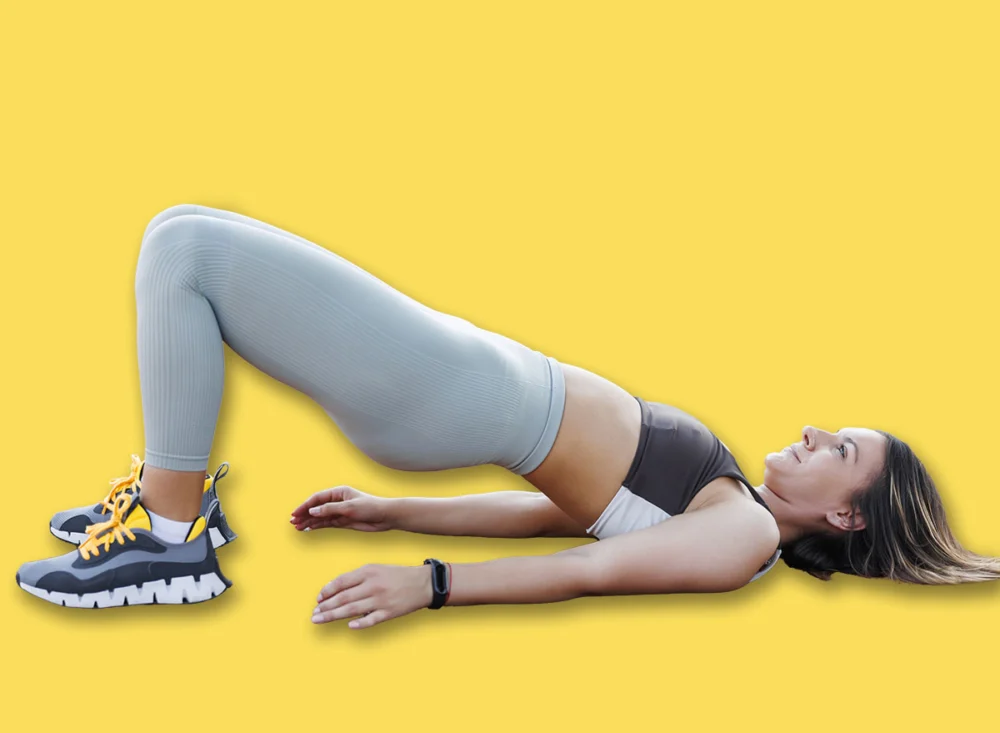
Glute bridges are fundamental for engaging the gluteal muscles and correcting common postural imbalances, particularly a forward pelvic tilt, which can contribute to the appearance of a protruding lower belly. According to Canham, "Glute bridges correct pelvic tilt and engage hips, which reduces lower belly protrusion." Strong glutes are essential not only for aesthetics but also for supporting the lower back, improving hip mobility, and enhancing overall functional strength.
- Execution: Lie on your back with knees bent, feet flat on the floor hip-width apart, and heels a few inches from your glutes. Arms can rest at your sides. Engage your glutes and core, then lift your hips off the floor until your body forms a straight line from your shoulders to your knees. Squeeze your glutes at the top, ensuring you don’t overarch your lower back. Hold briefly, then slowly lower your hips back down to the starting position. Aim for 10-15 repetitions.
- Benefits: Strengthens glutes and hamstrings; improves hip extension and mobility; helps alleviate lower back pain; contributes to a more neutral pelvic alignment.
5. Wall Pushups:
Wall pushups serve as an excellent full-body exercise that, while often seen as a modification, effectively builds upper body strength and engages core stabilizers. Canham explains that "Wall or incline pushups add full-body tension and stimulate muscle preservation." This exercise recruits muscles in the chest, shoulders, triceps, and core, all while being gentle on the joints, making it ideal for maintaining and building muscle mass, a critical factor in metabolic health after 50.
- Execution: Stand facing a wall, about arm’s length away. Place your hands on the wall slightly wider than shoulder-width apart, at chest height. Keep your body in a straight line from head to heels, engaging your core. Bend your elbows and lean towards the wall until your chest is close to it. Keep your elbows tucked in slightly, not flaring out. Push back to the starting position with control. Adjust your distance from the wall to modify difficulty – closer is easier, further is harder. Aim for 10-15 repetitions.
- Benefits: Strengthens chest, shoulders, triceps, and core; improves upper body endurance; supports muscle preservation and bone density; easily modifiable for all fitness levels.
While this five-minute morning routine offers a powerful tool for addressing abdominal fat and enhancing overall well-being in individuals over 50, it is crucial to understand that it forms part of a larger wellness ecosystem. Optimal results are achieved when combined with a holistic approach that includes balanced nutrition, adequate hydration, sufficient sleep, and effective stress management techniques. Prioritizing whole, unprocessed foods, ensuring adequate protein intake to support muscle mass, and staying consistently hydrated are complementary pillars. Similarly, aiming for 7-9 hours of quality sleep per night supports hormonal balance and recovery, while managing chronic stress through practices like mindfulness or meditation can help regulate cortisol levels.
In conclusion, the journey to a healthier, stronger core and reduced abdominal fat after 50 is not about grueling, unsustainable workouts. Instead, it is about intelligent, consistent effort. By adopting an expert-designed, five-minute morning routine focused on deep core strength, muscle preservation, and metabolic activation, individuals can proactively address the physiological changes of aging. This small, daily commitment can yield significant dividends, fostering not only a more stable and resilient body but also contributing to long-term health, vitality, and an improved quality of life. As always, consulting with a healthcare professional or a certified fitness expert before starting any new exercise regimen is recommended to ensure it aligns with individual health needs and capabilities.
About the Author










