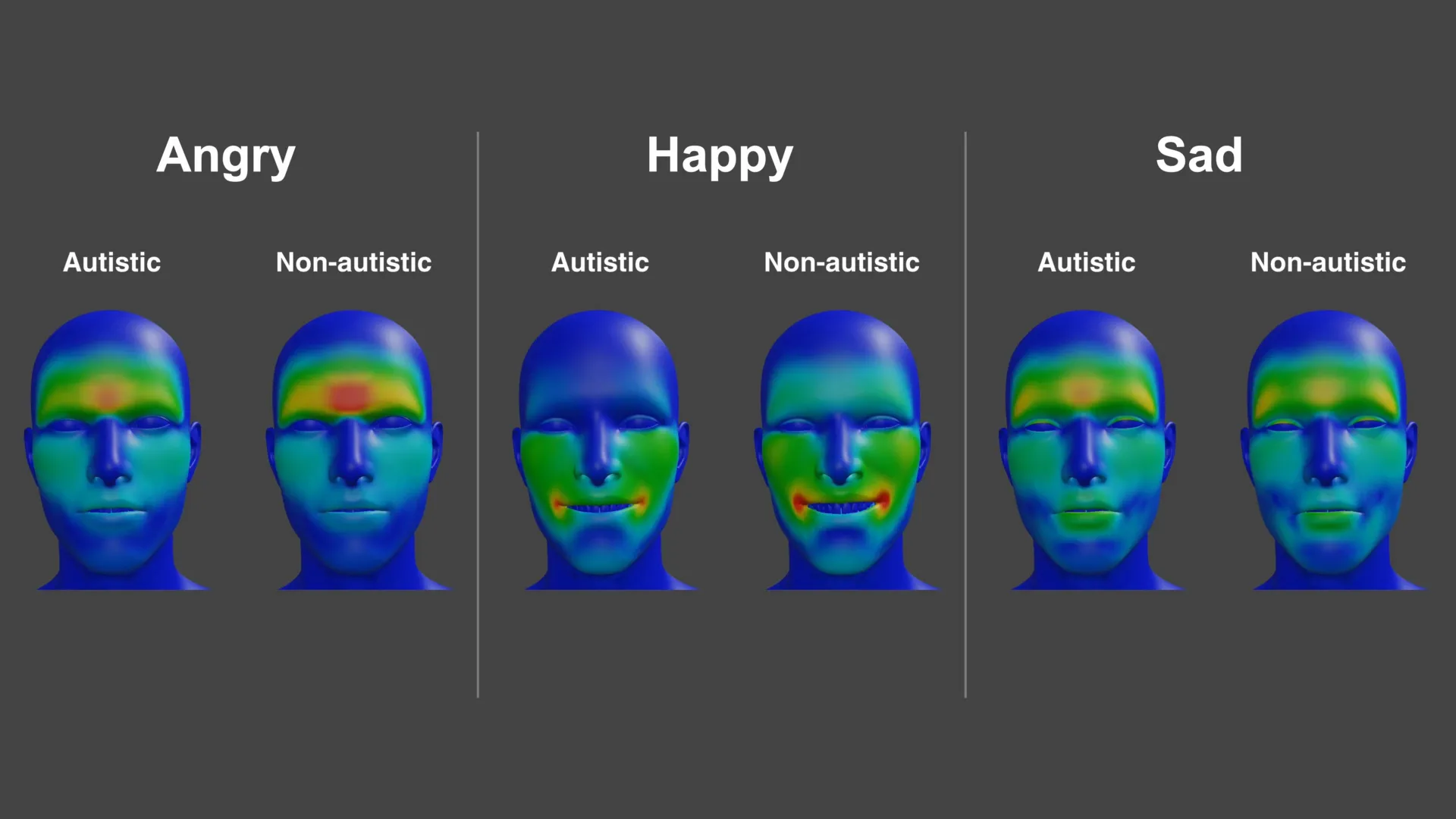
A groundbreaking investigation has illuminated distinct methodologies in facial communication of emotions between individuals on the autism spectrum and their neurotypical counterparts, offering profound insights into the origins of interpersonal misinterpretations. This extensive research, conducted by a team at the University of Birmingham and subsequently published in the esteemed journal Autism Research, employed sophisticated technology to meticulously map the subtle choreography of facial musculature during emotional display. The project’s ambition was to create an unparalleled repository of emotional facial movements, amassing an astonishing volume of over 265 million data points. This comprehensive dataset provides a granular view of how emotions are outwardly conveyed through facial configurations, revealing that these expressions are not universally standardized, even for foundational emotional states like anger, happiness, and sadness.
The methodology underpinning this significant study involved a cohort of 25 adults diagnosed with autism and 26 non-autistic adults, who collectively generated close to 5,000 distinct facial expressions. Participants were tasked with embodying specific emotions—anger, happiness, and sadness—under two distinct conditions. The first involved synchronizing their facial movements with accompanying auditory cues, thereby testing the precise execution of expressions in response to external stimuli. The second condition required participants to vocalize while simultaneously manifesting the target emotions, exploring how the act of speaking might influence or integrate with emotional display. This dual approach was crucial in capturing a broader spectrum of expressive behavior and identifying potential differences in the fluidity and structure of emotional presentation.
Analysis of the recorded facial movements revealed statistically significant divergences between the autistic and neurotypical groups. Notably, individuals within the autistic group exhibited a greater variety of unique facial configurations when expressing emotions. These unique expressions suggest a departure from commonly recognized patterns, potentially contributing to recognition challenges for those unfamiliar with these variations. While the study cataloged a wide array of differences, certain specific patterns emerged with particular clarity, indicating that the very architecture of emotional display can differ fundamentally across these neurotypes. The precise nature of these emergent patterns, though not detailed in the provided abstract, forms a core component of the research’s findings, suggesting that the visual language of emotion is subject to individual variation beyond the typical spectrum.
A critical dimension explored within the research was the impact of alexithymia, a condition characterized by pronounced difficulties in identifying, understanding, and articulating one’s own emotional states. Alexithymia is frequently observed in individuals with autism, often existing at a sub-clinical level. The study found a direct correlation between higher levels of alexithymia and less clearly defined facial expressions for emotions such as anger and happiness. This ambiguity in outward emotional display can render these feelings more difficult for observers to interpret accurately, further complicating social interactions. The researchers posited that the reduced clarity of facial cues stemming from alexithymia might lead observers to perceive these emotions as less intense or even absent, creating a disconnect in perceived emotional states.
Dr. Connor Keating, the principal investigator of this study, who has since transitioned to the Department of Experimental Psychology at the University of Oxford, elaborated on the multifaceted nature of these observed differences. He emphasized that the discrepancies extend beyond mere visual appearance, delving into the very process of expression formation. "Our findings suggest autistic and non-autistic people differ not only in the appearance of facial expressions, but also in how smoothly these expressions are formed," Dr. Keating stated. This insight points to a potential difference in the motor control or neural pathways involved in generating and executing emotional displays. Such mismatches in the temporal and spatial characteristics of facial expressions could be a significant factor in the observed difficulties autistic individuals face when interpreting neurotypical expressions, and conversely, why neurotypical individuals may struggle to decode the emotional signals from autistic individuals. The implication is that the "grammar" of facial emotion might be subtly different, leading to communication breakdowns when these differing grammars are not understood or accounted for.
Professor Jennifer Cook, the senior author on the study and a researcher at the University of Birmingham, stressed the importance of reframing these observed differences not as inherent deficits within the autistic population, but rather as variations in expressive styles. She drew an analogy, suggesting that autistic and neurotypical individuals might express emotions in ways that are distinct yet equally valid, akin to communicating in different languages. "What has sometimes been interpreted as difficulties for autistic people might instead reflect a two-way challenge in understanding each other’s expressions," Professor Cook explained. This perspective shifts the focus from a deficit model to one that acknowledges the complexity of inter-neurotype communication. It suggests that the perceived challenges in emotional understanding are not solely attributable to the autistic individual’s expressive capacity, but also to the neurotypical observer’s ability or willingness to interpret these divergent expressions. The research team is actively pursuing this line of inquiry, with future updates anticipated as they continue to explore this nuanced view of emotional communication as a reciprocal process.
The research was generously supported by the Medical Research Council (MRC) in the United Kingdom and the European Union’s Horizon 2020 Research and Innovation Programme, underscoring the international recognition of the study’s significance. These funding bodies have demonstrated a commitment to advancing our understanding of neurological diversity and its implications for human interaction. The implications of this research are far-reaching, potentially informing the development of more effective communication strategies, therapeutic interventions, and educational programs designed to foster greater mutual understanding and empathy between individuals of all neurotypes. By providing a detailed, data-driven account of the subtle yet significant differences in emotional expression, this study opens new avenues for research and practice aimed at bridging communication gaps and promoting more inclusive social environments. The detailed analysis of facial micro-movements and their correlation with emotional states, combined with an examination of internal emotional processing difficulties like alexithymia, offers a comprehensive framework for understanding why emotional expressions are so frequently subject to varied interpretation. Future research building upon this foundation may further refine our understanding of non-verbal communication and its intricate relationship with neurodevelopmental differences.
About the Author