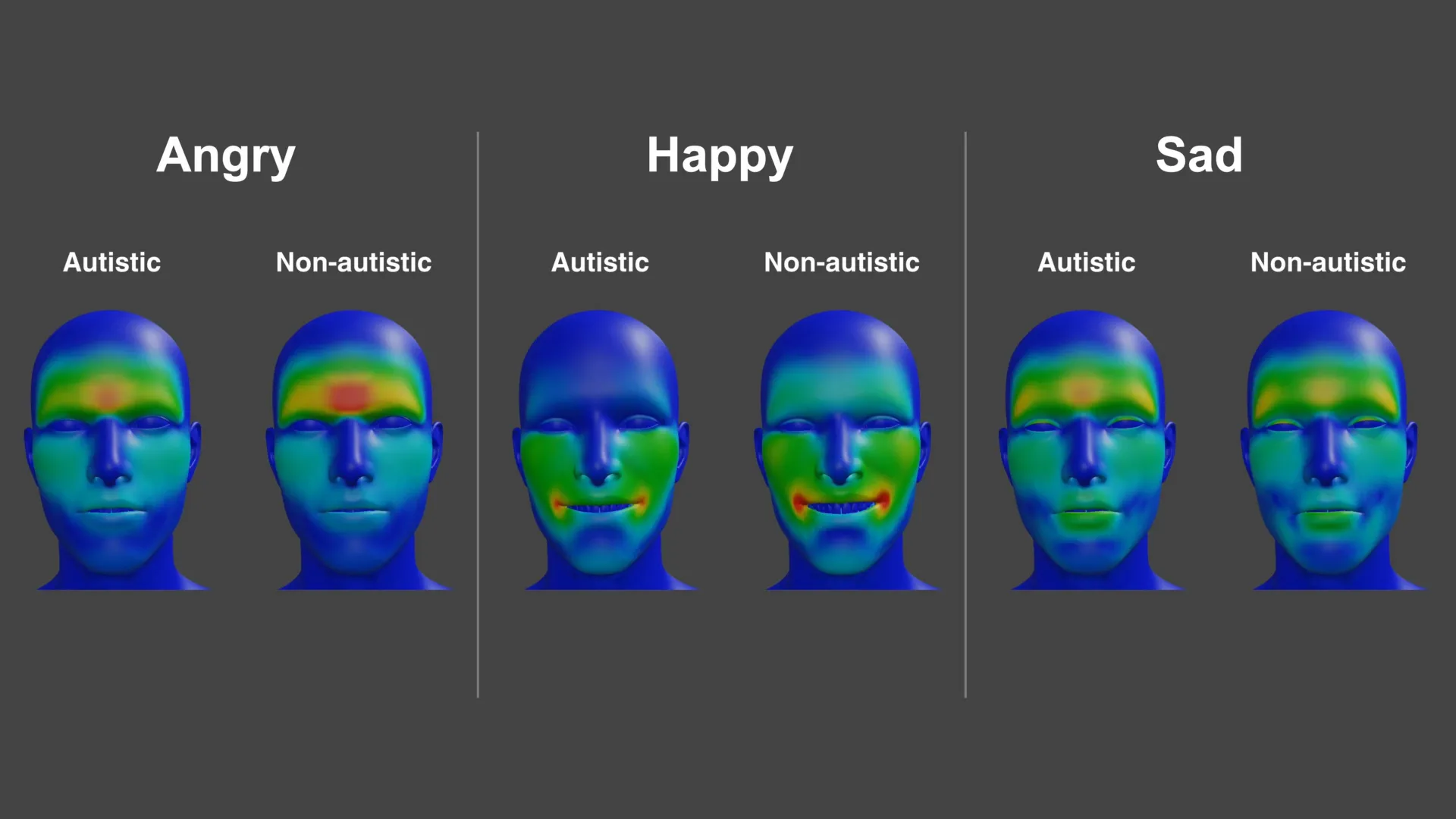
For generations, the intricacies of human emotional expression have formed a foundational pillar of social interaction, allowing individuals to convey internal states and understand the sentiments of others without uttering a single word. Yet, for many on the autism spectrum, this seemingly intuitive exchange often presents a profound challenge, contributing to long-standing misunderstandings in social contexts. Groundbreaking new research is now shedding light on the fundamental differences in how autistic and non-autistic individuals manifest emotions through their faces, suggesting these discrepancies are not merely a matter of interpretation but stem from distinct expressive styles. This novel perspective reframes emotional communication as a potential two-way challenge, moving beyond traditional deficit-based models to advocate for a more nuanced understanding of neurodivergent expression.
Autism Spectrum Disorder (ASD) is a complex neurodevelopmental condition characterized by a broad range of social communication difficulties and repetitive behaviors or restricted interests. While often associated with challenges in recognizing or producing "typical" emotional cues, the underlying mechanisms for these differences have remained a subject of intense scientific inquiry. The latest findings, published in the esteemed journal Autism Research, represent a significant leap forward, providing empirical evidence that autistic and non-autistic individuals may indeed be operating on different, albeit equally valid, emotional "dialects."
The comprehensive investigation was spearheaded by a dedicated team of academics at the University of Birmingham, leveraging state-of-the-art technology to meticulously map facial movements. Dr. Connor Keating, who led this pivotal study and has since transitioned to the Department of Experimental Psychology at the University of Oxford, emphasized the depth of this undertaking. The project involved an unprecedented level of detail, employing advanced facial motion tracking systems to capture an astounding volume of data—over 265 million data points in total. This massive dataset allowed researchers to construct one of the most exhaustive libraries of emotional facial movements ever compiled, offering an unparalleled window into the subtle mechanics of human expression.
To achieve this level of granularity, the study enrolled a carefully selected cohort comprising 25 autistic adults and 26 non-autistic adults. Participants were tasked with generating nearly 5,000 distinct facial expressions, focusing on three fundamental emotions: anger, happiness, and sadness. To ensure a robust and ecologically valid assessment, these expressions were elicited under two different conditions: first, while individuals were asked to synchronize their facial movements with auditory cues, and second, during natural speech. This dual approach allowed the researchers to observe both intentional, elicited expressions and those that might spontaneously arise during verbal communication, providing a richer context for analysis.
Upon detailed examination of the captured data, pronounced divergences in expressive patterns between the two groups became evident. Autistic participants, in particular, demonstrated a notably wider repertoire of unique facial expressions, suggesting a broader, less conventional spectrum of how emotions are outwardly displayed. While the specific patterns varied, the analysis indicated differences in the amplitude, duration, and dynamic unfolding of certain facial muscle movements. For instance, some autistic individuals might exhibit more subtle or prolonged expressions for happiness, while anger might manifest through different combinations of facial muscle activation compared to their non-autistic counterparts. These unique expressive signatures underscore the idea that autistic emotional display is not simply a reduced or impaired version of neurotypical expression, but rather a distinct form of communication altogether.
A crucial aspect explored by the research team was the influence of alexithymia, a ‘sub-clinical’ condition that frequently co-occurs with autism. Alexithymia is characterized by significant difficulty in identifying and describing one’s own emotions, as well as distinguishing between emotional arousal and physical sensations. It is estimated to affect a substantial portion of the autistic population, significantly more so than in the general neurotypical population. The study revealed that individuals, regardless of their neurotype, who reported higher levels of alexithymia tended to produce less clearly delineated facial expressions for emotions such as anger and happiness. These expressions appeared more ambiguous and harder to interpret, suggesting a direct link between the internal processing of emotions and their external manifestation. This finding adds a critical layer of understanding, indicating that for some autistic individuals, challenges in emotional expression might be mediated by this co-occurring condition, rather than being solely attributable to autism itself.
Dr. Keating elaborated on the implications of these findings, stating that the observed differences extend beyond the static appearance of facial expressions. "Our findings suggest autistic and non-autistic people differ not only in the appearance of facial expressions, but also in how smoothly these expressions are formed," he explained. This concept of "smoothness" refers to the dynamic transitions and fluid unfolding of facial movements over time. A mismatch in these dynamic qualities—how quickly an expression builds, holds, and fades—could significantly contribute to the difficulties experienced by both autistic and non-autistic individuals in recognizing each other’s emotional states. Imagine two people attempting to communicate using slightly different grammatical rules or timing cues; while both might be speaking the same language, subtle discrepancies can lead to misinterpretations or a sense of disconnect.
Professor Jennifer Cook, the senior author of the study, based at the University of Birmingham, strongly advocated for a paradigm shift in how these differences are perceived. She emphasized that these distinct expressive styles should not be pathologized or viewed as deficits. "Autistic and non-autistic people may express emotions in ways that are different but equally meaningful—almost like speaking different languages," Professor Cook articulated. This powerful analogy challenges the long-held notion that autistic individuals are somehow "lacking" in emotional capacity or expression. Instead, it posits that communication breakdowns in this domain are a mutual challenge—a "double empathy problem"—where neurotypical individuals may struggle just as much to decode autistic expressions as autistic individuals struggle with neurotypical ones.
The "double empathy problem" is a concept gaining increasing traction in autism research, suggesting that difficulties in social interaction between autistic and non-autistic individuals are not solely due to the autistic person’s social "deficits," but rather a reciprocal misunderstanding that arises when two different communication styles meet. This study provides robust empirical support for this theory within the realm of non-verbal emotional communication. Recognizing this as a two-way street fosters a more inclusive and empathetic approach to understanding neurodiversity.
The research has profound implications for improving social communication and fostering greater understanding across neurotypes. By identifying the specific ways in which facial expressions differ, future interventions could move beyond simply teaching autistic individuals to mimic neurotypical expressions. Instead, efforts could focus on educating neurotypical individuals about the diverse range of autistic expressions, and developing tools or strategies to bridge the communicative gap from both sides. This could include targeted training programs, educational resources, or even AI-assisted recognition systems that are calibrated to understand a broader spectrum of emotional displays.
Professor Cook highlighted that the team is actively pursuing further research to explore these ideas, signaling an ongoing commitment to uncovering the nuances of neurodivergent communication. Such continued investigation holds the promise of developing more effective strategies for mutual understanding, ultimately enhancing the social well-being and integration of autistic individuals within society.
The significance of this extensive research was recognized and supported by substantial funding from key organizations dedicated to advancing scientific knowledge. The project received backing from the Medical Research Council (MRC) in the United Kingdom, a primary funder of medical and health-related research, and also benefited from the European Union’s Horizon 2020 Research and Innovation Programme, a leading framework for research funding across Europe. These endorsements underscore the perceived importance and potential impact of this work on understanding human emotion and fostering inclusive societies.
In conclusion, this groundbreaking University of Birmingham study fundamentally reshapes our understanding of emotional expression in autism. By meticulously documenting the distinct facial patterns and dynamic qualities of autistic emotional displays, it challenges the traditional deficit model and champions a neurodiversity-affirming perspective. The findings highlight that differing expressions are not necessarily a sign of emotional deficiency, but rather distinct communicative styles that necessitate mutual effort and understanding. As society strives for greater inclusivity, this research provides a crucial roadmap for fostering environments where all forms of emotional expression are recognized, respected, and understood.
About the Author