The seamless integration of advanced prosthetic limbs into the human body hinges significantly on the perceived naturalness of their movement, a crucial factor influencing user acceptance and overall efficacy. As artificial intelligence continues to propel the sophistication of these assistive devices, understanding the nuanced psychological and functional responses of individuals to their operation becomes paramount. Research endeavors are increasingly focusing on quantifying the subjective experience of using AI-powered prosthetics, moving beyond mere functional accuracy to explore the deeper connection users form with these technological extensions.
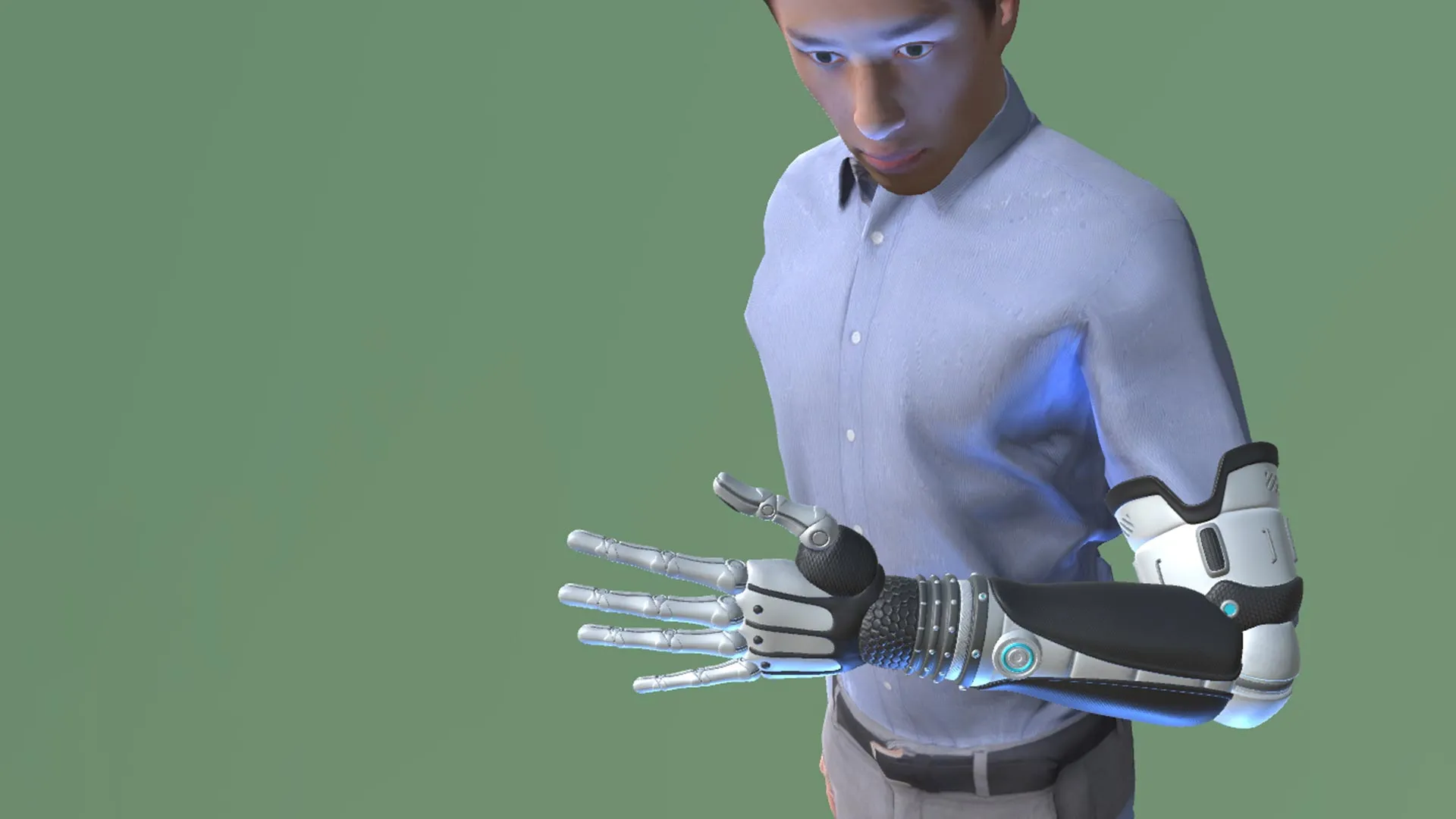
A recent investigation, employing immersive virtual reality environments, sought to meticulously dissect the relationship between movement velocity and the user’s sense of embodiment with a prosthetic limb. Participants were placed in scenarios where their virtual representation’s limb was replaced by a robotic counterpart, allowing researchers to precisely manipulate the speed of its actions. This innovative approach enabled the systematic evaluation of how varying temporal characteristics of movement affected key psychological metrics, including the feeling of body ownership, the sense of agency over the limb’s actions, perceived usability, and social perceptions such as competence and the potential for causing discomfort.
The findings from this controlled study revealed a discernible trend: a distinct "sweet spot" in movement speed emerged as critical for fostering a profound sense of integration. When the prosthetic limb executed movements that were either excessively rapid or notably sluggish compared to typical human biomechanics, participants reported a diminished connection to the device, rating it as less intuitive and more difficult to use. Conversely, when the prosthetic arm replicated the moderate pace characteristic of natural human reaching motions, generally taking approximately one second to complete a typical movement, the participants expressed the most robust feelings of the limb being an integral part of their own anatomy.
Historically, the evolution of prosthetic technology has been largely driven by the imperative to accurately translate user intentions into physical action. A significant portion of research in this domain has concentrated on the development of sophisticated biosignal detection systems, such as electromyography (EMG) and electroencephalography (EEG), to interpret neural and muscular signals. These signals are then translated into commands that control the prosthetic’s movements, aiming for a high degree of fidelity in replicating the user’s desired actions.
However, the advent of rapid advancements in machine learning and artificial intelligence is ushering in a new era of prosthetics that can exhibit a degree of autonomy. These intelligent systems hold the potential to anticipate user needs and proactively offer assistance in specific contexts, thereby augmenting the user’s capabilities. This shift towards semi-autonomous or fully autonomous operation, while offering significant functional advantages, introduces a unique psychological challenge. When a limb begins to move independently, it can evoke feelings of detachment or unease, often described as an unsettling experience where the limb does not feel like a genuine extension of oneself. This potential for psychological dissonance represents a substantial hurdle for the widespread adoption of highly advanced, AI-driven prosthetics.
Building upon prior research that suggested users are more receptive to autonomous movements when the underlying purpose is clearly understood, the current study, spearheaded by Harin Manujaya Hapuarachchi and his colleagues, delved into the specific role of movement speed. Hapuarachchi, who was a doctoral student at the time of the research and now serves as an Assistant Professor in the School of Informatics at Kochi University of Technology, led the exploration into whether the temporal dynamics of movement significantly influence user acceptance and embodiment.
The experimental setup involved participants engaging with a virtual reality simulation where their avatar’s left forearm was visually substituted with a robotic prosthetic. The task required participants to execute a reaching motion towards a designated target, while the virtual prosthetic arm moved autonomously to the same destination. The researchers meticulously varied the duration of each simulated movement across six distinct speeds, ranging from a rapid 125 milliseconds to a more deliberate 4 seconds. Following each simulated movement trial, participants were prompted to provide detailed feedback. They rated the extent to which the prosthetic arm felt like their own, their perceived level of control over its actions, its overall usability as measured by the System Usability Scale (SUS), and their impressions of the robotic limb using the Robot Social Acceptance Scale (RoSAS), which assesses perceptions of competence, warmth, and discomfort.
The observational outcomes were both consistent and remarkably definitive, underscoring a clear relationship between movement velocity and the subjective experience of embodiment. The research unequivocally demonstrated that simply increasing the speed of a prosthetic arm does not inherently translate to improved performance or user satisfaction. Instead, synchronizing the prosthetic’s movement timing with that of natural human motion appears to be a far more influential factor in cultivating a genuine sense of ownership and belonging for the user.
These crucial insights carry significant implications for the design of future AI-enabled prosthetic devices. Rather than solely optimizing for maximum speed, designers and engineers should prioritize the development of movement patterns that are intrinsically compatible with human biomechanics and perceptual expectations. The goal should be to fine-tune the articulation and cadence of prosthetic limbs to align with the ingrained neural pathways and anticipatory mechanisms that govern natural bodily movements.
The ramifications of this research extend beyond the realm of prosthetic arms, offering valuable guidance for a broader spectrum of human-robot interaction technologies that function as extensions of the body. Applications such as supernumerary robotic limbs designed to augment human capabilities, advanced exoskeletons intended for rehabilitation or industrial use, and other forms of wearable robotics could all benefit immensely from incorporating movement patterns that closely mirror natural human rhythms. Such alignment could significantly enhance user comfort, trust, and the overall effectiveness of these assistive technologies.
Furthermore, future research avenues are being explored to investigate the long-term effects of prosthetic use on perception and embodiment. It is a well-established phenomenon that individuals often begin to perceive frequently used tools and extensions of their body as extensions of themselves over time. With sustained daily use, even a prosthetic limb that may initially possess rapid and highly sophisticated capabilities could gradually become perceived as "normal," facilitating easier operation and a deeper sense of embodiment. This phenomenon suggests that the initial temporal characteristics of movement may play a crucial role in initiating this integration process, which can then be reinforced through habitual interaction.
Virtual reality continues to be an indispensable tool in this field of inquiry, offering a safe, controlled, and cost-effective environment for scientists to test nascent prosthetic technologies and innovative control systems before they are deployed in real-world applications. This simulated approach allows for the early evaluation of critical psychological responses, user acceptance metrics, and crucial design considerations, thereby accelerating the development of more human-centric assistive devices. The ability to manipulate variables such as movement speed and observe their impact on user perception in a virtual setting provides invaluable data that informs the iterative design process, ultimately leading to more effective and desirable prosthetic solutions.
About the Author