For decades, the interpretation of critical data generated by nanoscale pores, which are revolutionizing the study of genetic material, rested on a fundamental misunderstanding of how DNA behaves when constrained. A groundbreaking investigation spearheaded by scientists at the University of Cambridge, in collaboration with an international consortium, has meticulously unravelled this long-standing enigma, pinpointing a previously underappreciated DNA configuration known as a plectoneme as the true architect behind complex electrical signals. This revelation marks a significant paradigm shift, promising to reshape not only our foundational comprehension of DNA’s physical properties but also the precision and capabilities of advanced genomic technologies and biosensing applications. The implications ripple across diverse scientific disciplines, from molecular biology to nanotechnology, offering new avenues for diagnostics, drug discovery, and a deeper insight into life’s fundamental processes.
At the heart of this transformative research lies the nanopore, an ingeniously simple yet incredibly powerful analytical tool. These molecular-sized apertures, typically just a few nanometers in diameter, are engineered to permit the passage of single biological macromolecules, such as DNA strands, one at a time. As a DNA molecule threads its way through such a pore, often driven by an applied electric field, it temporarily obstructs the flow of ions through the channel, generating a unique electrical current signature. These minute fluctuations in ionic current serve as a highly sensitive readout, providing real-time, single-molecule information about the DNA’s sequence, structure, and modifications. The ability to perform rapid, inexpensive, and portable DNA sequencing and analysis has positioned nanopore technology as a cornerstone of modern genomics, with widespread applications ranging from pathogen detection to cancer diagnostics.
However, despite the immense promise and ongoing advancements in nanopore technology, certain enigmatic electrical patterns observed during DNA translocation events have consistently puzzled researchers. For a considerable period, the prevailing scientific consensus attributed these intermittent, extended disruptions in the electrical signal to the formation of true knots within the DNA strand. The mental image was compelling and intuitive: much like a tangled piece of string resists smooth passage through a small opening, it was hypothesized that a DNA molecule could tie itself into a knot, impeding its progress through the narrow nanopore and causing characteristic, irregular signal aberrations. This "knot hypothesis" provided a seemingly logical framework for interpreting anomalous data, influencing experimental design and data analysis protocols for an entire generation of molecular biologists and biophysicists. The visual simplicity and mechanical plausibility of a knot made it an enduring, albeit ultimately incorrect, explanation.
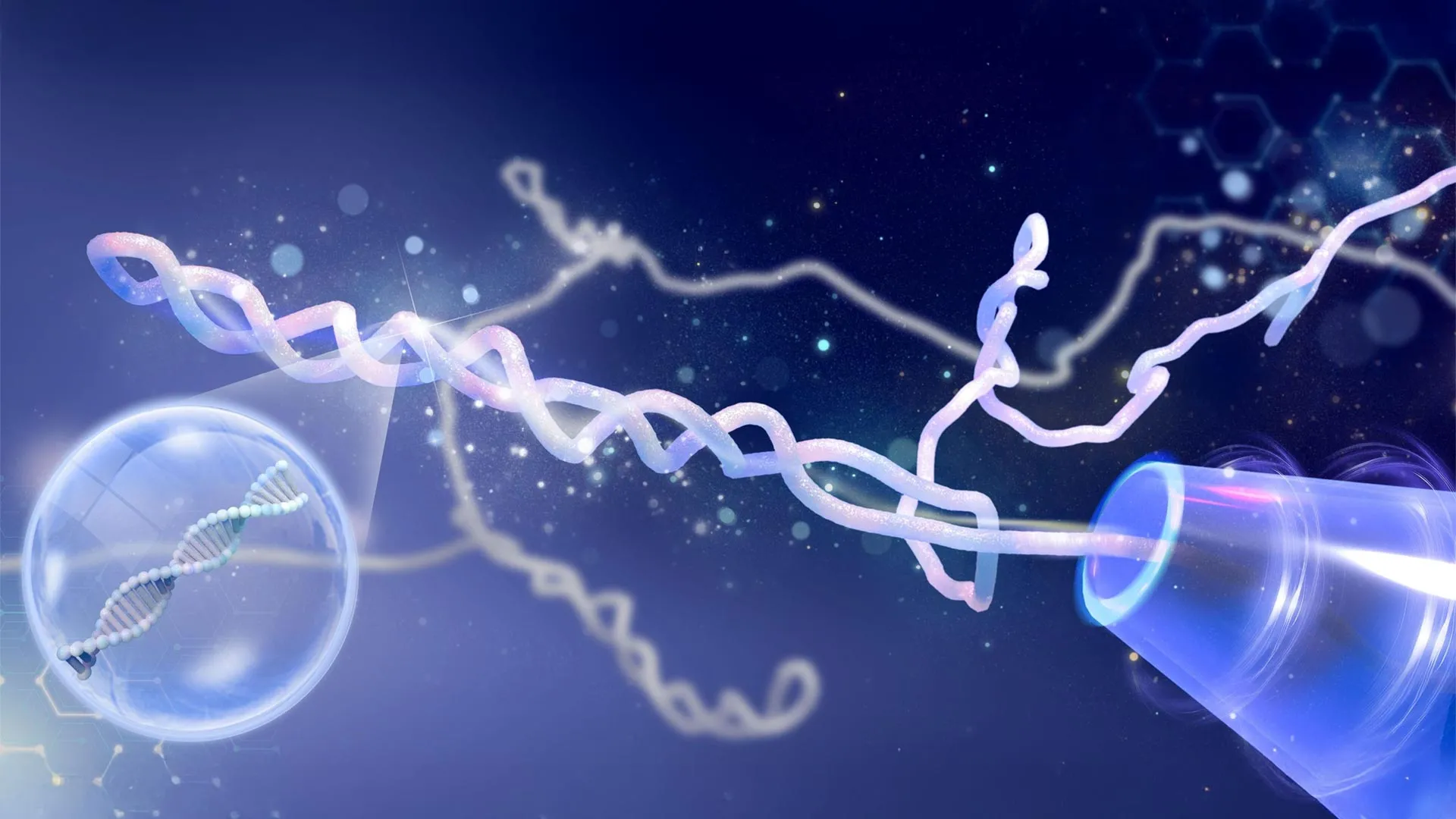
The recent study, whose findings were published in the esteemed journal Physical Review X, rigorously challenges and ultimately overturns this entrenched belief. Through a series of meticulously designed experiments and sophisticated computational modeling, the Cambridge-led team demonstrated unequivocally that the complex electrical signatures previously ascribed to knots are, in fact, predominantly caused by a different, yet visually similar, structural motif: the plectoneme. Unlike a true topological knot, which involves a closed loop interwoven with itself, a plectoneme is a supercoiled structure where a segment of a DNA double helix twists around itself to form a tighter, more compact coil. Imagine a flexible, elongated ladder that, instead of knotting, begins to writhe and coil upon itself, forming a tighter, braided-like structure. This distinction is not merely semantic; the biophysical properties and dynamic behaviors of knots versus plectonemes are profoundly different, leading to vastly disparate impacts on electrical signal generation within a nanopore.
The researchers’ innovative approach involved systematically investigating DNA translocation through various types of nanopores, including those fabricated from glass and silicon nitride, under a broad spectrum of applied voltages and solution conditions. A critical observation emerged from these experiments: the occurrence of what the team termed "tangled-like" events – instances where multiple segments of the DNA molecule appeared to simultaneously occupy or interact with the nanopore – was far more frequent and persistent than the theoretical probability of spontaneous knot formation could explain. Furthermore, the frequency and duration of these events exhibited a clear correlation with increasing voltage and longer DNA strand lengths, a pattern inconsistent with simple knotting mechanics. This compelling evidence strongly suggested the existence of an alternative, previously overlooked, physical mechanism at play.
The pivotal insight arrived with the identification of electroosmotic flow as the primary driver behind plectoneme formation within the nanopore environment. Electroosmotic flow refers to the bulk movement of fluid (in this case, water and ions) through a narrow channel under the influence of an electric field. As the DNA molecule, a negatively charged polyelectrolyte, traverses the nanopore, the surrounding water molecules are also drawn through by the electric field. Critically, this flowing fluid exerts a hydrodynamic drag force on the helical DNA molecule, imparting a rotational torque. This torsional force, propagating along the flexible DNA strand, causes segments of the molecule located outside the nanopore to begin coiling and supercoiling, progressively winding into stable plectonemes.
Crucially, the dynamics of plectoneme formation and resolution differ significantly from those of knots. While a true knot tends to tighten under tension and often resolves rapidly as the DNA is pulled through, plectonemes can grow in size and persist for extended periods throughout the entire translocation process, creating a sustained electrical signature. To further validate their hypothesis, the research team employed sophisticated computer simulations that accurately modeled the realistic forces and torques experienced by DNA within a nanopore. These simulations strikingly corroborated the experimental findings, demonstrating that plectoneme formation is an inherent outcome of the interplay between electroosmotic flow and DNA’s intrinsic ability to transmit twist along its axis.
A particularly elegant aspect of the study involved designing a definitive experimental test to confirm the role of twist propagation. The scientists engineered "nicked" DNA strands – molecules containing intentional single-strand breaks at specific points along their backbone. These nicks effectively act as molecular hinges, preventing the transmission of torsional stress along the DNA molecule. When these nicked DNA strands were subjected to nanopore translocation, the researchers observed a dramatic reduction in the formation of plectonemes. This outcome provided unequivocal evidence that the ability of DNA to propagate twist is absolutely essential for the formation of these supercoiled structures, thereby reinforcing the central role of electroosmotic torque in the process. Intriguingly, this experimental design also hinted at a novel potential application: the detection of DNA damage. Since breaks in the DNA strand interfere with its twisting behavior, nanopore readouts could potentially be engineered to identify sites of genetic integrity compromise.
The ramifications of this discovery are profound and far-reaching. From a technological standpoint, the ability to definitively differentiate between the electrical signatures of transient knots and persistent plectonemes fundamentally enhances the interpretative power of nanopore data. Professor Ulrich F. Keyser, a co-author from the Cavendish Laboratory, highlighted that while knots manifest as fleeting "bumps" in the signal, plectonemes generate extended, sustained patterns. This newfound clarity paves the way for significantly richer and more nuanced analyses of DNA organization, integrity, and even the detection of subtle structural alterations. This enhanced precision holds immense promise for improving the accuracy of DNA sequencing, refining diagnostic assays, and developing more sensitive biosensors capable of identifying minute genetic changes associated with disease pathogenesis.
Beyond the realm of technology, this research offers critical insights into fundamental biological processes. Within living cells, DNA is constantly subjected to mechanical stresses, twisting, and supercoiling as it undergoes vital processes like replication, transcription, and repair. Enzymes such as topoisomerases actively manage DNA topology, creating and resolving both knots and supercoils (including plectonemes) to ensure genomic stability and function. A more accurate understanding of how plectonemes form and behave under confined conditions, as illuminated by this study, can significantly refine existing models of cellular DNA mechanics, providing a clearer picture of how genetic material is organized and regulated within the complex cellular environment. This knowledge could have implications for understanding various genetic disorders and developing therapeutic strategies targeting DNA-modifying enzymes.
Ultimately, the Cambridge research underscores the extraordinary versatility of nanopores, not merely as sophisticated analytical tools but also as platforms for actively manipulating and investigating biopolymers at the nanoscale. By leveraging the subtle forces within these tiny channels, scientists can gain unprecedented control over molecular behavior, opening doors to innovative applications in materials science, drug discovery, and the development of next-generation biotechnologies. The correction of this decades-old scientific misconception represents a triumph of rigorous experimental design and critical thinking, propelling the field of single-molecule biophysics into a new era of understanding and technological capability. The true architecture of DNA within confined spaces has finally been revealed, and with it, a wealth of new opportunities for scientific exploration and innovation.
About the Author