
As individuals advance beyond their fifth decade, a natural physiological process known as sarcopenia, or age-related muscle loss, typically accelerates. This decline in muscle mass and strength can significantly impact functional independence, metabolic health, and overall quality of life. While the prospect of rebuilding muscle might seem daunting, especially if traditional heavy lifting feels less accessible or causes discomfort, contemporary fitness approaches emphasize that substantial gains in upper limb strength and muscle volume are entirely achievable. The key lies in selecting intelligent, joint-friendly training modalities that provide consistent, effective stimulus without excessive stress on the musculoskeletal system. For many, bodyweight exercises and resistance bands emerge as superior tools, offering a pathway to robust muscle rejuvenation that often surpasses the practicality and joint-sparing benefits of heavy dumbbells.
The frustration often stems from attempting to replicate youthful training routines, which may no longer align with the body’s current recovery capacity or joint resilience. Post-50, the body still responds powerfully to resistance training, but it benefits most from a nuanced approach where the exercise stimulus precisely matches current physiological needs. This involves embracing daily movement, optimizing training volume, and integrating exercises that challenge the arm muscles through their diverse functional roles—stabilization, pressing, pulling, and controlled resistance. Such a strategy fosters greater muscle engagement throughout each repetition, promoting more efficient and sustainable growth.
Resistance bands and bodyweight movements particularly excel in this context. They deliver continuous tension to the target muscles without imposing the high impact or sheer joint forces often associated with heavy free weights. This characteristic allows for more frequent training sessions, reducing the need for extensive recovery periods between workouts. By compelling the arms to perform multiple functions within a single movement—stabilizing the torso, generating force, and controlling deceleration—these exercises create richer opportunities for muscle fiber activation. Moreover, their inherent accessibility and minimal equipment requirements foster unparalleled consistency. When the arm musculature receives quality stimulation on a regular basis, the anabolic signals for muscle repair and growth remain robust, rather than diminishing in prolonged gaps between training sessions.
A holistic understanding of muscle physiology in the aging body is crucial. Sarcopenia typically begins around age 30, with a more noticeable acceleration after 50, leading to a loss of 3-8% of muscle mass per decade. This isn’t merely an aesthetic concern; reduced muscle mass is linked to decreased basal metabolic rate, increased risk of falls, impaired glucose metabolism, and diminished bone density. Resistance training, regardless of age, counters these effects by stimulating muscle protein synthesis, improving neuromuscular efficiency, and enhancing mitochondrial function. For individuals over 50, the focus shifts slightly to optimizing recovery and minimizing injury risk, making modalities like bodyweight and bands particularly advantageous. These tools allow for progressive overload—the gradual increase in training stress—through manipulating factors like repetitions, sets, tempo, range of motion, and exercise variations, rather than solely relying on heavier external loads.
Incorporating specific, targeted exercises daily can precisely address these needs, promoting not only arm muscle hypertrophy but also improving crucial aspects of shoulder health, joint stability, and overall upper-body motor control. The following five exercises, curated for their effectiveness and adaptability, form a cornerstone of such a regimen. Each movement has been selected for its multi-faceted benefits and capacity to be scaled to various fitness levels, ensuring both challenge and safety.
1. Foundational Strength: Push-ups
The push-up stands as a quintessential compound exercise, loading the triceps, shoulders, and chest while simultaneously demanding core and shoulder girdle stabilization. This comprehensive engagement enhances muscle recruitment across multiple muscle groups. Its remarkable scalability makes it ideal for consistent daily application. Beginners can start with incline push-ups against a wall or elevated surface, progressively moving to knee push-ups, and eventually full push-ups on the floor. As strength develops, subtle modifications in hand position, such as a narrower grip for increased triceps emphasis or a wider stance for broader chest activation, can maintain progressive overload.
- Muscles Engaged: Primarily triceps, pectorals (chest), deltoids (shoulders), with significant involvement from the core musculature.
- Execution Protocol: Position yourself on the floor with hands slightly wider than shoulder-width apart, fingers pointing forward. Ensure your body forms a straight line from head to heels, engaging your core and glutes. Lower your chest towards the floor by bending your elbows, keeping them tucked slightly towards your body (not flared out). Descend until your chest is just above the floor, then powerfully push back up to the starting position. Maintain a controlled tempo throughout.
- Recommended Volume: Aim for three sets of 8 to 15 repetitions, allowing for a 60-second recovery period between each set.
- Adaptations: Incline push-ups (hands on an elevated surface), knee push-ups, close-grip push-ups for triceps emphasis.
- Refinement Tip: Throughout the movement, actively maintain a rigid plank position, preventing any sagging in the hips or arching in the lower back.
2. Triceps and Shoulder Durability: Bench Dips
Bench dips effectively isolate the triceps through a substantial range of motion, while simultaneously challenging the stability of the shoulders and core. This multi-joint action enhances overall muscle engagement compared to more isolated dumbbell movements. By supporting your own bodyweight, the exercise deeply involves the nervous system, which is critical for preserving and enhancing strength as one ages. The intensity is readily adjustable; bending the knees significantly reduces the load, while extending the legs or elevating the feet increases it. This adaptability renders bench dips an excellent candidate for daily inclusion without unduly stressing the elbow joints.
- Muscles Engaged: Predominantly triceps, with secondary activation of the anterior deltoids and chest, and core stability.
- Execution Protocol: Sit on the edge of a sturdy bench or chair, placing your hands shoulder-width apart beside your hips, fingers pointing forward or slightly outwards. Slide your hips off the bench, supporting your weight with your hands and heels. Keep your back close to the bench as you slowly lower your body by bending your elbows until your upper arms are parallel to the floor or just below. Press through your palms to return to the starting position.
- Recommended Volume: Complete three sets of 10 to 15 repetitions, with a 45-second rest interval between sets.
- Adaptations: Bent-knee bench dips (easiest), straight-leg bench dips, elevated-foot bench dips (most challenging).
- Refinement Tip: Consciously depress your shoulders, keeping them away from your ears throughout the entire exercise to protect the shoulder joint.
3. Postural Enhancement and Rotator Cuff Support: Band Pull-aparts
Band pull-aparts are invaluable for strengthening the often-neglected muscles of the upper back and posterior shoulders, which are vital for maintaining good posture and supporting overall shoulder joint health. As arm muscles may diminish with age, these stabilizing muscles often become weaker, leading to imbalances. Stronger rear deltoids and upper back muscles create a more stable platform, allowing the primary arm movers (biceps and triceps) to function more effectively during pressing and pulling movements. Furthermore, improved posture not only enhances appearance but also optimizes biomechanics for all upper body activities. The constant tension provided by the band ensures every segment of the movement contributes to muscle stimulus.
- Muscles Engaged: Primarily rear deltoids, rhomboids, trapezius (upper back), with synergistic involvement of the biceps and forearms.
- Execution Protocol: Hold a resistance band with an overhand grip, hands shoulder-width apart, arms extended straight out in front of you at shoulder height. Keeping your arms straight (a slight bend in the elbow is acceptable but avoid excessive bending), pull the band apart by squeezing your shoulder blades together. Continue until your arms are fully extended to the sides and the band touches your chest. Slowly return to the starting position under control.
- Recommended Volume: Perform three sets of 15 to 20 repetitions, resting for 30 seconds between each set.
- Adaptations: Overhand grip, underhand grip (targets slightly different angles), diagonal pull-aparts.
- Refinement Tip: Execute the movement slowly and deliberately, pausing briefly at the peak contraction when the band is fully stretched to maximize muscle engagement.
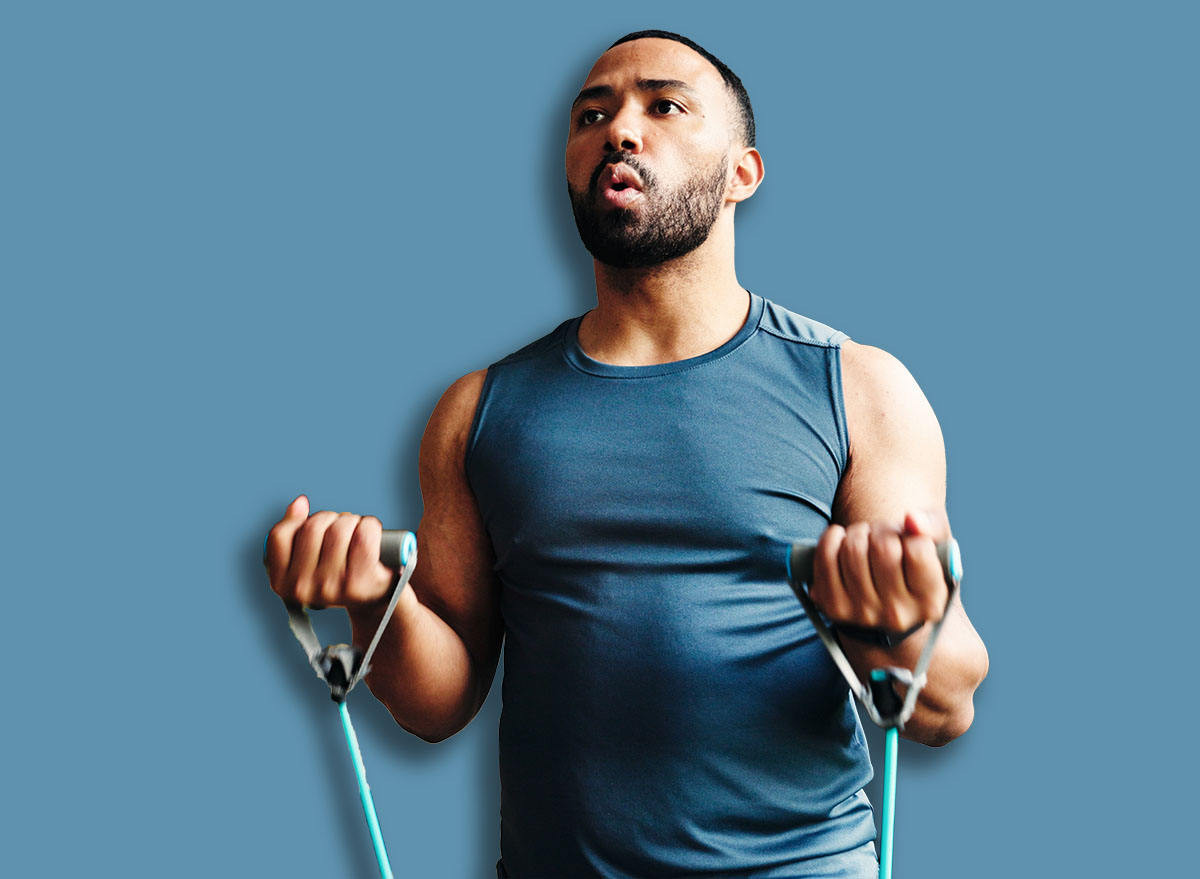
4. Bicep Development with Joint Comfort: Band Curls
Band curls offer a unique advantage over traditional dumbbell curls by providing continuous tension throughout the entire range of motion, rather than fluctuating with gravity. Resistance bands typically provide the most resistance at the top of the movement, where many individuals tend to lose tension with free weights. This characteristic makes each repetition profoundly productive without necessitating heavy loads, which is particularly beneficial for joint longevity. The elastic nature of the band also provides a smoother, more accommodating resistance curve, making band curls exceptionally joint-friendly and suitable for consistent daily training.
- Muscles Engaged: Predominantly biceps brachii, with significant involvement of the brachialis and brachioradialis (forearms).
- Execution Protocol: Stand with your feet shoulder-width apart, stepping on the middle of a resistance band. Hold one end of the band in each hand, palms facing forward, arms extended by your sides. Keeping your elbows tucked close to your body, slowly curl the band upwards towards your shoulders, contracting your biceps. Squeeze at the top, then slowly lower the band back to the starting position, controlling the eccentric phase of the movement.
- Recommended Volume: Complete three sets of 12 to 20 repetitions, allowing for a 30-second rest period between sets.
- Adaptations: Hammer band curls (palms face each other), alternating band curls, slow-tempo band curls.
- Refinement Tip: Focus on isolating the bicep contraction; avoid using momentum or swinging your torso to assist the lift.
5. Anterior Shoulder Strength and Control: Band Front Shoulder Raise
Front shoulder raises specifically target the anterior deltoids, the muscles that assist in nearly every pushing and lifting movement performed by the arms. Developing strong anterior deltoids not only contributes to the visible size and shape of the upper arms and shoulders but also significantly supports overall pressing strength and provides crucial protection for the delicate shoulder joint. Resistance bands maintain a smooth and manageable tension throughout the movement, enabling consistent training without exacerbating any existing shoulder discomfort. Over time, this consistent stimulus translates into both increased muscle volume and superior control over arm movements.
- Muscles Engaged: Primarily anterior deltoids (front shoulders), with synergistic involvement from the medial deltoids and upper trapezius.
- Execution Protocol: Stand upright with your feet shoulder-width apart, stepping on the middle of a resistance band. Hold the ends of the band in each hand, palms facing your thighs, arms extended downwards. Keeping your arms relatively straight with a slight elbow bend, slowly raise them directly in front of you until they reach shoulder height. Control the movement, avoiding any jerky motions. Pause briefly at the top, then slowly lower your arms back to the starting position.
- Recommended Volume: Aim for three sets of 12 to 15 repetitions, with a 30-second rest period between sets.
- Adaptations: Single-arm front raises, alternating front raises, pause front raises (holding at the top for a few seconds).
- Refinement Tip: Focus on lifting with deliberate control and stop the movement precisely at shoulder height, preventing excessive shrugging or momentum.
Beyond the Exercises: A Holistic Framework for Muscle Rejuvenation
Rebuilding arm muscle after the age of 50 demands more than just executing exercises; it requires cultivating an environment where the body feels adequately challenged yet simultaneously supported for growth and repair. When resistance training, nutritional strategies, and recovery protocols work synergistically, even concise daily sessions can instigate profound, visible transformations in arm size and functional strength.
- Prioritize Protein Intake: Adequate protein is paramount for muscle protein synthesis. Aim for approximately 1.6 to 2.2 grams of protein per kilogram of body weight daily, distributed across meals. Lean meats, fish, eggs, dairy, and plant-based sources like legumes and tofu are excellent choices.
- Ensure Sufficient Calories: Muscle growth is an energy-intensive process. While avoiding excessive calorie intake, ensure you consume enough to support recovery and anabolism, rather than operating in a persistent deficit.
- Embrace Quality Sleep: Sleep is a critical recovery window during which muscle repair and hormone regulation (including growth hormone and testosterone) occur. Aim for 7-9 hours of uninterrupted sleep each night.
- Stay Hydrated: Water plays a crucial role in nutrient transport, metabolic processes, and maintaining joint lubrication. Consistent hydration is essential for overall cellular function and exercise performance.
- Manage Stress: Chronic stress elevates cortisol levels, which can have catabolic effects on muscle tissue. Incorporate stress-reduction techniques like meditation, mindfulness, or hobbies into your daily routine.
- Listen to Your Body: While consistency is vital, pay attention to signals of fatigue or discomfort. Some days might warrant lighter intensity or fewer repetitions. Prioritize proper form over lifting heavier or doing more.
By integrating these evidence-based training principles and lifestyle habits, individuals over 50 can not only restore lost muscle mass but also cultivate more durable, capable, and functionally stronger arms. This approach mitigates reliance on heavy weights or overly complex training schemes, making sustainable muscle rebuilding a tangible and enjoyable pursuit. The journey to a stronger, more resilient upper body post-50 is not about returning to past glories, but rather about forging a new, robust future.
About the Author