As individuals progress through their fifth decade and beyond, concerns regarding body composition, particularly the accumulation of abdominal fat, frequently emerge. This phenomenon, often referred to colloquially as a "belly pooch" or "overhang," is more than just a cosmetic issue; it represents a significant health indicator. The increase in visceral fat, which surrounds internal organs, is associated with a heightened risk of various chronic conditions, including cardiovascular disease, type 2 diabetes, and certain cancers. Understanding the physiological underpinnings of this age-related shift is crucial for developing effective mitigation strategies.
The human body undergoes a series of metabolic and hormonal changes with advancing age that contribute to altered fat distribution. Hormonal fluctuations, such as a decline in estrogen for women and testosterone for men, play a pivotal role. Concurrently, there is a natural tendency for sarcopenia, the age-related loss of muscle mass, which further impacts metabolic rate. Lean muscle tissue is more metabolically active than fat tissue, meaning that a reduction in muscle mass leads to fewer calories burned at rest. This, coupled with potentially decreased physical activity levels and dietary habits that may not adjust to a slower metabolism, creates a conducive environment for fat storage around the midsection. Addressing this complex interplay requires a multifaceted approach, with targeted exercise emerging as a cornerstone.
While various fitness modalities exist, an increasing body of expert opinion highlights the superior benefits of functional, standing exercises for older adults seeking to enhance core strength and reduce abdominal adiposity. Steve Chambers, a Senior Certified Personal Trainer and Gym Manager at Ultimate Performance, emphasizes that the core musculature is fundamentally designed to provide stability and support during upright, dynamic movements. Unlike isolated exercises performed on gym machines that often target specific muscle groups in a seated or supine position, functional standing movements engage the core in a manner that directly translates to real-life activities. These exercises compel the abdominal muscles to brace, rotate, resist unwanted movement, and support the spine, mimicking the demands of daily tasks such as lifting groceries, walking, bending, and transitioning from sitting to standing. This integrated engagement of the core within a broader movement pattern is what often makes them more effective than machine-based alternatives for this demographic.
The concept of "functional fitness" revolves around training the body for the activities it performs daily, improving strength, balance, coordination, and flexibility simultaneously. For individuals over 55, maintaining or enhancing these capabilities is paramount for preserving independence and quality of life. By incorporating exercises that challenge the core in an upright posture, individuals can foster a more robust and responsive midsection, which in turn contributes to better posture, reduced back pain, and improved overall physical resilience. Chambers underscores the importance of progressive overload – gradually increasing the challenge of an exercise – as a critical factor for achieving tangible changes in the abdominal region and overall physical conditioning.
Let us explore four highly effective standing exercises recommended for their capacity to strengthen the core and contribute to a healthier abdominal profile:
1. Squats
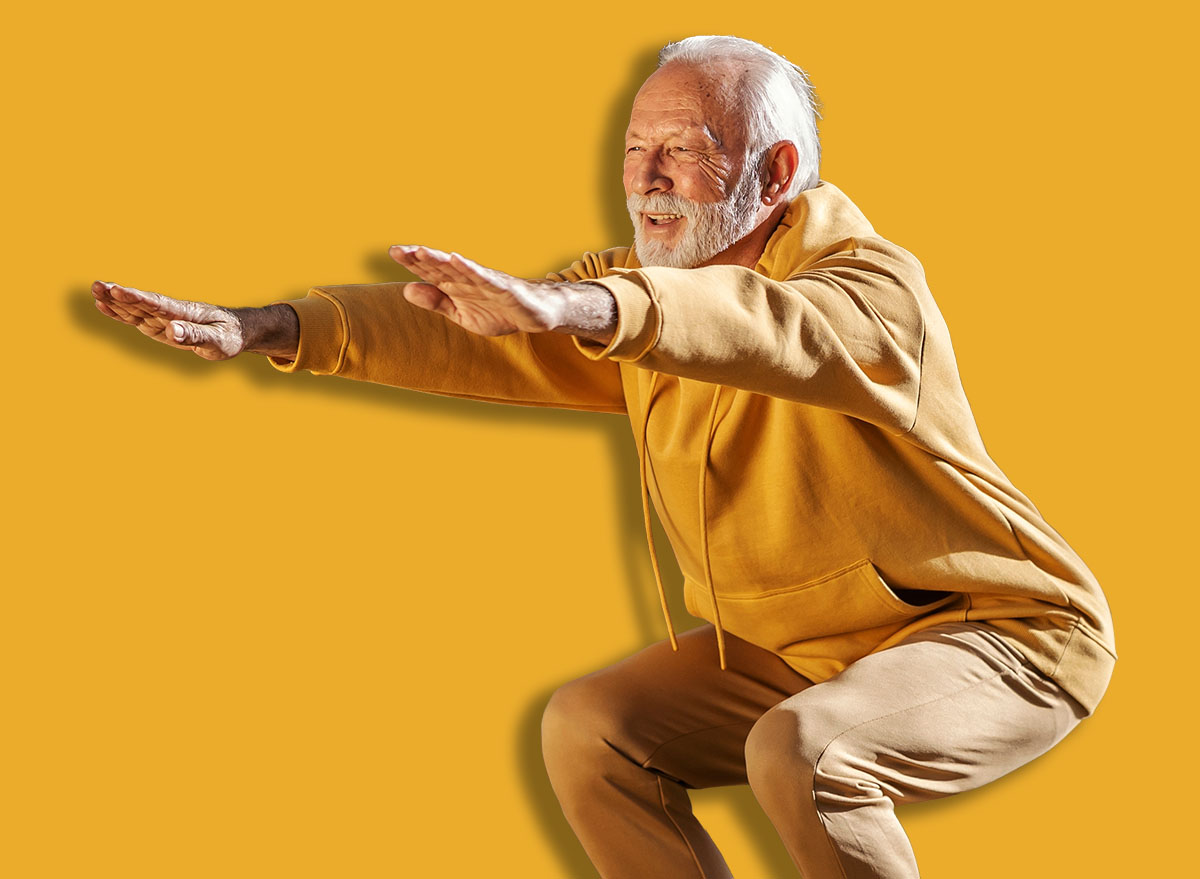
Often hailed as the "king of exercises," the squat is a fundamental human movement pattern that profoundly impacts core and lower body strength. Far from being merely a leg exercise, squats demand significant core engagement to maintain an upright posture and control the descent and ascent. As you lower your hips towards the ground, your abdominal muscles must brace intensely to stabilize the spine and prevent excessive forward lean, thereby acting as a crucial counterbalance. This continuous tension and stabilization requirement effectively works the entire core musculature, including the rectus abdominis, obliques, and erector spinae.
For older adults, mastering the bodyweight squat is an excellent starting point. Begin by standing with feet shoulder-width apart, toes pointed slightly outward. Initiate the movement by pushing your hips back as if sitting into a chair, keeping your chest lifted and your gaze forward. Descend until your thighs are parallel to the floor, or as far as comfort and mobility allow, ensuring your knees track in line with your toes. Exhale as you push through your heels to return to the starting position. As strength and confidence improve, variations such as goblet squats (holding a dumbbell or kettlebell at chest height) can be introduced, which further increase core activation due to the anterior load. The squat’s compound nature not only builds muscle and burns calories but also improves balance and mobility, crucial benefits for the over-55 demographic.
2. Farmer’s Carry
The Farmer’s Carry is deceptively simple yet remarkably potent for comprehensive core development and full-body strength. This exercise involves walking a designated distance while holding a heavy weight (such as dumbbells or kettlebells) in each hand. The core’s primary role during a Farmer’s Carry is to resist lateral flexion (bending sideways) and rotation, keeping the torso upright and stable despite the external load. This "anti-movement" function intensely activates the obliques and deeper stabilizing muscles of the abdomen and lower back.
To perform a Farmer’s Carry effectively, select weights that challenge you but do not compromise your form. Stand tall with a neutral spine, shoulders pulled back and down, and engage your core as if bracing for a punch. Walk with a controlled, deliberate pace, avoiding any slouching or swaying. The heavy load also significantly enhances grip strength, which is a vital indicator of overall health and functional capacity in older age. Beyond the core benefits, this exercise strengthens the shoulders, traps, and forearms, making it an excellent full-body conditioning tool that directly mimics the act of carrying heavy bags or luggage in everyday life.
3. Deadlifts
Regarded by Chambers as one of the most effective movements for building a robust core, the deadlift is another foundational exercise that engages nearly every muscle in the body, with a particular emphasis on the posterior chain (glutes, hamstrings, lower back) and, crucially, the core. During a deadlift, the core acts as a rigid brace, preventing spinal flexion or extension under load, thereby protecting the back and transferring force efficiently between the lower and upper body. This makes it an unparalleled exercise for developing static core strength and stability.
For individuals over 55, proper form is paramount to avoid injury. It is highly recommended to learn the deadlift technique under the guidance of a qualified personal trainer, especially when incorporating external weights. Variations such as the Romanian Deadlift (RDL) or trap bar deadlift can be more accessible and safer entry points for beginners or those with limited mobility, as they place less direct stress on the lower back while still heavily engaging the glutes, hamstrings, and core. Start with light weights or even just a broomstick to master the hip hinge pattern: keeping a slight bend in the knees, pushing the hips back, and maintaining a neutral spine as you lower the weight. The focus should always be on controlled movement and core engagement, rather than lifting maximal weight, particularly in older adults.
4. Standing Woodchops
The Standing Woodchop is a dynamic, rotational exercise that specifically targets the oblique muscles, which are responsible for twisting and side-bending movements of the torso, as well as the rectus abdominis and upper back. This exercise effectively trains the core’s ability to generate and control rotational force, a critical aspect of functional movement in sports and daily activities.
To perform a standing woodchop, you typically use a cable machine or resistance band anchored above your head to one side. Stand with your feet shoulder-width apart, facing the anchor point slightly. Grasp the handle with both hands and, keeping your arms relatively straight, pull the cable diagonally downwards and across your body towards the opposite hip, mimicking the motion of chopping wood. Allow your hips and shoulders to rotate naturally with the movement, but ensure the core remains engaged throughout to control the motion. Slowly return to the starting position, resisting the pull of the cable. This exercise not only sculpts the obliques but also improves shoulder stability and upper back strength, contributing to a more powerful and stable torso. For those without access to a cable machine, resistance bands can be effectively used, or even a light dumbbell can be swung carefully in a similar diagonal pattern, emphasizing control over momentum.
In conclusion, while the pursuit of a leaner midsection is a common goal, particularly after the age of 55, the benefits of these functional standing exercises extend far beyond mere aesthetics. By prioritizing movements that mimic real-life demands, individuals can foster a stronger, more stable core that supports daily activities, enhances balance, and reduces the risk of injury. These exercises, when performed consistently and with a focus on progressive overload, empower individuals to take a proactive role in managing age-related body composition changes. Coupled with a balanced nutritional approach, adequate sleep, and stress management, incorporating squats, Farmer’s Carries, deadlifts, and standing woodchops into a regular fitness regimen offers a holistic pathway to improved abdominal health, functional independence, and an elevated quality of life in later years. Consulting with a fitness professional is always recommended to ensure proper technique and tailor the program to individual needs and capabilities.
About the Author