A groundbreaking discovery originating from the University of Cambridge, in collaboration with an international consortium of researchers, has fundamentally altered long-held scientific assumptions regarding the behavior of deoxyribonucleic acid (DNA) as it navigates through minute, sub-micron apertures known as nanopores. This pivotal insight, recently unveiled, illuminates a previously overlooked structural phenomenon within the DNA molecule, identifying specialized twisted formations—plectonemes—as the true architects behind complex electrical signatures observed in these cutting-edge genetic analysis systems. The ramifications of this research are far-reaching, promising to enhance the precision of genomic studies, refine diagnostic methodologies, and unlock new capabilities in the burgeoning field of biosensing.
For several decades, the scientific community operated under a widely accepted premise that irregular electrical signals generated when DNA translocates through nanopores were indicative of the genetic material forming conventional knots. This hypothesis, intuitive in its simplicity, drew parallels to macroscopic examples, such as a shoelace snagging or tangling when pulled through a constricted opening. Researchers theorized that any deviation from a smooth, uniform electrical readout signified a physical knot obstructing the pore, impeding the DNA’s unimpeded passage. This interpretation subsequently became deeply embedded in the protocols and analytical frameworks used for deciphering nanopore data, inadvertently shaping the trajectory of genetic sequencing and single-molecule analysis for a significant period. The perception of knots as the primary culprits for signal anomalies, while logical on the surface, ultimately proved to be an incomplete and, in many instances, inaccurate explanation.
Nanopore technology itself represents a revolutionary leap in molecular detection, offering a unique platform for examining individual biomolecules with unprecedented detail. These systems typically employ a membrane containing an extremely small pore, often just a few nanometers in diameter—comparable to the width of a single DNA strand. When an electrical potential is applied across this membrane, ions flow through the pore, generating a measurable ionic current. As a DNA molecule passes through, it transiently obstructs this flow, causing characteristic fluctuations in the current. These electrical disturbances act as a molecular fingerprint, providing information about the DNA’s sequence, length, and structural integrity. The allure of nanopores lies in their potential for real-time, label-free, and highly portable genetic analysis, making them invaluable tools in applications ranging from rapid pathogen identification to personalized medicine. The misinterpretation of signal patterns, however, presented a persistent bottleneck, hindering the full realization of the technology’s analytical power.
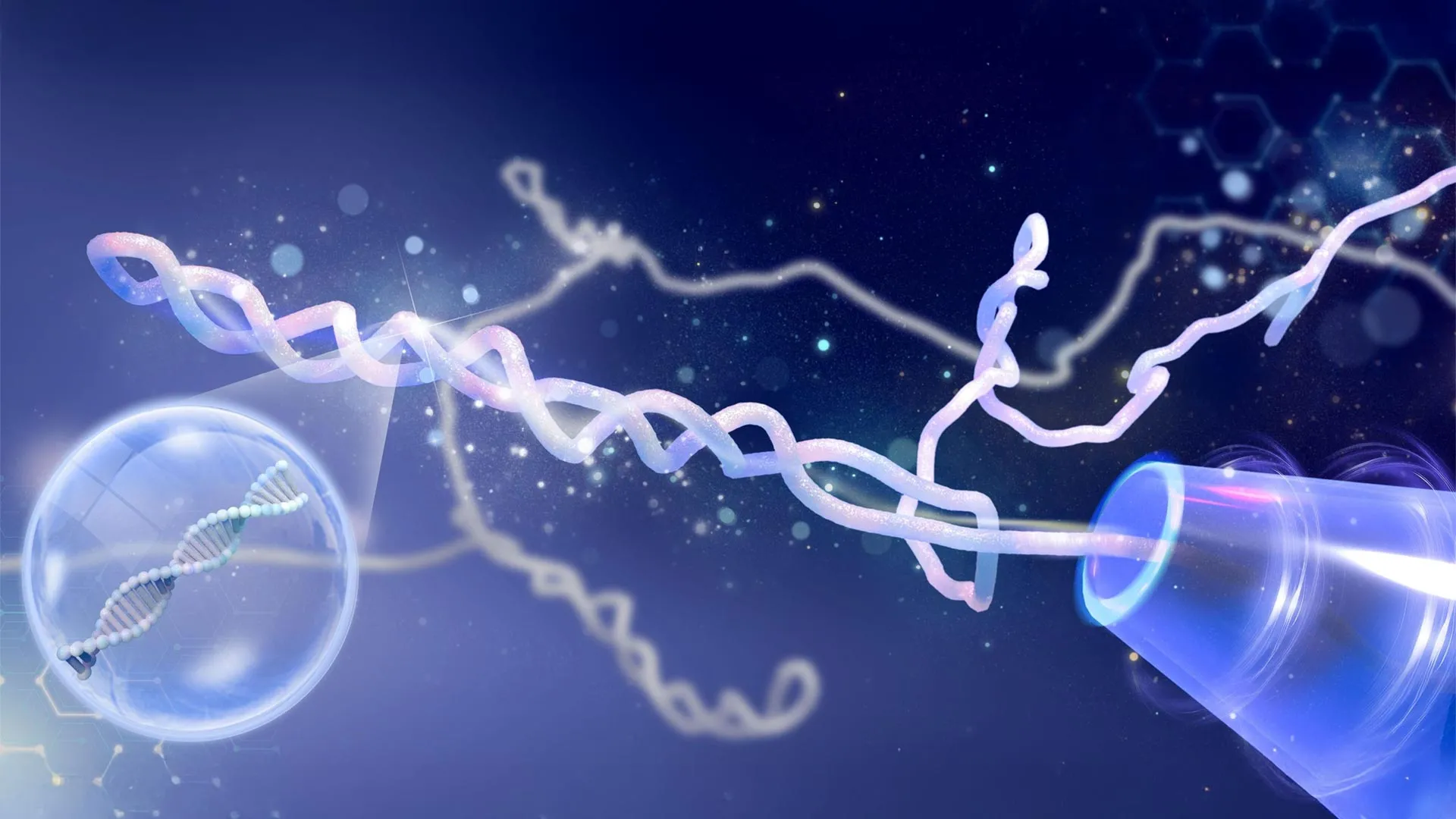
The recent study, whose findings were meticulously detailed in the prestigious journal Physical Review X, systematically dismantles the long-standing "knot hypothesis." Instead of random entanglements, the research conclusively demonstrates that DNA frequently undergoes a highly organized form of self-interaction: it twists around itself, generating what are scientifically termed plectonemes. These structures are distinct from true topological knots; rather than being a tight, localized entanglement that can only be resolved by passing one strand end through another, plectonemes resemble a supercoiled telephone cord—a helical structure where the double helix itself is further coiled upon its own axis. This crucial differentiation between a transient knot and a persistent, propagating twist fundamentally alters how researchers must now interpret the intricate electrical signatures emanating from nanopore experiments. The varying topological properties and dynamic behaviors of knots versus plectonemes mean they exert vastly different influences on ionic current, necessitating a complete re-evaluation of historical data and future analytical approaches.
Dr. Fei Zheng, the lead author from the Cavendish Laboratory at the University of Cambridge, articulated the essence of this discovery, stating, "Our experimental observations unequivocally revealed that as DNA is drawn into and through the nanopore, the inherent ionic current within the pore exerts a rotational force upon the strand. This mechanical torque accumulates along the DNA molecule, compelling it to wind into plectonemes, rather than merely forming random knots. Crucially, these ‘hidden’ twisting formations imprint a distinct, enduring signature onto the electrical signal, a stark contrast to the fleeting, transient electrical blips characteristic of true knots." This statement underscores the profound impact of the finding: the signals previously attributed to knots were, in fact, predominantly the tell-tale signs of DNA supercoiling into plectonemes.
To arrive at this paradigm-shifting conclusion, the research team engineered a series of sophisticated experiments, employing both glass and silicon nitride nanopores—materials chosen for their diverse surface chemistries and structural properties—and systematically varying experimental parameters such as applied voltage and the length of the DNA strands. A consistent and compelling pattern emerged: events characterized by multiple sections of DNA simultaneously occupying the nanopore, often labeled as "tangled" events, occurred with a frequency that far exceeded what could be explained by conventional knot theory. Moreover, the prevalence of these complex events escalated proportionally with increases in the applied voltage and the overall length of the DNA molecules. This unexpected correlation strongly suggested the existence of an unacknowledged physical mechanism at play, one that actively promoted the formation of these intricate DNA conformations.
The elucidation of this "missing mechanism" pointed directly to electroosmotic flow. Within the confined space of a nanopore, an electric field not only drives the charged DNA molecule but also induces the movement of the surrounding water molecules. This phenomenon, electroosmotic flow, essentially creates a microscopic current of fluid. As this water flows past the helical DNA strand, it imparts a subtle yet persistent spinning force—a torque—upon the molecule. This torque, rather than being localized, propagates along the length of the DNA. Consequently, sections of the DNA located outside the immediate vicinity of the pore begin to coil upon themselves, accumulating supercoils that manifest as plectonemes. Unlike true knots, which tend to tighten under pulling forces and are often quickly resolved as the DNA translocates, plectonemes can grow in size and persist throughout a substantial portion, or even the entirety, of the DNA’s passage through the pore. Advanced computer simulations, incorporating realistic physical forces and torques, corroborated these experimental observations, confirming that plectoneme formation is intrinsically linked to DNA’s ability to efficiently transmit torsional stress along its double helical axis.
To definitively validate their hypothesis, the researchers devised an ingenious experimental control: they created "nicked" DNA. A "nick" refers to a single-strand break within the DNA double helix. While not severing the entire molecule, this interruption effectively disrupts the structural continuity required for efficient torque propagation. When these nicked DNA strands were introduced into the nanopore system, the formation of plectonemes was sharply and consistently reduced. This elegant experiment provided conclusive evidence that the ability of the DNA molecule to propagate twist along its length is absolutely fundamental to the observed plectoneme formation. Intriguingly, this specific experimental outcome also hints at a novel application for nanopore technology: the detection of DNA damage. Since breaks in the DNA strand directly interfere with its twisting behavior, nanopores could potentially be refined to identify such damage, offering a new avenue for early disease diagnostics.
Professor Ulrich F. Keyser, also from the Cavendish Laboratory and a co-author of the seminal study, highlighted the immediate practical implications for signal interpretation: "The true power of this discovery lies in our newfound capability to unequivocally differentiate between true knots and plectonemes based on their distinct durations within the nanopore signal. Knots manifest as rapid, transient disturbances, akin to a fleeting bump in the road. In contrast, plectonemes linger, generating extended, prolonged electrical signatures. This provides an invaluable pathway toward obtaining richer, far more nuanced readouts concerning DNA’s intricate organizational state, its genomic integrity, and crucially, the presence of subtle damage." This ability to resolve previously ambiguous signals promises to dramatically enhance the resolution and reliability of nanopore-based analyses.
The implications of this research extend far beyond the immediate confines of nanopore sensing, resonating deeply within broader fields of biology and nanotechnology. Within living biological systems, DNA is a remarkably dynamic molecule, constantly undergoing twisting, winding, and uncoiling processes as it interacts with a myriad of cellular enzymes. Both knots and plectonemes play crucial roles in vital cellular functions, including gene regulation, DNA replication, repair mechanisms, and the overall organization and stability of the genome. A more accurate understanding of how these complex structures form and behave at the nanoscale could significantly improve theoretical models of cellular DNA dynamics, offering new perspectives on fundamental biological processes. For instance, processes involving topoisomerases, enzymes responsible for managing DNA supercoiling, might be re-evaluated through the lens of this new understanding.
From a technological and diagnostic perspective, the ability to precisely detect, and potentially even control, DNA twisting opens up exciting new frontiers. It could lead to the development of highly sensitive biosensors capable of identifying subtle genetic alterations, such as single nucleotide polymorphisms or small deletions/insertions, that are often linked to the onset and progression of various diseases. Furthermore, the enhanced capacity to detect early indicators of DNA damage, which is a hallmark of conditions like cancer and certain neurodegenerative disorders, holds immense promise for preventative medicine and personalized therapeutic strategies. The refinement of nanopore technology, guided by this deeper understanding of DNA’s nanoscale mechanics, could yield diagnostic tools with unprecedented specificity and sensitivity.
Professor Keyser concluded by emphasizing the broader impact on the field of nanotechnology itself: "From the vantage point of nanotechnology, this research vividly underscores the transformative potential of nanopores, not merely as sophisticated analytical sensors, but as powerful tools capable of actively manipulating biopolymers in innovative and controlled ways." This perspective suggests a future where nanopores might not only read genetic information but also actively influence or modify the structural states of DNA and other biomolecules, paving the way for entirely new applications in bioengineering and synthetic biology. The Cambridge team’s work thus represents not just a correction of past scientific thought, but a robust foundation for a new era of precision in understanding and leveraging the intricate world of DNA at its most fundamental level.
About the Author