Groundbreaking neuroscientific inquiry originating from Trinity College Dublin has unveiled a remarkable capacity within the infant brain: the ability to discern and categorize visual information into distinct object groups emerges as early as two months post-birth. This developmental milestone significantly predates previous scientific assumptions, suggesting that the fundamental architecture of perceptual processing is deeply ingrained from the nascent stages of human life. The implications of this discovery extend to our understanding of cognitive development, offering profound insights into the foundational elements of how humans begin to make sense of their surroundings.
The research, published in the prestigious journal Nature Neuroscience, leveraged a sophisticated confluence of advanced brain imaging techniques and cutting-edge artificial intelligence models. This synergistic approach provided researchers with an unprecedented window into the cognitive processes of infants during their initial months, a period characterized by significant neural maturation and the laying of groundwork for future learning and interaction. By meticulously analyzing brain activity patterns, scientists have been able to illuminate the complex mental operations occurring long before the emergence of articulated language or voluntary motor control, thus offering a richer tapestry of infant cognition than previously imagined.
A team of dedicated researchers from the Trinity College Institute of Neuroscience (TCIN) and the School of Psychology spearheaded this comprehensive investigation. Their work, notably including contributions from Dr. Cliona O’Doherty, the study’s lead author, who conducted her research within Trinity’s Cusack Lab, sought to address age-old questions about the inner world of infants. As Dr. O’Doherty articulated, parents and scientists alike have long been captivated by the question of what infants perceive and how their minds process the visual stimuli of the world. This study powerfully underscores the inherent richness and complexity of brain function even within the first year of life.
The findings suggest that even when an infant’s capacity for communication is constrained by a lack of linguistic skills and underdeveloped motor coordination, their cognitive systems are already engaged in sophisticated processing. Beyond mere visual representation, these young minds are actively engaged in the process of classifying what they see, assigning items to their appropriate conceptual categories. This demonstrates that the essential underpinnings of visual cognition are firmly established and operative at a much earlier developmental stage than previously posited by developmental psychology and neuroscience.
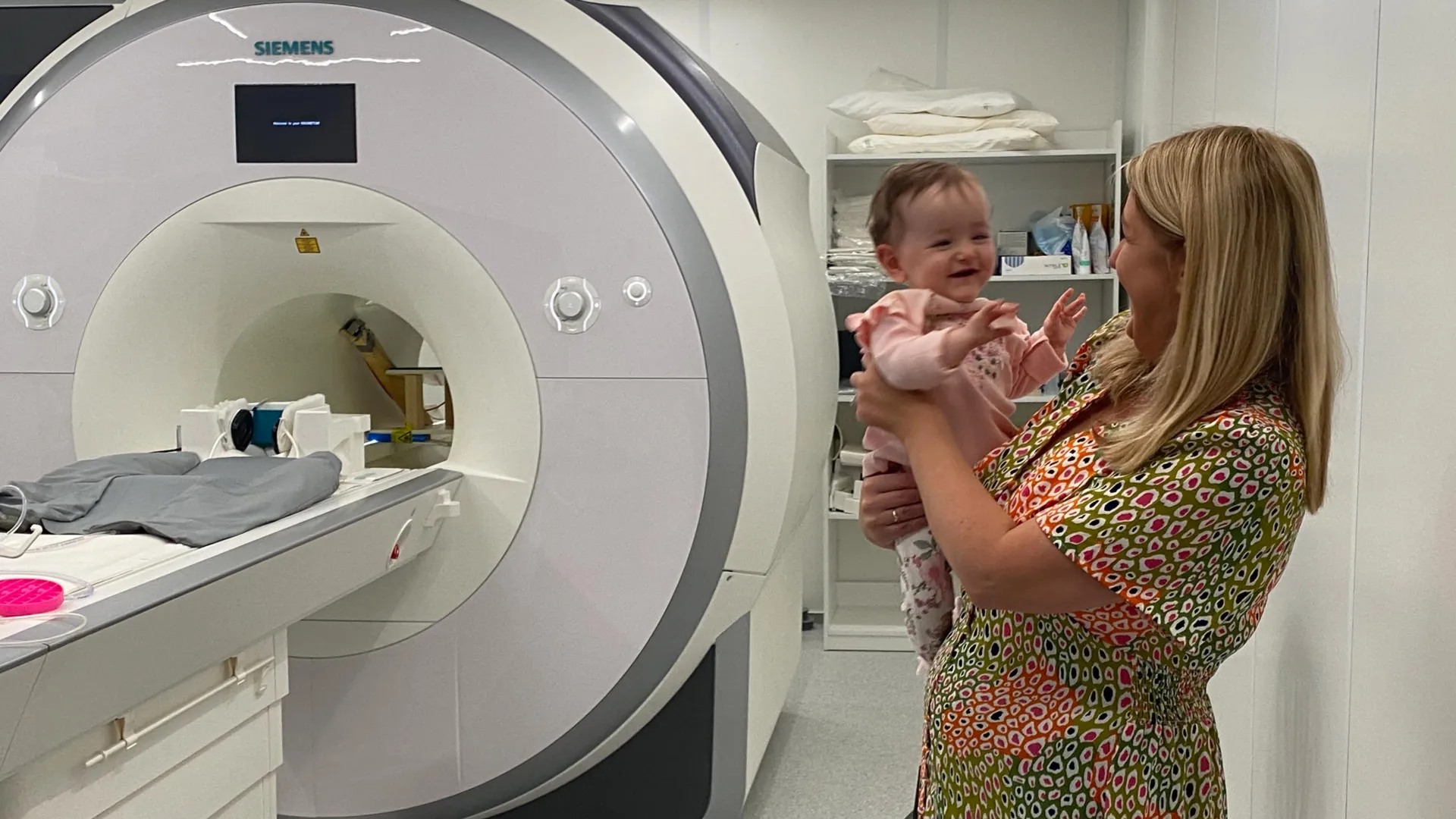
The experimental design involved a cohort of 130 infants, all two months of age, recruited through collaborations with the Coombe and Rotunda Hospitals in Dublin. The infants were positioned comfortably on soft beanbag chairs, equipped with noise-cancelling headphones, and presented with a series of visually stimulating, colorful images specifically curated to capture and maintain their attention for periods ranging from 15 to 20 minutes. This carefully controlled environment was crucial for enabling the precise collection of data.
Within this setting, researchers employed functional Magnetic Resonance Imaging (fMRI) to meticulously record the neural activity occurring within the infants’ brains as they viewed a diverse array of images. These images were drawn from 12 distinct and familiar visual categories, encompassing everyday objects and creatures such as cats, birds, rubber ducks, shopping carts, and trees. The goal was to observe how the infant brain responded to and processed these varied visual inputs.
The subsequent analysis phase employed advanced artificial intelligence algorithms to interpret the intricate patterns of brain activity. By comparing the neural signatures of visual category representation in the AI models with those observed in the infant brains, the research team was able to gain a more profound understanding of the mechanisms underlying early visual categorization. This computational approach allowed for a more objective and detailed dissection of how the brain, at such a young age, begins to organize the vast influx of visual information.
Professor Rhodri Cusack, the Thomas Mitchell Professor of Cognitive Neuroscience at Trinity’s School of Psychology and TCIN, who led the research, highlighted the pioneering nature of the study. He emphasized that this investigation represents the largest longitudinal study utilizing fMRI in awake infants to date. The comprehensive dataset of brain activity offers a novel paradigm for assessing infant cognition at an extremely early age. Furthermore, Professor Cusack pointed to the significant potential of neuroimaging combined with computational modeling as a future diagnostic tool for very young children, particularly in identifying early signs of developmental variations.
Professor Cusack also drew a parallel between infant learning and artificial intelligence, noting that babies possess a remarkable capacity for rapid learning that currently outpaces even sophisticated AI models. He expressed hope that by studying the intricate learning processes of infants, researchers can inspire the development of next-generation AI systems that are more efficient, thereby reducing their considerable economic and environmental footprints. This cross-disciplinary perspective underscores the bidirectional benefits of investigating infant cognition.
Dr. Anna Truzzi, now affiliated with Queen’s University Belfast and a co-author of the study, underscored the role of recent technological advancements in making this research feasible. She explained that until recently, reliably measuring how specific brain regions in infants process visual information was a significant challenge. The integration of AI and neuroimaging has provided a unique vantage point, significantly enhancing our comprehension of infant learning during the crucial first year of life.
The initial year of life is a period of extraordinarily rapid and complex brain development. This study contributes foundational knowledge that can inform a range of fields, including early childhood education, clinical support for neurodevelopmental conditions, and the design of more biologically informed artificial intelligence systems. The insights gleaned from this research have the potential to guide interventions and educational strategies aimed at optimizing early cognitive development.
Professor Eleanor Molloy, a neonatologist at Children’s Health Ireland and another co-author, stressed the broader clinical significance of the findings. She highlighted a critical need for a deeper understanding of how neurodevelopmental disorders impact early brain development. In this context, awake fMRI technology emerges as a promising tool with considerable potential to address this crucial gap in knowledge and facilitate earlier identification and intervention.
The research team’s dedication to unraveling the complexities of infant cognition is further complemented by artistic interpretations of their work. Artist Cian McLoughlin, who served as Artist in Residence at the Trinity College Institute of Neuroscience in 2024, created artwork inspired by this research, offering a visual dialogue with the scientific findings. An accompanying exhibition essay further contextualizes this artistic engagement, demonstrating the interdisciplinary impact of these discoveries. Dr. O’Doherty is presently based at Stanford University, and Dr. Truzzi holds a Senior Lecturer position in the School of Psychology at Queen’s University Belfast, continuing their impactful contributions to the field.
About the Author