Groundbreaking research originating from the University of Birmingham has illuminated significant divergences in the way autistic and neurotypical individuals utilize facial musculature to convey internal emotional states. This extensive investigation, published in the esteemed journal Autism Research, meticulously maps the intricate choreography of facial movements associated with fundamental emotions, offering profound insights into the potential origins of interpersonal communication challenges often encountered between these groups. The study’s findings suggest that the very architecture of emotional expression, far from being a universal language, exhibits distinct dialects influenced by neurodivergence.
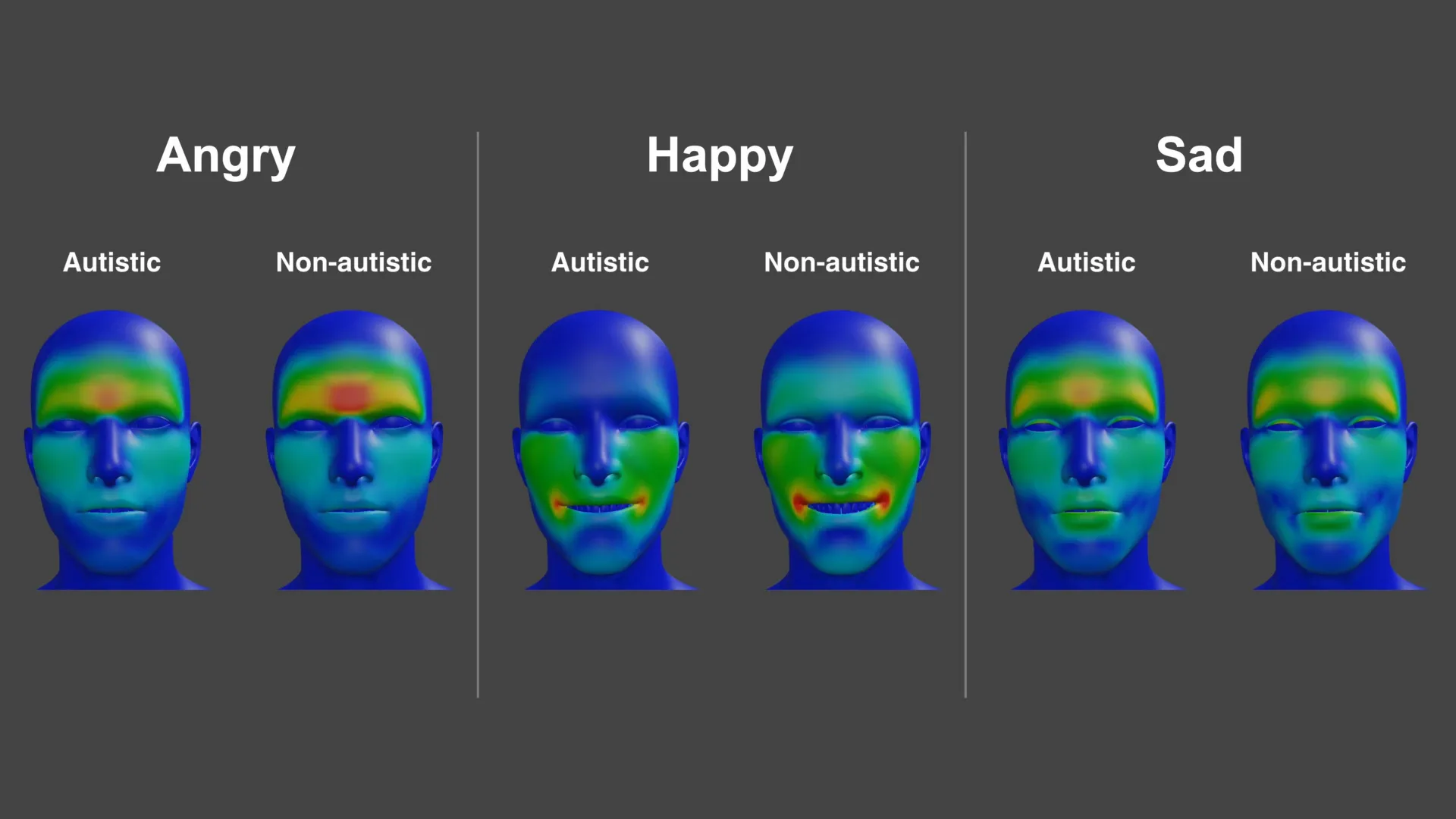
At the core of this scientific endeavor was an ambitious project designed to create an unparalleled repository of emotional facial kinematics. Employing state-of-the-art facial motion capture technology, the research team amassed an astonishing dataset, exceeding 265 million individual data points. This granular level of detail allowed for the construction of what is arguably the most comprehensive library of emotional facial movements documented to date, providing a robust foundation for comparative analysis. The methodology involved a controlled yet dynamic approach, with participants tasked with manifesting specific emotions such as anger, happiness, and sadness. Crucially, these expressions were elicited under two distinct conditions: firstly, while participants were synchronizing their facial movements with auditory cues, and secondly, during periods of verbal articulation. This dual-pronged approach ensured a multifaceted examination of expressive capabilities.
The cohort for this seminal study comprised 25 adults diagnosed with autism spectrum disorder and 26 neurotypical adults, forming a balanced sample for comparison. Across these participants, nearly 5,000 distinct facial expressions were meticulously recorded and analyzed. The emerging patterns revealed a discernible divergence in the expressive repertoires of the two groups. Notably, individuals on the autism spectrum exhibited a broader spectrum of unique facial configurations when conveying emotions. While the study did not present a list of specific patterns in its original dissemination, the overarching observation pointed to qualitative and quantitative differences in the execution and configuration of these expressions. These distinctions, researchers posit, may lie at the heart of the frequent misunderstandings that arise in social interactions, where subtle cues are paramount for accurate emotional interpretation.
Further exploration within the research delved into the potential mediating role of alexithymia, a condition frequently co-occurring with autism, though not exclusive to it. Alexithymia, characterized by an inherent difficulty in identifying, understanding, and articulating one’s own emotional experiences, was examined for its impact on outward emotional displays. The findings indicated a correlation: individuals exhibiting higher levels of alexithymia tended to produce less clearly defined facial manifestations of emotions like anger and happiness. This reduced clarity rendered these emotional expressions more ambiguous, potentially increasing the likelihood of misinterpretation by observers. The study underscores that the outward expression of emotion is not solely a matter of intent but is also intricately linked to the internal processing and awareness of one’s own affective landscape.
Dr. Connor Keating, the lead investigator of this significant study, now affiliated with the Department of Experimental Psychology at the University of Oxford, elaborated on the multifaceted nature of these observed differences. He emphasized that the discrepancies extend beyond the mere visual appearance of facial expressions. "Our findings suggest autistic and non-autistic people differ not only in the appearance of facial expressions, but also in how smoothly these expressions are formed," Dr. Keating stated. This suggests that the temporal dynamics and the fluidity with which facial muscles move to create an expression are also areas of divergence. These subtle yet crucial mismatches in the very formation and execution of facial cues can contribute significantly to the difficulties autistic individuals may face in accurately decoding the expressions of neurotypical individuals, and conversely, why neurotypical individuals might struggle to interpret the emotional signals emanating from autistic individuals. The challenge, therefore, is not simply about recognizing a static image of an expression but understanding the dynamic process of its generation.
Professor Jennifer Cook, the senior author of the research and a distinguished figure at the University of Birmingham, offered a vital perspective, cautioning against framing these differences as inherent deficits. Professor Cook advocates for a nuanced understanding, suggesting that the divergent expressive styles may represent variations in communicative fluency rather than deficiencies. "Autistic and non-autistic people may express emotions in ways that are different but equally meaningful — almost like speaking different languages," she posited. This linguistic analogy highlights the potential for mutual intelligibility through adaptation and learning, rather than through a presumed universal congruence. What has historically been interpreted as a communicative handicap for autistic individuals could, in fact, reflect a reciprocal challenge in mutual understanding, where both parties navigate different expressive frameworks. The research team is actively pursuing this line of inquiry, indicating that future studies will further investigate this concept of a "two-way challenge" in emotional expression and comprehension.
The research was made possible through substantial financial backing from the Medical Research Council (MRC) in the United Kingdom and the European Union’s Horizon 2020 Research and Innovation Programme, underscoring the international recognition and importance of this work. The implications of these findings are far-reaching, impacting fields ranging from clinical psychology and neuroscience to artificial intelligence and human-computer interaction. By meticulously dissecting the biomechanics of emotional expression in autistic individuals, this study paves the way for more effective diagnostic tools, improved therapeutic interventions, and, crucially, the fostering of greater empathy and understanding in a diverse society. The work challenges long-held assumptions about the universality of non-verbal communication and opens new avenues for exploring the rich tapestry of human emotional expression across the neurodiversity spectrum. The detailed mapping of facial movements provides a concrete, data-driven foundation for re-evaluating social communication paradigms and promoting more inclusive interaction strategies. It calls for a shift in perspective from viewing differences as deficits to appreciating them as variations in a complex, multi-faceted human communication system.
About the Author