
As individuals navigate the landscape of aging, typically beyond the age of 50, a series of physiological shifts often begins to manifest, impacting various aspects of physical form and function. Among the commonly observed changes is a gradual decrease in muscle mass, scientifically termed sarcopenia, alongside a reduction in the skin’s inherent elasticity and collagen production. These natural processes can contribute to a softer appearance in areas such as the upper arms, often leading to a desire for greater firmness and definition. While these transformations are an inherent part of the aging journey, contemporary understanding of exercise physiology demonstrates that targeted, consistent physical activity can significantly mitigate these effects, fostering improved muscular support, enhanced aesthetic appeal, and overall functional strength. Far from being an insurmountable challenge, maintaining and even building upper body strength in later life is an achievable goal, pivotal for preserving independence, improving metabolic health, and boosting self-confidence.
For many older adults, traditional gym environments or high-impact workouts might seem daunting due to concerns about joint stress, accessibility, or simply a lack of familiarity. This is where the concept of accessible, low-impact strength training becomes invaluable. Incorporating exercises that leverage existing home furniture, such as a sturdy bed, offers a practical and comfortable entry point into a fitness regimen. The slight elevation provided by a bed or similar stable surface can strategically reduce the load on joints like the wrists and shoulders, making movements more approachable and less intimidating. This adaptive approach not only minimizes the physical barriers to exercise but also addresses potential psychological hesitations, fostering an environment where individuals can confidently begin to challenge their muscles and build foundational strength. Fitness professionals frequently advocate for starting with supported or inclined movements, recognizing their effectiveness in quickly establishing confidence and generating early momentum in a new exercise program.
The pursuit of more defined and resilient arms primarily involves strengthening the underlying musculature, particularly the triceps brachii, which constitutes a significant portion of the upper arm’s mass, along with the pectorals (chest muscles) and anterior deltoids (front shoulder muscles). When these muscle groups are robust, they provide a firmer base, naturally supporting the overlying skin and contributing to a more toned appearance. Beyond aesthetics, developing strength in these areas is crucial for daily functional movements, from lifting objects and pushing doors to maintaining good posture. The exercises outlined below are designed to target these key muscle groups, utilizing only body weight and a stable, elevated surface, thereby making effective strength training readily available within the comfort of one’s home. Each movement is structured to progressively build strength, enhance muscular endurance, and improve overall bodily control, contributing to not only visible changes but also significant improvements in physical capability.
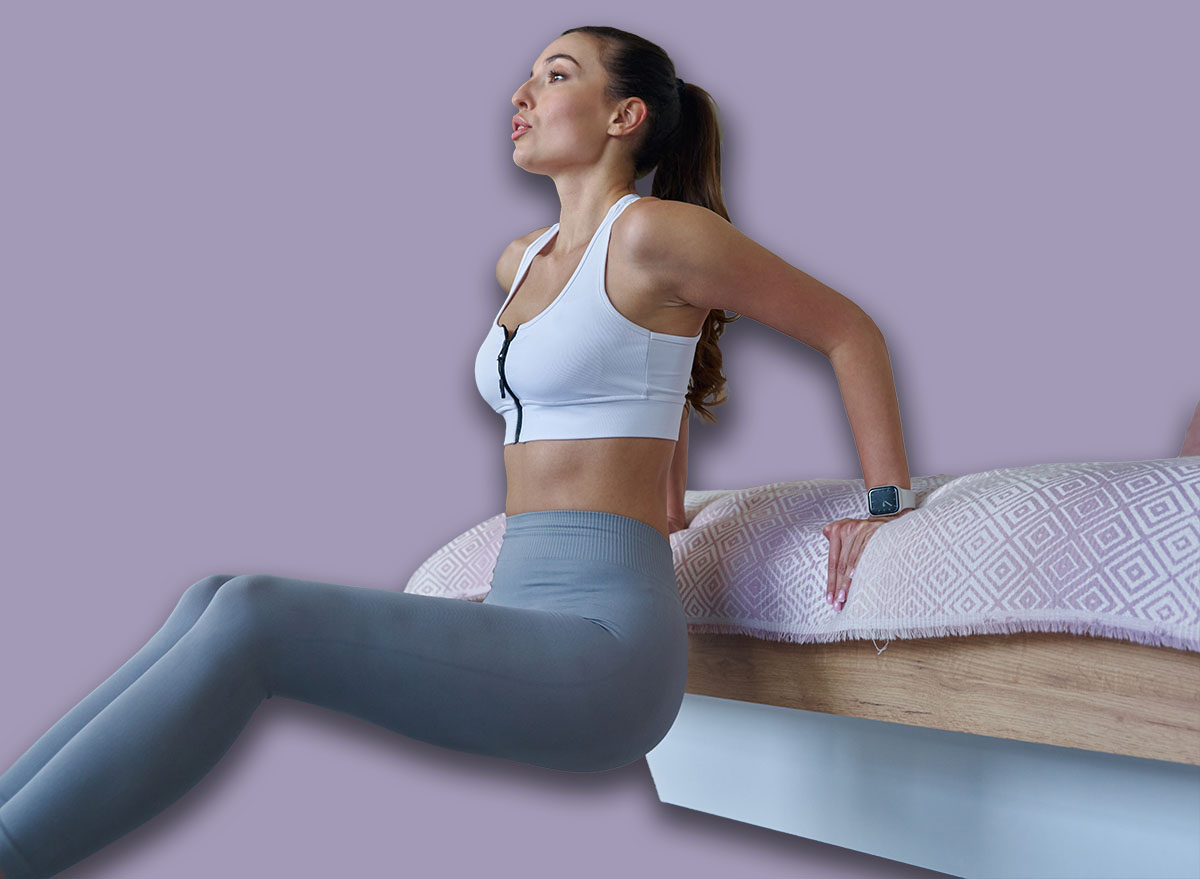
1. Supported Triceps Dips
The triceps brachii muscle, located at the back of the upper arm, plays a paramount role in arm extension and overall arm definition. Supported triceps dips are an exceptionally effective exercise for directly engaging this muscle group, alongside the anterior deltoids and pectorals, which act as synergistic muscles providing stability and assistance. This compound movement challenges the muscles responsible for straightening the elbow, and when performed with proper form, it promotes significant strength gains in the posterior upper arm. For individuals new to strength training or seeking a joint-friendly alternative to traditional dips, using a bed or a sturdy chair as a support offers a modified yet highly effective pathway to muscle activation. The immediate sensation of muscle engagement often serves as a powerful motivator, reinforcing consistent effort.
- Execution:
- Position yourself on the edge of a sturdy bed or chair, sitting upright with your hands placed beside your hips, fingers gripping the edge and pointing forward.
- Slide your hips forward until they are off the edge, supporting your body weight primarily through your arms and feet. Your knees should be bent at approximately a 90-degree angle, with feet flat on the floor directly beneath them.
- Slowly lower your body by bending your elbows directly backward, keeping them close to your sides. Descend until your elbows form roughly a 90-degree angle, or to a comfortable depth that does not strain your shoulders.
- Engage your triceps to push back up to the starting position, fully extending your arms without locking your elbows. Maintain a stable core and ensure your shoulders remain relaxed and away from your ears throughout the movement.
- Recommended Protocol: Perform 3 sets of 10 to 12 repetitions. Allow for a 60-second recovery period between each set.
- Adaptations: For a reduced challenge, keep knees more bent and feet closer to the support. To increase intensity, extend your legs further, or even perform the movement with straight legs. Tempo variations, where the lowering or lifting phase is slowed, can also amplify muscle engagement.
- Expert Insight: Focus on controlling the downward movement and pushing powerfully upwards. Imagine driving your palms through the bed surface. This mindful engagement enhances muscle fiber recruitment.
2. Elevated Surface Chest Presses
Incline push-ups, or elevated surface chest presses, are a cornerstone exercise for developing strength in the chest, shoulders, and triceps, while offering a scalable alternative to traditional floor push-ups. By utilizing an elevated surface like a bed, the body’s angle is adjusted, reducing the overall load that needs to be pressed, which significantly diminishes stress on the wrists and shoulders. This makes the exercise particularly suitable for adults over 55 who desire robust upper body training without excessive joint strain. Furthermore, the movement inherently teaches core bracing and total-body control, as the trunk must remain rigid throughout the pressing action. This exercise is highly adaptable, allowing individuals to progress as their strength improves by gradually decreasing the elevation of their support surface.
- Execution:
- Stand facing a sturdy bed or elevated surface. Place your hands slightly wider than shoulder-width apart on the edge of the bed, fingers pointing forward.
- Step your feet back until your body forms a straight line from your head to your heels, engaging your core and glutes to prevent your hips from sagging or rising too high. Your arms should be fully extended.
- Bend your elbows, allowing your chest to descend towards the edge of the bed. Keep your elbows tracking slightly backward and outward, not flaring directly to the sides.
- Once your chest is close to the surface, press firmly through your palms to push your body back up to the starting position, maintaining the straight body alignment.
- Recommended Protocol: Complete 3 sets of 8 to 12 repetitions. Rest for 60 seconds between sets.
- Adaptations: To reduce difficulty, use a higher surface or stand closer to the bed. For increased challenge, lower the surface height or try a narrower hand grip to emphasize triceps activation.
- Expert Insight: Ensure your body moves as a single, rigid unit. Avoid allowing your hips to drop or pike upwards. A strong core is fundamental to protecting your lower back and maximizing upper body engagement.
3. Elevated Forearm Plank Hold
While often associated with core strength, the elevated forearm plank hold is a foundational exercise that profoundly impacts overall upper body stability, particularly in the shoulders, chest, and triceps. This seemingly static posture demands sustained tension across multiple muscle groups, significantly enhancing muscular endurance in the arms and shoulders, which translates into improved control and support for daily activities. Performing the plank on an incline, such as with forearms on a bed, reduces the gravitational pull compared to a floor plank, making it more accessible and joint-friendly, especially for individuals building foundational strength. This exercise reinforces crucial full-body stability, contributing to a more resilient and toned physique over time.
- Execution:
- Position yourself facing a sturdy bed or elevated surface. Place your forearms on the bed, shoulder-width apart, with elbows directly beneath your shoulders and palms flat or clasped.
- Step your feet back until your body forms a straight line from your head to your heels. Engage your abdominal muscles by imagining pulling your belly button towards your spine, and squeeze your glutes.
- Maintain this rigid, straight line, resisting any urge for your hips to sag towards the floor or pike upwards. Keep your gaze directed slightly forward or down to maintain a neutral neck alignment.
- Hold this position for the prescribed duration, focusing on deep, steady breathing.
- Recommended Protocol: Hold for 3 sets of 20 to 30 seconds. Take a 45-second break between each set.
- Adaptations: To decrease intensity, use a higher surface or shorten the hold duration. To increase intensity, extend the hold time, or for a greater challenge, try a single-leg lift while maintaining stability.
- Expert Insight: Actively "pull your ribs down" and brace your core as if preparing for a gentle punch to the stomach. This cue helps to maintain a flat back and prevents hyperextension in the lower spine.
4. Dynamic Elevated Plank with Shoulder Stability Challenge
Building upon the static stability of the elevated plank, incorporating shoulder taps introduces a dynamic element that significantly amplifies the challenge to core stability and unilateral arm strength. This movement demands anti-rotational strength, forcing the core, arms, and shoulders to work synergistically to prevent the body from twisting as one arm lifts off the support surface. For those who have mastered the basic elevated plank, this progression is an excellent way to enhance coordination, control, and endurance within the upper body. The controlled instability inherent in shoulder taps directly contributes to strengthening the intricate network of muscles that support the shoulder joint and spine, leading to a more robust and responsive upper body.
- Execution:
- Begin in the elevated forearm plank position, with your forearms on the bed, body forming a straight line from head to heels. Ensure your core is tightly engaged.
- Carefully shift your weight slightly onto your left forearm and hand.
- Slowly lift your right hand from the bed and tap your left shoulder. The goal is to minimize any swaying or rotation in your hips and torso.
- Return your right hand to the bed, re-establishing a stable plank.
- Shift your weight onto your right forearm and hand, then lift your left hand to tap your right shoulder.
- Continue alternating taps, maintaining a controlled, deliberate pace and prioritizing stability over speed.
- Recommended Protocol: Perform 3 sets of 10 to 16 total taps (5-8 taps per side). Rest for 45 seconds between each set.
- Adaptations: To simplify, widen your stance with your feet for a broader base of support. For a more advanced challenge, perform taps at a slower tempo or try lifting the opposite arm and leg simultaneously while maintaining control.
- Expert Insight: The key to this exercise is controlled anti-rotation. Imagine a glass of water on your lower back that you don’t want to spill. This mental image encourages minimal hip sway and maximizes core engagement.
Holistic Approach to Enhancing Arm Definition and Overall Wellness
While targeted exercises form the cornerstone of improving arm tone and strength, their effectiveness is greatly amplified when integrated within a broader framework of supportive daily habits. Achieving and maintaining physiological improvements, particularly after the age of 55, necessitates a comprehensive approach that extends beyond the exercise routine itself. Sustained progress is a product of consistent effort, mindful recovery, and strategic nutritional practices. Individuals who witness the most significant and lasting transformations typically embrace a lifestyle that harmonizes their physical activities with other crucial elements of well-being.
- Optimized Nutrition for Muscle Support: Adequate protein intake is paramount for muscle repair and growth. As we age, the body’s efficiency in synthesizing protein can decrease, making it even more important to consume sufficient amounts through lean meats, fish, eggs, dairy, legumes, and plant-based protein sources. Additionally, a diet rich in antioxidants and vitamins, particularly Vitamin C, supports collagen production, which is vital for skin health and elasticity.
- Consistent Hydration: Water plays a crucial role in maintaining skin elasticity, facilitating nutrient transport to muscles, and aiding in metabolic processes. Chronic dehydration can negatively impact both physical performance and the appearance of skin. Aim for consistent water intake throughout the day.
- Prioritizing Rest and Recovery: Muscle growth and repair do not occur during the workout itself but during periods of rest. Adequate sleep, typically 7-9 hours per night for adults, is essential for hormone regulation, cellular repair, and overall physical and mental rejuvenation. Over-training without sufficient recovery can hinder progress and increase the risk of injury.
- Regular Cardiovascular Activity: Incorporating aerobic exercises such as walking, swimming, or cycling complements strength training by improving cardiovascular health, enhancing circulation, and contributing to overall fat loss, which can further reveal underlying muscle definition.
- Patience and Persistence: Physiological adaptations take time. Visible changes in muscle tone and body composition are typically the result of weeks and months of consistent effort, not days. Cultivating a patient mindset and celebrating incremental progress can sustain motivation through the journey.
- Professional Guidance: Consulting with a healthcare provider or a certified fitness professional before embarking on a new exercise regimen is always advisable, especially for individuals with pre-existing health conditions. They can provide personalized advice and ensure the exercises are appropriate and safe for individual needs.
By diligently adhering to these accessible exercise protocols and integrating supportive lifestyle practices, many adults over 55 can experience remarkable improvements in upper body strength, arm definition, and overall physical confidence. The journey towards a stronger, more toned physique is not merely about aesthetic enhancement; it is about fostering greater functional independence, improving quality of life, and embracing a proactive approach to well-being in later years.
About the Author