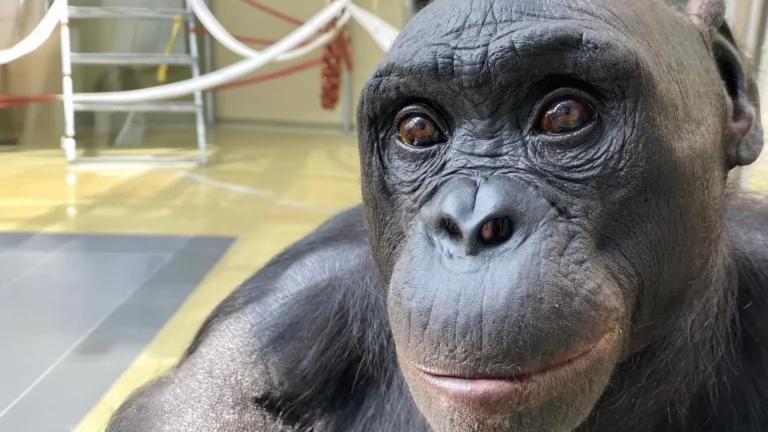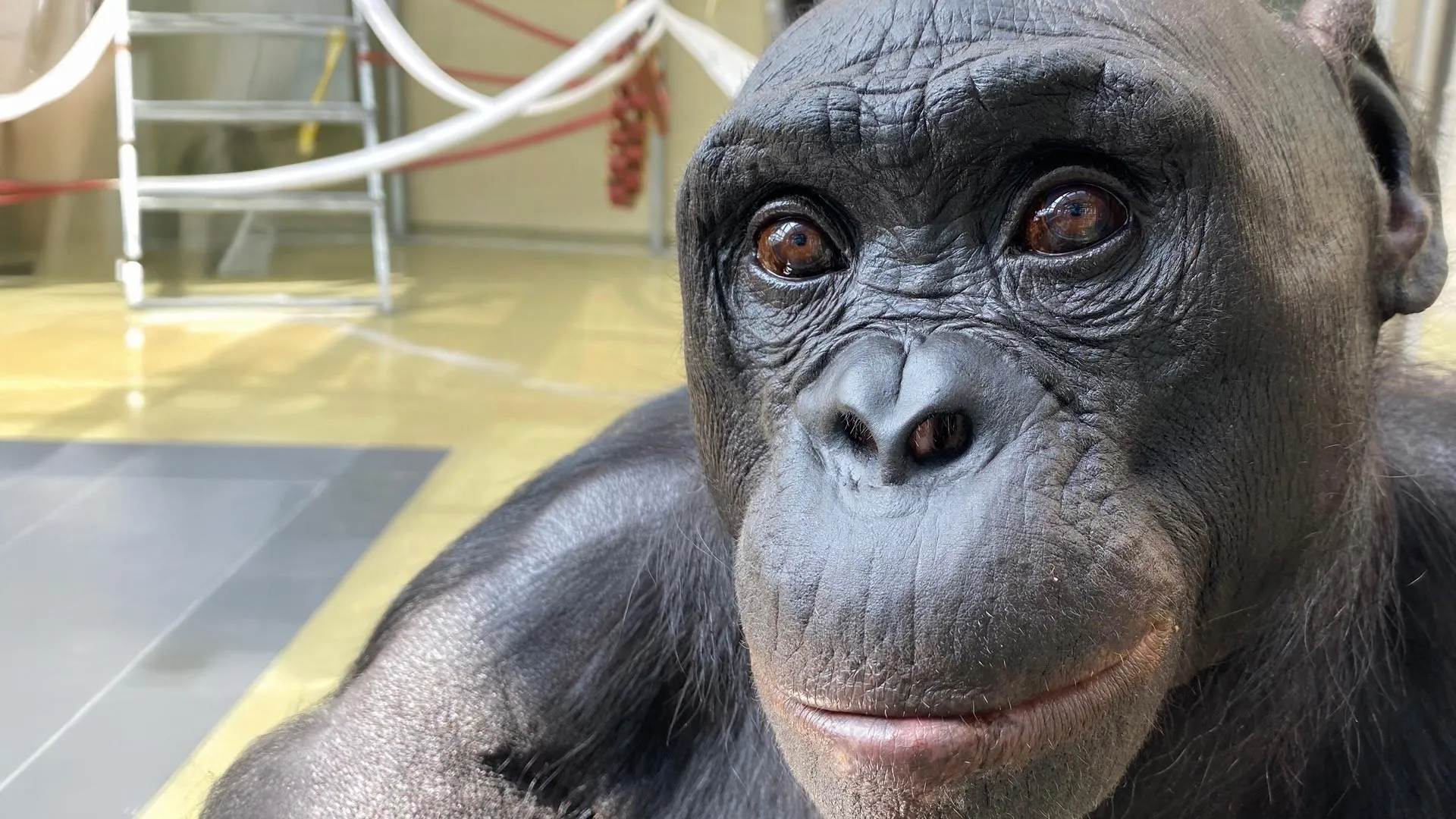
A groundbreaking study involving a bonobo named Kanzi has unveiled compelling evidence suggesting that advanced imaginative capacities, once thought to be exclusively human, may be present in other primate species. Conducted by researchers at Johns Hopkins University, the meticulously designed experiments provide the first empirical demonstration of an ape engaging in pretend play and understanding the concept of imaginary objects. This research challenges long-held assumptions about the exclusivity of such cognitive abilities to Homo sapiens and indicates a potentially broader spectrum of flexible thinking within the animal kingdom than previously acknowledged.
The investigation unfolded across a series of three distinct experimental phases, each meticulously crafted to mirror the playful scenarios often observed in human children’s developmental stages. Kanzi, a 43-year-old bonobo residing at the Great Ape Trust in Des Moines, Iowa, served as the sole participant. His previous documented instances of exhibiting behaviors suggestive of symbolic representation and his demonstrated ability to comprehend and respond to complex spoken language through a lexigram system made him an ideal candidate for this pioneering research. The researchers hypothesized that if imaginative thought possessed deep evolutionary roots, then an enculturated ape, exposed to human-like interaction and communication, might exhibit similar cognitive mechanisms.
Central to the experimental design was the concept of "pretend play," a hallmark of human childhood development, typically emerging around the age of two. This involves mentally representing objects or scenarios that are not physically present, such as pretending a stick is a spoon or a block is a car. While anecdotal observations of such behaviors in non-human primates have been noted for decades – including young chimpanzees seen cradling sticks as if they were infants or captive apes appearing to move invisible blocks – these instances lacked the rigor of controlled scientific inquiry. The Johns Hopkins study aimed to bridge this gap, providing a systematic framework to assess the presence and nature of imaginative thought in apes.
The experimental setup involved Kanzi interacting across a table with an experimenter, with the environment furnished to evoke the semblance of a convivial social gathering. In the initial phase, a pitcher and two transparent cups were placed on the table, all empty. The experimenter would then engage in a pantomime of pouring imaginary juice into the cups. Following this, the experimenter would dramatically empty one of the cups, shake it to emphasize its supposed emptiness, and then pose the question, "Where’s the juice?" The consistent and statistically significant finding was that Kanzi would reliably indicate the cup that had been presented as containing the pretend liquid. This outcome suggested an ability to mentally track the presence of an object that was not physically there.
To rigorously exclude the possibility that Kanzi was responding to subtle cues or simply associating the action with any cup, a crucial control experiment was implemented. In this second phase, one cup was filled with actual juice, while the other contained only air, serving as the "pretend" cup. When presented with the same question, Kanzi’s preference shifted decisively towards the cup containing the real juice. This demonstrated that he could differentiate between the imaginary and the tangible, a critical distinction for understanding genuine pretend play rather than a misinterpretation of the experimenter’s actions. This phase underscored that Kanzi was not simply mimicking or responding to a generalized request, but was actively distinguishing between the represented and the actual.
A third experimental variation extended the investigation to a different type of object: grapes. The experimenter would mime picking and consuming an imaginary grape from an empty container, then proceed to place this intangible fruit into one of two jars. Subsequently, after pretending to empty one of the jars, the question "Where’s the grape?" was posed. Again, Kanzi’s responses indicated he could track and identify the jar that was supposed to contain the pretend grape. While his accuracy was not absolute in every instance, the overall reliability of his responses strongly supported the hypothesis that he possessed the cognitive capacity to mentally represent and track non-existent items.
The implications of these findings are profound and far-reaching, potentially necessitating a recalibration of our understanding of primate cognition and the evolutionary trajectory of imagination. Co-author Christopher Krupenye, an assistant professor in Psychological and Brain Sciences at Johns Hopkins, highlighted the transformative nature of these results, stating that the ability to conceive of things beyond immediate sensory experience fundamentally expands our perception of animal mental lives. He emphasized that imagination has long been a cornerstone of defining human uniqueness, and its potential presence in other species prompts a critical re-evaluation of what truly sets humans apart and the richness of cognitive experiences among non-human creatures.
This research echoes the paradigm shifts brought about by earlier discoveries, such as Jane Goodall’s observations of chimpanzees crafting tools. Such findings compelled scientists to reconsider the definition of human intelligence and cognitive exclusivity. Similarly, the evidence for Kanzi’s imaginative capabilities invites a deeper contemplation of the mental landscapes inhabited by other species, challenging anthropocentric views that confine complex thought processes solely to humans.
Amalia Bastos, a co-author and former postdoctoral fellow at Johns Hopkins, who is now a lecturer at the University of St. Andrews in Scotland, articulated the excitement surrounding the data, noting that apes, in their minds, can conceptualize entities that are not physically present. She further elaborated that Kanzi demonstrates the capacity to generate a mental representation of a pretend object while simultaneously maintaining an awareness that it is not real. This dual awareness—the creation of a mental model and the understanding of its hypothetical status—is a sophisticated cognitive feat.
The study, published in the prestigious scientific journal Science, opens avenues for extensive future research. The researchers express keen interest in exploring whether similar imaginative abilities are present in other ape species or even in a wider array of animal taxa. Beyond the direct investigation of pretend play, the team aims to delve into related cognitive functions, such as the capacity for future planning and the understanding of others’ mental states, often referred to as theory of mind. These interconnected abilities are deeply intertwined with imaginative thought and contribute to a richer, more complex cognitive architecture.
Krupenye underscored the broader ethical and philosophical implications of the findings. He argued that imagination is a key component of the rich mental lives humans experience, and if foundational elements of this capacity are shared with apes, it should prompt a critical re-examination of the assumption that other animals lead purely instinct-driven, present-focused existences. The discovery, he suggests, should foster a greater sense of responsibility and a commitment to protecting and preserving these creatures, recognizing the profound depth and beauty of their cognitive worlds. The study therefore not only advances scientific understanding but also carries significant weight for conservation efforts and our ethical obligations towards other intelligent life on Earth.
About the Author