In a series of meticulously designed observational studies, a groundbreaking investigation at Johns Hopkins University has provided compelling evidence that a bonobo, a great ape species, possesses the capacity for imaginative thought and engagement in symbolic play, activities previously considered exclusive to humans. This research challenges long-held assumptions about the cognitive architecture of non-human animals and suggests a more nuanced understanding of their mental lives, potentially extending back millions of years in evolutionary history. The findings, detailed in a recent publication in the prestigious journal Science, indicate that the ability to conceptualize absent objects and engage in make-believe scenarios is not solely a hallmark of human intellect.
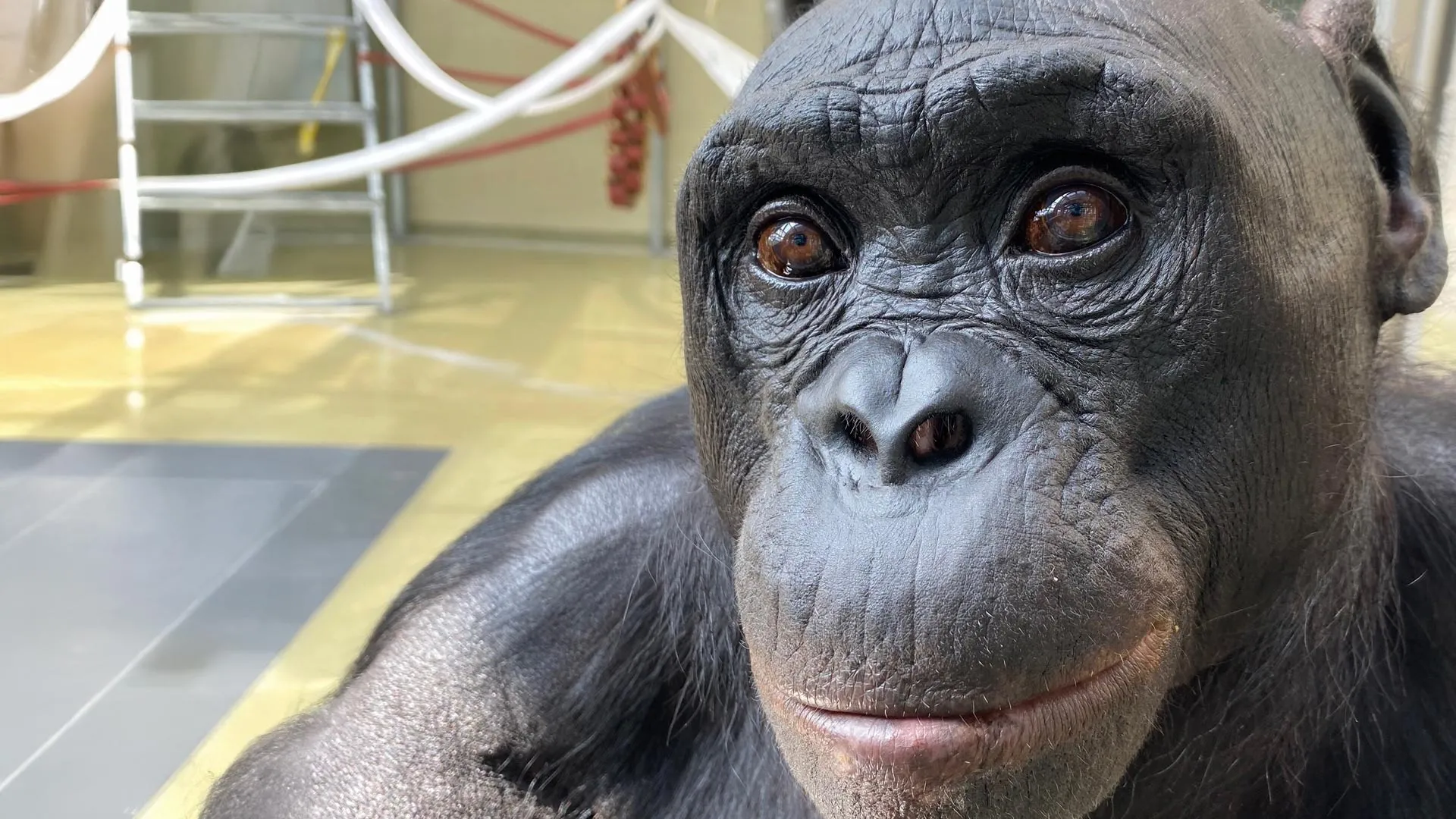
The experimental design centered around replicating scenarios familiar to human toddlers, specifically the act of a pretend tea party, to assess the bonobo’s comprehension of symbolic representation. Through three distinct phases, the bonobo, identified as Kanzi, a 43-year-old individual residing at Ape Initiative known for his advanced linguistic comprehension and reported instances of rudimentary symbolic behavior, interacted with non-existent beverages and fruits in a consistent and statistically significant manner. These experiments were crafted to move beyond mere observation of spontaneous behavior, aiming to create controlled conditions that could isolate and measure specific cognitive abilities related to imagination. The outcomes of these trials suggest a flexible cognitive capacity in Kanzi that transcends immediate sensory input, allowing him to mentally represent and manipulate concepts of objects that are not physically present.
Traditional scientific perspectives have often bifurcated the animal kingdom from humans based on complex cognitive functions, with imagination and abstract thought frequently cited as key differentiators. However, this new research posits that such distinctions may be less absolute than previously assumed. The researchers hypothesize that the cognitive mechanisms enabling pretend play in Kanzi could be rooted in a shared ancestry with humans, potentially dating back six to nine million years to the common ancestor of all great apes. This deep evolutionary connection implies that the foundational elements of imagination may have been present in our distant predecessors, offering a glimpse into the ancestral cognitive landscape.
Dr. Christopher Krupenye, a co-author of the study and an assistant professor in Psychological and Brain Sciences at Johns Hopkins, emphasized the transformative nature of these findings, stating that the ability to mentally operate beyond the immediate present is a significant revelation. He elaborated that while imagination has been a cornerstone in defining human uniqueness, its potential presence in other species necessitates a re-evaluation of what makes us distinct and what forms of mental richness exist within the broader animal kingdom. This sentiment echoes historical shifts in scientific understanding, such as Jane Goodall’s seminal work on tool use in chimpanzees, which profoundly altered perceptions of animal intelligence and challenged anthropocentric definitions of human exceptionalism.
The development of pretend play in human children provides a valuable comparative framework for understanding Kanzi’s abilities. Typically, human youngsters begin to engage in symbolic play, such as simulating tea parties or nurturing dolls, around the age of two. Even earlier, infants as young as 15 months exhibit rudimentary comprehension of make-believe, demonstrating surprise when an adult pretends to drink from an empty cup. Despite these well-documented developmental milestones in humans, controlled scientific investigations into whether non-human animals could similarly grasp or track pretend situations had remained largely absent. While anecdotal accounts from both wild and captive environments have hinted at such capacities – including young chimpanzees observed carrying sticks as if they were infants, or captive chimpanzees dragging imaginary blocks – these lacked the rigor of systematic experimental validation.
To bridge this research gap, Krupenye and Dr. Amalia Bastos, a former postdoctoral fellow at Johns Hopkins and now a lecturer at the University of St. Andrews, embarked on the ambitious task of creating a controlled test for ape imagination. Their experimental setup mirrored the familiar context of a children’s tea party, with Kanzi positioned across a table from an experimenter. The table was adorned with empty vessels, such as cups, pitchers, bowls, and jars, arranged to evoke a sense of playful social activity. This environment was deliberately chosen to be conducive to Kanzi’s participation and to facilitate the manipulation of symbolic objects.
The core of the experimental protocol involved tracking Kanzi’s responses to scenarios where objects were presented as real and then as pretend. In the initial experiment, two empty transparent cups and an empty transparent pitcher were placed on the table. The experimenter then performed the action of pretending to pour juice into both cups. Following this, the experimenter enacted the motion of emptying one cup, shaking it to visually signify its emptiness, and then posed the question, "Where’s the juice?" The results were remarkably consistent: Kanzi predominantly indicated the cup that was intended to still contain the imaginary juice, even when the cups were repositioned on the table. This suggested that he was not merely responding to the physical presence of the cups but to the conceptual state of the juice within them.
To meticulously rule out the possibility that Kanzi perceived the pretend juice as somehow physically present or hidden within the cup, a second, more controlled experiment was conducted. In this variation, one cup contained actual, observable juice, while the other contained only the pretend liquid. When Kanzi was presented with the choice and asked what he desired, his preference overwhelmingly leaned towards the cup with the real juice. This critical differentiation demonstrated that Kanzi could distinguish between tangible and symbolic representations of the same object, indicating a sophisticated level of cognitive discrimination. He did not simply default to any cup that had been involved in the pretend pouring action but could identify the real substance when given the option.
A third experiment extended this principle to a solid object, employing grapes as the symbolic item. The experimenter would pretend to take a grape from an empty container, then place it into one of two jars. After miming the emptying of one jar, the question, "Where’s the grape?" was posed. Again, Kanzi reliably indicated the jar that was meant to contain the pretend grape. While Kanzi’s accuracy was not absolute in every instance, his performance across these varied scenarios demonstrated a statistically significant ability to track and identify these imaginary objects. The consistency of his responses under controlled conditions provided robust evidence for his engagement with symbolic representation.
Dr. Bastos remarked on the profound implications of these findings, noting the striking ability of apes to conceive of entities that are not physically present. She explained that Kanzi’s capacity to generate a mental concept of a pretend object while simultaneously understanding that it is not real underscores a complex cognitive process. This ability to hold two divergent conceptual states – the imagined object and its non-existent reality – is a fundamental component of imaginative thought.
The researchers believe these discoveries pave the way for extensive future research into the cognitive abilities of other ape species and potentially a broader range of animals. Future investigations are expected to explore whether these capacities for pretend play and tracking imaginary objects are widespread or unique to Kanzi. Furthermore, the team aims to delve into related cognitive functions, such as foresight, planning for future events, and the understanding of others’ mental states, often referred to as theory of mind.
Dr. Krupenye concluded by highlighting the broader ethical and philosophical implications of this research. He posited that imagination is a crucial element in the richness of human mental experience, and if its roots are shared with apes, it compels a reconsideration of the assumption that other animals lead lives confined solely to immediate, instinctual responses. He urged that these findings should inspire greater empathy and a commitment to the welfare and continued existence of creatures possessing such complex and fascinating mental lives. The study’s publication in Science signifies its importance and contribution to the scientific community’s understanding of animal cognition and the evolution of intelligence.
About the Author