As individuals age, maintaining and building muscle mass becomes an increasingly vital component of overall health, functional independence, and quality of life. The conventional wisdom often suggests that significant muscular development is an endeavor best suited for younger demographics or requires extensive gym equipment and lengthy sessions. However, emerging perspectives in fitness science, supported by decades of practical experience from industry professionals, challenge this notion, particularly for those over the age of 55. A targeted, time-efficient bodyweight regimen, surprisingly, can prove more effective for this demographic than prolonged sessions involving external weights, offering a pathway to robust strength and vitality without the common barriers of traditional fitness environments.
The journey of aging often brings with it a phenomenon known as sarcopenia, a progressive and generalized loss of skeletal muscle mass and strength. This natural decline typically begins in a person’s 30s but accelerates significantly after the fifth decade, impacting everything from metabolic health and bone density to balance and the ability to perform daily activities. Tasks that were once effortless, such as climbing stairs, lifting groceries, or rising from a chair, can become challenging, leading to a diminished sense of independence and an increased risk of falls. Furthermore, reduced muscle mass contributes to a slower metabolism, making weight management more difficult, and can exacerbate conditions like type 2 diabetes.
While the physiological landscape changes with age, the capacity for muscle growth, or hypertrophy, does not disappear. It simply requires a more nuanced and patient approach. Seasoned fitness educators frequently observe a common misconception: that muscle building becomes impossible after 55. This belief often stems from a combination of factors, including hormonal shifts and practical challenges. Testosterone and growth hormone levels, which play crucial roles in muscle protein synthesis, naturally decrease with age. This means that while muscle can still be built, the rate of progress may be slower than in one’s 30s or 40s, demanding greater consistency and realistic expectations.
Beyond the hormonal considerations, recovery periods also tend to lengthen. What might have been a sufficient rest interval between intense workouts in youth may prove inadequate for an older adult. Over-training, rather than insufficient training, can often be the hidden culprit behind a lack of progress, as muscles require adequate time to repair and grow stronger. Moreover, pre-existing conditions like joint stiffness, arthritis, or old injuries frequently present physical limitations, making certain exercises or heavy lifting potentially painful or unsafe. The psychological barrier is equally significant; many older adults feel intimidated by the gym environment, perceiving heavy weights and complex machinery as dangerous or confusing, which can deter them from starting a fitness journey altogether.
This is precisely where a concise, bodyweight-focused program offers a compelling alternative. Instead of lengthy, high-impact sessions, a carefully curated 12-minute bodyweight routine can provide the necessary stimulus for muscle adaptation and growth. The key lies in understanding that muscular development is driven by intensity and progressive overload, not merely by the duration of a workout or the magnitude of external weight. Short bursts of focused effort can effectively signal muscles to grow stronger without inducing excessive fatigue or taxing the central nervous system, which recovers more slowly in older adults from very heavy loads.
The inherent nature of bodyweight exercises also confers significant advantages in terms of safety and joint health. When performing movements using only one’s own body weight, the joints are not subjected to the same degree of external loading that comes with barbells or dumbbells. This "self-limiting" aspect ensures that the stress placed on joints remains within a safer, more manageable range, making it ideal for individuals with joint concerns or those aiming to prevent injury. The focus shifts to control, stability, and proper movement patterns, which are paramount for long-term functional fitness.
Perhaps the most powerful benefit of a brief, home-based bodyweight routine is its unparalleled accessibility and convenience. Eliminating the need for a gym membership, specialized equipment, or travel time removes virtually every excuse for not exercising. This low barrier to entry significantly enhances the likelihood of consistency, which is arguably the single most important factor in achieving sustainable fitness results. A 12-minute workout that is performed regularly, even daily, far surpasses an hour-long gym session that is rarely completed. Muscles respond best to consistent, repeated stimuli, gradually adapting and strengthening over time.
The proposed routine strategically targets major muscle groups through six foundational bodyweight exercises, each performed for two minutes. This structure allows for a full-body workout that alternates between upper body, lower body, and core, facilitating a degree of active recovery for different muscle groups within the session.
-
Wall Press-Ups (2 minutes): This exercise primarily engages the chest, shoulders, and triceps. Its advantage lies in the adjustable intensity; by simply moving your feet further from the wall, the resistance increases, allowing for gradual progression. It builds crucial upper body pushing strength without placing undue strain on wrists or shoulders, making it an excellent alternative to traditional push-ups.
- How to Do It: Stand facing a wall, about arm’s length away. Place hands slightly wider than shoulder-width on the wall at chest height. Lean towards the wall, bending elbows until your chest nearly touches the wall, keeping your body in a straight line from head to heels. Push back to the starting position.
- Common Mistakes: Letting hips sag or pike up; flaring elbows out excessively; losing control on the way down.
-
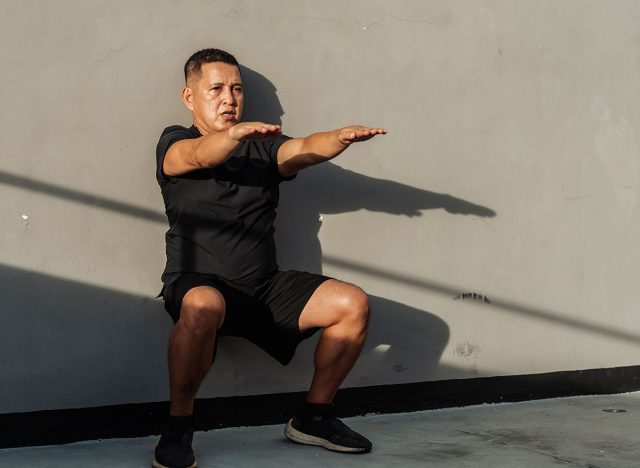
Chair Squats (2 minutes): Targeting the quadriceps, glutes, and hamstrings, chair squats are fundamental for lower body strength. The chair acts as a depth guide and a safety net, enabling individuals to focus on proper form and build confidence in the squatting movement. Strong leg muscles are critical for mobility, balance, and the ability to stand from a seated position. This exercise also elicits a significant hormonal response, beneficial for overall muscle development.
- How to Do It: Stand in front of a sturdy chair with feet shoulder-width apart. Slowly lower your hips back and down as if to sit on the chair, maintaining a straight back and engaged core. Lightly tap the chair with your glutes, then push through your heels to return to a standing position.
- Common Mistakes: Leaning too far forward; letting knees collapse inward; not using the full range of motion.
-
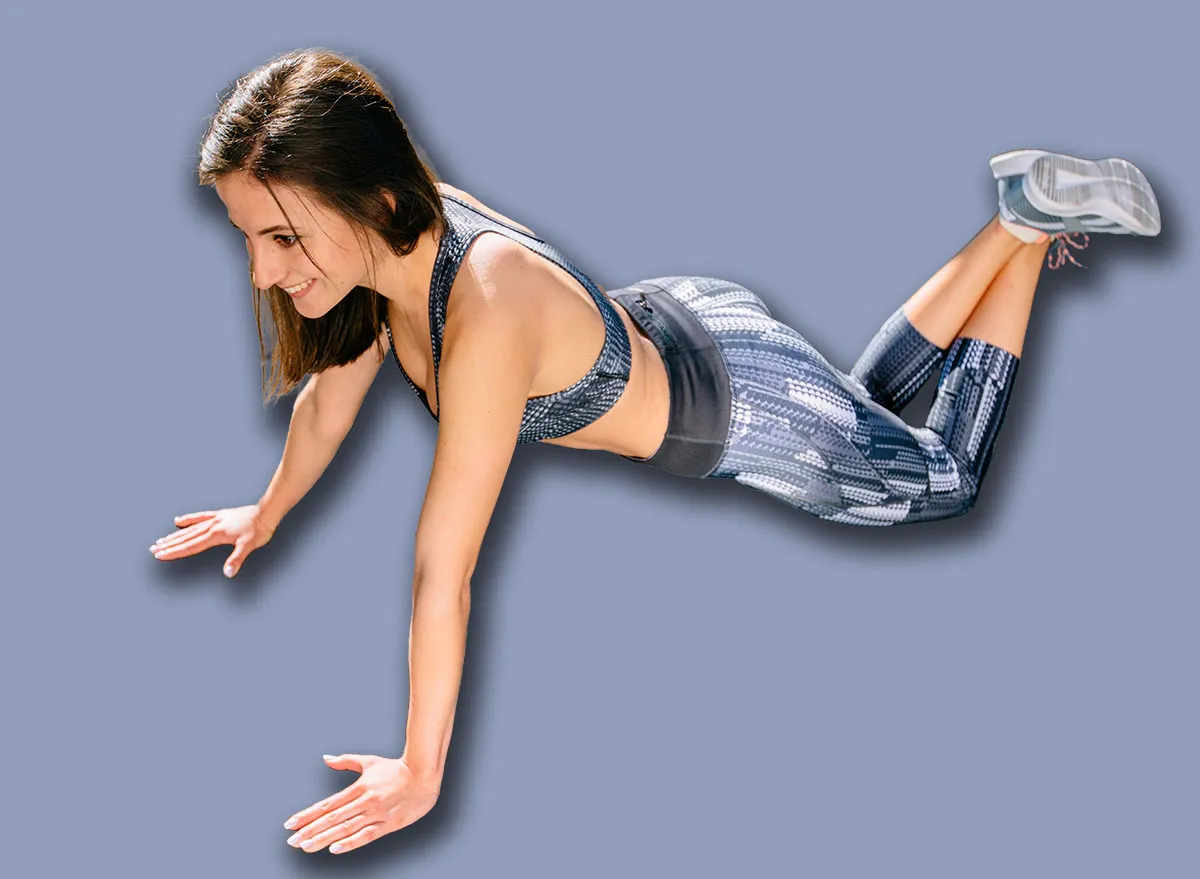
Modified Plank Hold (2 minutes total, broken into intervals): A robust core is essential for posture, spinal stability, and preventing back pain. The modified plank, performed on the knees, effectively strengthens the transverse abdominis, rectus abdominis, and spinal stabilizers without the intense shoulder strain that a full plank might impose on beginners or those with shoulder issues.

- How to Do It: Begin on your hands and knees. Walk your hands forward until your shoulders are directly over your elbows, forearms flat on the ground. Extend your legs back, resting on your knees, maintaining a straight line from head to knees. Engage your core, pulling your belly button towards your spine. Hold this position.
- Common Mistakes: Arching or rounding the lower back; letting hips sag; shrugging shoulders towards ears.
-
Standing Knee Raises (2 minutes): This exercise specifically targets the hip flexors and core, while also significantly improving balance and proprioception—qualities that tend to decline with age. Strong hip flexors are crucial for everyday movements like walking, climbing stairs, and getting in and out of vehicles.
- How to Do It: Stand tall, holding onto a wall or sturdy chair for balance if needed. Slowly lift one knee towards your chest, engaging your core. Hold briefly at the top, then slowly lower the leg. Alternate legs.
- Common Mistakes: Leaning back excessively; using momentum instead of muscle control; not maintaining an upright posture.
-
Wall Sits (2 minutes total, broken into intervals): Wall sits are an isometric exercise that builds immense strength and endurance in the quadriceps, glutes, and hamstrings without any joint impact. The sustained muscular contraction is highly effective for enhancing leg stability, particularly around the knees, and improving overall lower body resilience.
- How to Do It: Stand with your back flat against a wall. Slide down the wall until your knees are bent at approximately a 90-degree angle, as if sitting in an invisible chair. Ensure your thighs are parallel to the floor and your feet are flat. Hold this position.
- Common Mistakes: Not maintaining a 90-degree bend in the knees; pushing off the wall with hands; arching the lower back.
-
Standing Calf Raises (2 minutes): Calf muscles, the gastrocnemius and soleus, often weaken with age, impacting balance, gait, and circulation. Strong calves are vital for pushing off the ground during walking and aiding venous return from the legs to the heart. This exercise directly translates to improved functional mobility.
- How to Do It: Stand tall with feet hip-width apart, holding onto a support for balance if necessary. Slowly raise up onto the balls of your feet, lifting your heels as high as possible. Hold for a moment at the peak contraction, then slowly lower your heels back down.
- Common Mistakes: Rushing the movement; not achieving full range of motion; bouncing at the bottom.
To maximize the benefits of this 12-minute regimen, adhere to a specific structure. Perform each exercise for its allocated two minutes with minimal rest between movements. The objective is to maintain continuous activity for the entire duration, creating an efficient and potent muscular stimulus. For isometric holds like the modified plank and wall sit, breaking the two minutes into shorter, manageable intervals (e.g., four 30-second holds with 10 seconds of rest) is highly effective and more realistic for many individuals. It’s crucial to begin each exercise at a sustainable pace, prioritizing impeccable form over speed or maximum repetitions, especially in the initial stages. The alternating sequence of upper body, lower body, and core exercises is intentional, allowing for a slight recovery of specific muscle groups while others are actively working. Utilizing a simple timer or stopwatch is highly recommended to maintain focus and ensure adherence to the prescribed intervals.
Consistency is the cornerstone of any successful fitness program, particularly for muscle building after 55. Aim to complete this routine five times a week, allowing for two dedicated rest days. This frequency provides ample opportunity for muscle stimulation and sufficient recovery for repair and growth. For those completely new to exercise, a gradual introduction is advisable: start with three sessions per week for the first two weeks, then incrementally add more sessions as your body adapts. Listen intently to your body; while some muscle soreness is normal, intense or debilitating pain warrants an extra rest day. Remember, muscles grow during recovery, not solely during the workout. Light activities like walking, gentle stretching, or swimming are excellent options for active recovery on non-training days.
After approximately six weeks, your body will have adapted to the initial demands of this routine. At this juncture, instead of extending the workout duration, focus on progressive overload by increasing the difficulty of each exercise. This can be achieved by: increasing the distance of your feet from the wall for press-ups, lowering the chair height or trying single-leg variations for squats, extending the hold time for planks and wall sits, increasing the height or control for knee raises, or even performing calf raises on a slightly elevated surface to increase range of motion. The goal is to continuously challenge your muscles in new ways to stimulate ongoing growth.
The transformative results from consistent adherence to this program can manifest in both tangible physical changes and profound improvements in overall well-being. Within the first two to four weeks, individuals typically report a noticeable ease in performing daily tasks. Simple actions like standing up, carrying groceries, or walking up a flight of stairs feel less effortful. These initial functional improvements are often the most motivating indicators of progress, preceding visible aesthetic changes.
By the four-week mark, muscles will begin to feel firmer to the touch, indicating increased density, even if significant size increases aren’t yet apparent. Improved posture is another common early benefit, often noticeable to others, as a stronger core helps align the spine more effectively. As weeks progress towards six and eight, more visible changes emerge: increased definition in arms and legs, a flatter midsection due to strengthened core muscles, and an overall sense of feeling more "toned." This isn’t about achieving a bodybuilder physique but rather developing realistic, functional strength that enhances daily movement and confidence, reflected in how clothes fit and how one carries themselves.
Beyond the physical, the mental and emotional benefits are equally impactful. Enhanced self-confidence, improved sleep quality, and sustained energy levels throughout the day are frequently reported side effects. These holistic improvements often become the primary drivers for long-term adherence, transforming exercise from a chore into an indispensable part of a vibrant lifestyle. It is crucial to maintain a realistic perspective on the timeline for muscle development after 55; progress is steady but gradual. Prioritizing consistent effort over weeks and months, rather than seeking immediate perfection, will yield the most enduring and life-enhancing outcomes. This accessible, efficient bodyweight routine empowers older adults to reclaim and build strength, fostering greater independence and a higher quality of life for years to come.
About the Author