
The United States Department of Health and Human Services (HHS) has unveiled a monumental revision to the nation’s dietary guidance, signaling what officials describe as the most profound transformation in federal nutrition policy in decades. This comprehensive update introduces an innovative "inverted food pyramid" model, moving away from the familiar MyPlate system, to champion an eating approach centered on unprocessed, nutrient-dense ingredients. The core philosophy underpinning these new recommendations is a decisive pivot towards real, foundational foods, with a particular emphasis on high-quality proteins, healthy fats, diverse fruits, vegetables, and dairy products, positioning them at the broadest section of the reconfigured pyramid. Conversely, whole grains, while still recognized for their benefits, occupy a proportionally smaller, foundational space at the pyramid’s base, reflecting a strategic re-evaluation of their role in the daily diet.
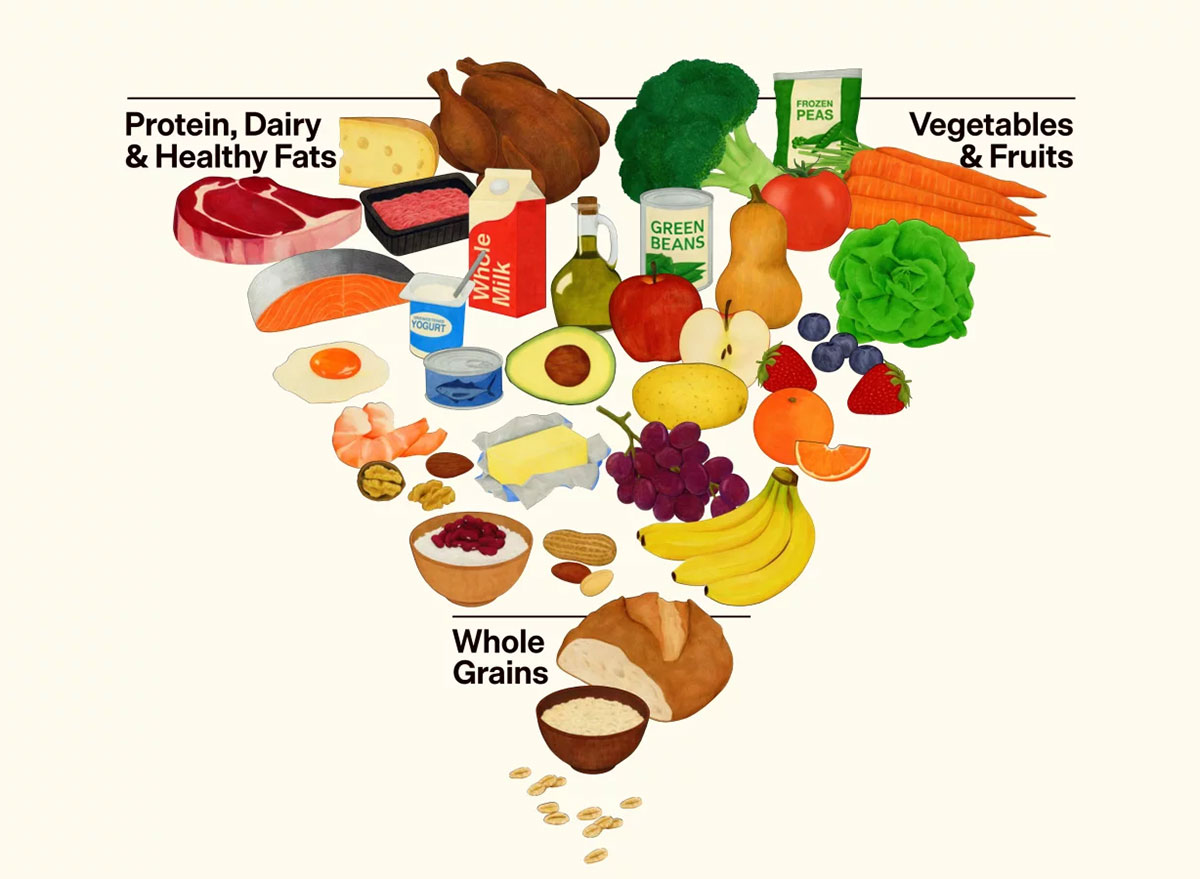
This paradigm shift represents a significant departure from previous nutritional advice, which often emphasized carbohydrate-rich foods as the primary caloric source. According to Secretary Robert F. Kennedy, Jr., these guidelines are designed to steer American households back to fundamental dietary principles. "Our nation’s citizens must prioritize genuine, nutrient-rich provisions—including protein, dairy, produce, healthy lipids, and unrefined grains—while substantially curtailing the consumption of heavily processed items," he stated, highlighting the urgency of this dietary redirection. The revised framework distinctly advocates for the inclusion of protein in every meal, a directive supported by contemporary scientific understanding that underscores protein’s critical role in satiety, muscle maintenance, and overall metabolic health. The guidelines explicitly articulate that where past dietary recommendations may have inadvertently marginalized protein in favor of carbohydrates, the current iteration is firmly rooted in "gold standard science," advocating for the consistent integration of high-quality, nutrient-dense protein sources across all daily eating occasions.
The history of U.S. dietary guidance illustrates a continuous evolution in response to scientific advancements and changing public health challenges. From the early Food Guide Pyramid of the 1990s, which placed grains at its expansive base, to the subsequent MyPlate initiative, these guidelines have consistently aimed to inform and improve the nutritional habits of Americans. However, critics often pointed to perceived complexities or an overemphasis on certain food groups that may have contributed to rising rates of obesity and chronic diseases. This latest "reset" is explicitly engineered to simplify and clarify, making the message of whole, unprocessed foods more accessible and actionable for the average consumer. The "inverted pyramid" visually communicates a re-prioritization: the wider top indicates larger recommended servings of foods like protein, dairy, fruits, vegetables, and healthy fats, signifying their crucial role in providing essential nutrients and promoting fullness. The narrower base, now occupied by whole grains, suggests they are still valuable but should be consumed in more measured quantities relative to the nutrient-dense components above.

This recalibration is also a direct response to the escalating public health crisis associated with the pervasive availability and consumption of ultra-processed foods. These items, often high in refined sugars, unhealthy fats, and sodium, and low in fiber and micronutrients, have been linked to a myriad of health issues, including weight gain, cardiovascular disease, and type 2 diabetes. By explicitly championing "real, whole foods," the HHS aims to empower individuals to make choices that support long-term health outcomes, moving away from diets dominated by convenience foods.
Among the cornerstone food categories now receiving heightened attention, protein-rich selections stand out prominently. The guidelines enumerate several key sources, ranging from various meats and seafood to dairy and plant-based options, each offering unique nutritional advantages crucial for a balanced diet.

Beef and Ground Beef:
Beef, whether in cuts or as ground meat, is positioned at the forefront of the new dietary recommendations due to its exceptional nutritional profile. It is not merely a robust source of complete protein, meaning it contains all nine essential amino acids necessary for human health, but also a powerhouse of vital micronutrients. A serving of beef delivers significant amounts of iron, crucial for oxygen transport in the blood; zinc, essential for immune function and cell growth; phosphorus, important for bone health; selenium, an antioxidant mineral; and a spectrum of B vitamins, including B12, which is vital for nerve function and red blood cell formation. The emphasis on beef underscores its role in providing foundational nutrition that supports energy levels, muscle repair, and overall vitality, explicitly countering earlier dietary narratives that may have unduly restricted its consumption.
Poultry:
Lean poultry, such as chicken and turkey, is consistently recommended as an excellent source of protein, aligning with health objectives focused on cardiovascular well-being. The Mayo Clinic highlights the importance of selecting lean protein options to promote heart health, stating, "Maintaining heart health doesn’t necessitate eliminating protein; instead, opt for lean varieties like chicken, fish, turkey, or tofu. These lean proteins are naturally low in saturated fat, which contributes to reducing cholesterol levels and preserving arterial integrity." Beyond its protein content, poultry provides niacin, vitamin B6, and phosphorus, making it a versatile and beneficial component of a nutrient-rich diet.

Fish:
Americans are strongly encouraged to incorporate more fatty fish into their diets, recognizing species like salmon, mackerel, and tuna as not only rich in protein but also abundant in other critical nutrients. These fish are particularly prized for their high concentration of omega-3 fatty acids, eicosapentaenoic acid (EPA) and docosahexaenoic acid (DHA), which are renowned for their profound heart-protective properties. As emphasized by the Mayo Clinic, "Fish such as salmon, mackerel, and tuna are celebrated for their cardioprotective benefits. These varieties are replete with omega-3 fatty acids, which effectively lower triglyceride levels, mitigate inflammation, and inhibit plaque accumulation within arteries." Regular consumption of these fatty fish supports brain health, vision, and anti-inflammatory processes throughout the body.
Shellfish:
Shellfish, encompassing a wide variety of aquatic invertebrates like shrimp, crab, oysters, and mussels, is another highly recommended protein source within the updated guidelines. Dr. Faye M. Dong, a professor and department head in Food Science and Human Nutrition at the University of Illinois in Urbana-Champaign, advocates for their increased consumption: "A diverse intake of shellfish should be promoted to foster a healthy diet. Shellfish are inherently low in fat, particularly saturated fat, contain beneficial omega-3 fatty acids, serve as outstanding protein sources, and are exceptionally rich in iron, zinc, copper, and vitamin B-12." These qualities make shellfish an invaluable addition to a balanced diet, providing a dense array of micronutrients with relatively low caloric impact.

Full-Fat Yogurt:
Unsweetened, full-fat yogurt has earned a strong recommendation as an outstanding protein source. This inclusion marks a notable shift from previous advice that often pushed for low-fat dairy options, reflecting a growing understanding of the benefits of natural fats and the detrimental effects of added sugars. Greek yogurt, in particular, is highlighted for its high protein content, which is instrumental in promoting satiety and aiding in weight management. As the UT Medical Center points out, "Greek yogurt offers substantial protein, which helps foster a feeling of fullness. A standard 6-ounce serving typically delivers 15 to 20 grams of protein, equivalent to the protein found in 2 to 3 ounces of lean meat. This makes it particularly attractive to vegetarians who sometimes find it challenging to consume adequate amounts of this nutrient." Beyond protein, full-fat yogurt also provides beneficial probiotics, calcium, and vitamin D, supporting gut health, bone density, and immune function.
Walnuts:
Among plant-based protein options, healthy nuts like walnuts are prominently featured in the new food recommendations. Walnuts stand out for their robust nutritional profile, offering approximately 4 grams of protein per ounce. Furthermore, they are a rich source of healthy fats, particularly alpha-linolenic acid (ALA), a plant-based omega-3 fatty acid. The Cleveland Clinic notes their micronutrient contributions: "An ounce of walnuts also supplies approximately 10% of the daily iron requirement and 14% of the magnesium adults need." These nuts contribute to heart health, brain function, and provide dietary fiber, making them an excellent snack or addition to meals for sustained energy and nutrient intake.

The implications of these revised U.S. Dietary Guidelines extend far beyond individual eating habits. They signify a deliberate effort to realign national food policy with evolving scientific consensus and public health priorities. Secretary Brooke Rollins underscored the broader vision, stating, "Finally, our food system is being reoriented to bolster American farmers, ranchers, and enterprises dedicated to cultivating and producing real food. Farmers and ranchers are pivotal to this solution, translating into more protein, dairy, produce, healthy fats, and whole grains gracing American dining tables." This policy aims to not only improve individual health but also to strengthen the agricultural sector focused on wholesome food production.
This comprehensive dietary overhaul invites a deeper national conversation about food choices, food systems, and public health. It challenges long-held beliefs about healthy eating and encourages a more mindful approach to food consumption, one that prioritizes nutrient density over caloric volume, and whole foods over their processed counterparts. While the transition may present challenges for consumers accustomed to convenience and for industries built around processed food production, the intent is clear: to foster a healthier America by returning to the fundamentals of nutrition, guided by contemporary scientific understanding. The success of this reset will ultimately depend on widespread education, accessibility to quality whole foods, and a collective commitment to embracing these foundational principles for improved well-being.
About the Author