As individuals progress beyond their mid-forties, the pursuit of strength training often shifts from purely aesthetic goals to a more holistic focus on functional capacity, injury prevention, and long-term health. While traditional weightlifting with external loads like dumbbells and barbells remains a valid approach, bodyweight training offers a profoundly effective and often superior pathway to developing integrated strength that directly translates to improved daily living and sustained vitality. This methodology, rooted in controlling one’s own mass through various planes of motion, fosters not just muscular power but also enhanced coordination, balance, and proprioception, qualities that become increasingly vital with age.
The human body is an intricate system designed for dynamic movement, not isolated muscle contractions. Everyday activities – from lifting groceries and navigating stairs to maintaining posture and preventing falls – demand that multiple muscle groups work in concert, stabilizing joints and generating force simultaneously. Bodyweight exercises inherently mimic these complex, real-world movements. Unlike exercises performed on fixed machines or with isolated free weights, which can sometimes neglect the synergistic engagement of stabilizer muscles, bodyweight regimens compel the entire kinetic chain to participate. This integrated demand ensures that strength gains are not merely theoretical but profoundly practical, building a resilient physique capable of adapting to diverse challenges.
One of the most compelling advantages of bodyweight training, particularly for the over-45 demographic, lies in its capacity to fortify joint health and integrity. With advancing age, joints can become more susceptible to wear and tear, and connective tissues may lose some elasticity. Bodyweight movements, by their nature, emphasize controlled motion through a full range of articulation, reinforcing the muscles, tendons, and ligaments surrounding critical joints like the knees, hips, and shoulders. This strengthens the support structures without imposing excessive, sudden external loads that could potentially lead to strain or injury. The focus on leveraging one’s own mass encourages a deeper connection to movement patterns, promoting optimal alignment and reducing detrimental compensatory actions.
Furthermore, the accessibility and inherent convenience of bodyweight training are unparalleled, fostering a consistency that is often the bedrock of lasting fitness success. The absence of a need for specialized equipment, gym memberships, or even dedicated space eliminates many common barriers to regular exercise. Whether at home, in a hotel room, or outdoors, an effective workout is always within reach. This ease of access promotes higher adherence rates, allowing individuals to train more frequently and with greater focus on technique. Over time, this sustained commitment to quality movement translates into significant, sustainable improvements in strength, mobility, and overall physical competence. The emphasis shifts from merely "lifting" to consciously "moving," cultivating a more mindful and effective approach to physical conditioning.
For individuals over 45, where recovery times might lengthen and the risk of injury might be a greater concern, bodyweight exercises provide a highly adaptable training modality. The intensity can be precisely scaled through variations, tempo adjustments, or modifying leverage, allowing for progressive overload without necessarily adding external weight. This ensures that the body is consistently challenged to adapt and grow stronger, yet always within its current capacity, minimizing undue stress on joints and connective tissues. It empowers individuals to take ownership of their physical development, making informed choices about how to safely and effectively advance their strength journey.
Here are seven foundational bodyweight movements, selected by certified strength and conditioning specialists, that exemplify these principles, offering profound benefits for building comprehensive strength and functional resilience well into the later decades of life.
1. Side Plank: Cultivating Core and Lateral Stability
The side plank is far more than an oblique exercise; it is a fundamental builder of lateral core stability, a critical component for protecting the spine and hips during dynamic movements and preventing falls. This isometric hold demands the synchronized activation of the core musculature, gluteal muscles (particularly the gluteus medius), and shoulder stabilizers, forcing them to function as a cohesive unit. This integrated demand yields strength that directly enhances walking gait, improves balance, and fortifies the body against rotational forces encountered in daily life and recreational activities. Regular practice can significantly improve postural alignment and eliminate "energy leaks" during compound exercises by providing a robust, stable foundation.
- Muscles Engaged: Obliques, transverse abdominis, gluteus medius, quadratus lumborum, and shoulder stabilizers.
- Why It’s Crucial for Over 45: Enhances spinal protection, improves balance to mitigate fall risk, strengthens the often-neglected lateral chain, and supports hip health.
- Execution Guide: Lie on your side with your forearm directly beneath your shoulder, elbow bent at 90 degrees. Stack your feet, or place the top foot slightly in front for increased stability. Engage your core and glutes, then lift your hips off the floor until your body forms a straight line from head to heels. Avoid sagging at the hips or rotating your torso.
- Programmatic Recommendations: Aim for 3 sets, holding each side for 20 to 40 seconds. Incorporate a 45-second rest period between sets.
- Progressive Variations: Side plank with hip abduction (lifting the top leg), side plank march (marching feet), side plank reach-through (twisting the torso), or elevating feet for greater challenge.
- Critical Form Cues: Drive your bottom elbow into the ground, actively push your hips towards the ceiling, and envision lengthening your spine to maintain a rigid, straight line from head to ankles.
2. Push-Ups: Foundational Upper Body and Full-Body Tension
The push-up is a quintessential exercise for developing pressing strength in the upper body while simultaneously requiring profound full-body tension and core stability. Each repetition necessitates active engagement of the core, glutes, and upper back to maintain a rigid, plank-like posture throughout the movement. This integrated tension not only enhances shoulder stability but also reinforces proper pressing mechanics, translating to safer and more effective movement patterns. The inherent scalability of push-ups, from incline variations to deficit push-ups, allows for continuous progressive overload without imposing excessive joint strain, making them ideal for sustained strength gains.
- Muscles Engaged: Pectorals (chest), deltoids (shoulders), triceps, core (rectus abdominis, obliques), and glutes.
- Why It’s Crucial for Over 45: Builds practical upper body strength for pushing tasks, enhances shoulder joint integrity, and improves core bracing capabilities.
- Execution Guide: Begin in a high plank position with hands slightly wider than shoulder-width apart, fingers pointing forward, and body forming a straight line from head to heels. Lower your chest towards the floor by bending your elbows, keeping them tucked slightly inward (about 45 degrees from the body). Push through your palms to return to the starting position, maintaining full-body tension.
- Programmatic Recommendations: Perform 3 to 4 sets of 8 to 15 repetitions, allowing for a 60-second rest interval between each set.
- Progressive Variations: Incline push-ups (easier), tempo push-ups (slower descent/ascent), deficit push-ups (increased range of motion), or single-arm push-ups (advanced).
- Critical Form Cues: Imagine pushing the entire floor away from your body as a single, solid unit, avoiding any sagging in the hips or arching in the lower back.
3. Lunges: Unilateral Strength, Balance, and Mobility
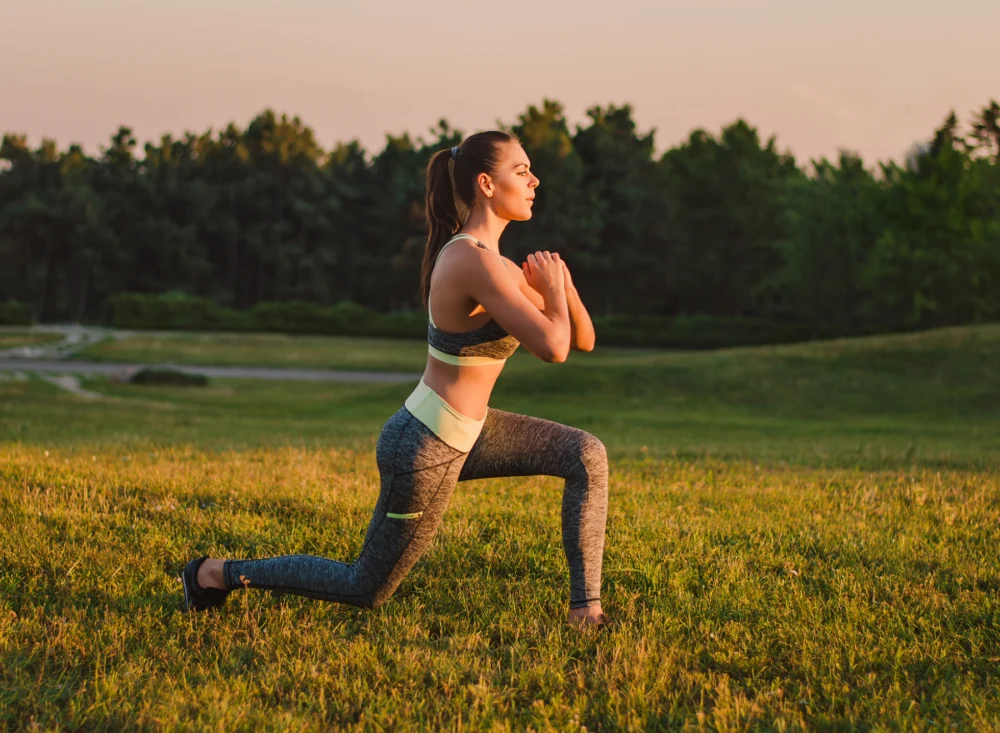
Lunges are invaluable for cultivating unilateral (single-leg) strength, balance, and coordination, all within one dynamic movement. Each lunge rep exposes and helps correct side-to-side muscular imbalances while dynamically engaging the hips and core for stabilization. This demand builds highly practical strength that directly improves everyday actions such as walking, climbing stairs, and participating in sports. Furthermore, lunges actively enhance hip mobility and strengthen the musculature surrounding the knees, contributing to their protection and long-term health.
- Muscles Engaged: Glutes, quadriceps, hamstrings, calves, and core.
- Why It’s Crucial for Over 45: Addresses strength imbalances between legs, improves balance to reduce fall risk, and enhances hip and knee joint health.
- Execution Guide: Stand tall with feet hip-width apart. Step forward with one leg, lowering your hips until both knees are bent at approximately a 90-degree angle. Ensure your front knee is directly above your ankle and your back knee hovers just above the floor. Push off your front foot to return to the starting position. Alternate legs with each repetition.
- Programmatic Recommendations: Complete 3 sets of 8 to 12 repetitions per leg, resting for 60 seconds between sets.
- Progressive Variations: Reverse lunges (often more knee-friendly), walking lunges, lateral lunges (for frontal plane movement), or jump lunges (plyometric).
- Critical Form Cues: Keep your torso upright and stable, and focus on the front knee tracking directly over your toes, preventing it from collapsing inward.
4. Squats: Comprehensive Lower Body Power and Mobility
The bodyweight squat is a fundamental movement pattern that trains the entire lower body to generate force through a full, functional range of motion. It places a significant emphasis on control, depth, and precise joint alignment. Executed correctly, squats build robust strength in the hips, knees, and ankles while simultaneously reinforcing efficient movement patterns. This dual benefit of improved strength and enhanced mobility is paramount for maintaining lower body resilience and independence as the body ages.
- Muscles Engaged: Glutes, quadriceps, hamstrings, calves, and core.
- Why It’s Crucial for Over 45: Strengthens major leg muscles, improves hip and ankle mobility, and reinforces natural movement patterns essential for daily life.
- Execution Guide: Stand with feet shoulder-width apart, toes pointed slightly outward. Initiate the movement by pushing your hips back as if sitting into a chair, while simultaneously bending your knees. Lower yourself as far as comfortably possible while maintaining a neutral spine, keeping your chest upright. Drive through your heels to return to the standing position, squeezing your glutes at the top.
- Programmatic Recommendations: Perform 3 to 4 sets of 12 to 20 repetitions, with a 60-second rest period between each set.
- Progressive Variations: Tempo squats (slowed eccentric/concentric phases), squat to a box (for depth control), pause squats (isometric hold at the bottom), or jump squats (plyometric).
- Critical Form Cues: Focus on sitting between your hips and driving your knees outward slightly, ensuring they don’t collapse inward, which protects the knee joint.
5. Renegade Row: Dynamic Core Stability and Upper Body Pulling
The renegade row represents a dynamic integration of core stability and upper body pulling strength. Performed from a plank position, this exercise challenges the body to resist rotation while one arm actively supports the body’s weight during a rowing motion. This potent anti-rotational demand profoundly strengthens the deep core musculature and enhances shoulder girdle stability. It simultaneously reinforces proper plank mechanics and builds significant strength in the back and arms, contributing to a balanced, resilient upper body.
- Muscles Engaged: Latissimus dorsi (lats), rhomboids and trapezius (upper back), deltoids (shoulders), biceps and triceps (arms), and a broad range of core stabilizers.
- Why It’s Crucial for Over 45: Improves anti-rotational core strength vital for spinal health, enhances pulling strength for everyday tasks, and boosts shoulder stability.
- Execution Guide: Assume a high plank position with hands gripping two stable dumbbells or sturdy objects on the floor (if using dumbbells, ensure they are hexagonal to prevent rolling). Keep your feet wider than shoulder-width for a more stable base. Engage your core tightly. While maintaining a level pelvis and resisting rotation, pull one dumbbell up towards your rib cage, squeezing your shoulder blade. Slowly lower the dumbbell back to the floor and repeat on the opposite side.
- Programmatic Recommendations: Execute 3 sets of 6 to 10 repetitions per side, resting for 60 seconds between sets.
- Progressive Variations: Knee-supported renegade rows (regressed), slow tempo rows, pause rows at the top of the pull, or elevating the non-rowing hand for increased challenge.
- Critical Form Cues: Maintain a perfectly level pelvis throughout the movement; any hip rotation indicates a loss of core engagement. Move with deliberate control rather than momentum.
6. Glute Bridge: Posterior Chain Power and Lumbar Support
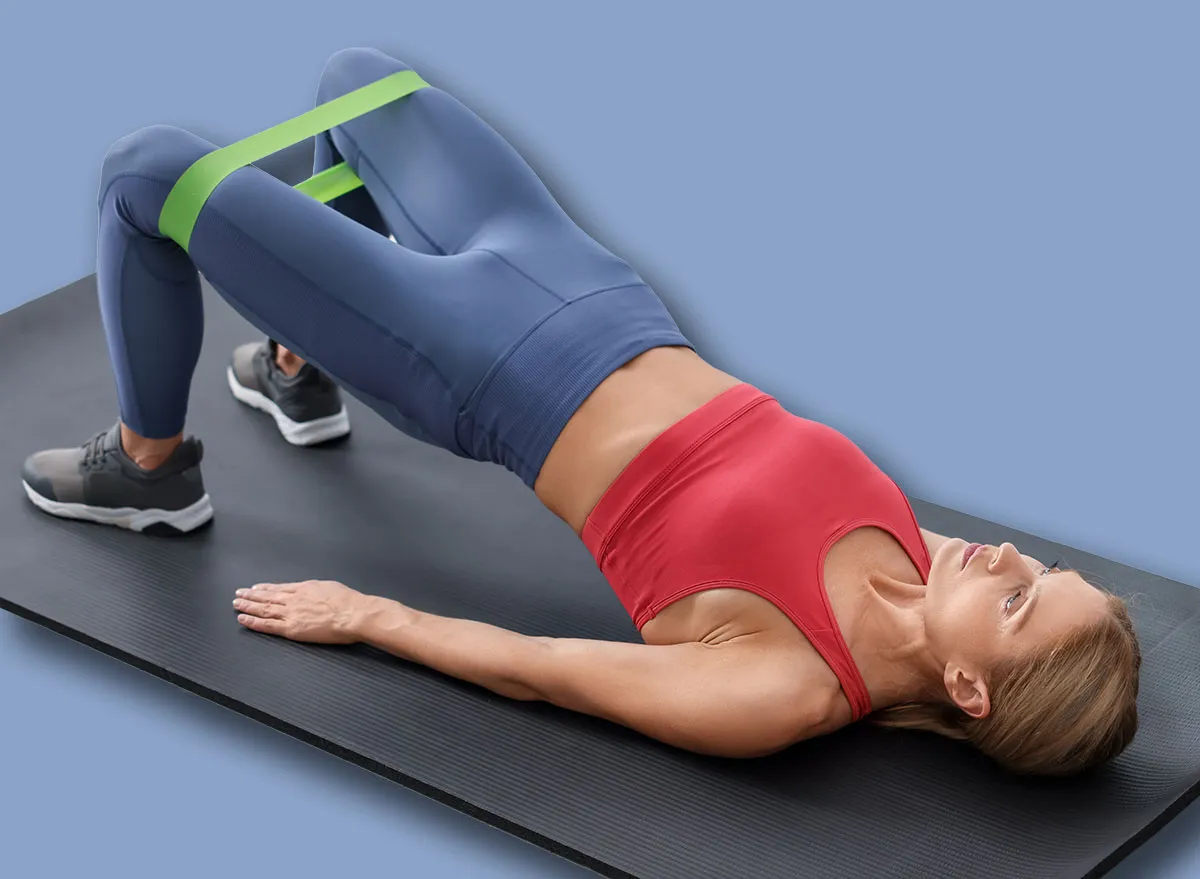
The glute bridge is a foundational exercise for strengthening the gluteal muscles and hamstrings, muscles that are critical for protecting the hips and lower back. Strong glutes are instrumental in improving posture, optimizing walking mechanics, and enhancing performance in various lifting and movement activities. This exercise also serves as an excellent countermeasure to the adverse effects of prolonged sitting by restoring and improving hip extension strength. Over time, enhanced gluteal function significantly reduces undue stress on both the lumbar spine and knee joints.
- Muscles Engaged: Gluteus maximus, hamstrings, core, and erector spinae (lower back).
- Why It’s Crucial for Over 45: Alleviates lower back pain, improves hip mobility, strengthens the posterior chain, and contributes to better posture.
- Execution Guide: Lie on your back with knees bent, feet flat on the floor about hip-width apart and a comfortable distance from your glutes. Arms can rest by your sides, palms down. Engage your glutes and press through your heels to lift your hips off the floor until your body forms a straight line from your shoulders to your knees. Squeeze your glutes forcefully at the top. Slowly lower your hips back to the starting position with control.
- Programmatic Recommendations: Aim for 3 to 4 sets of 12 to 20 repetitions, with a 45-second rest period between sets.
- Progressive Variations: Single-leg glute bridge (increased challenge), pause bridge (hold at the top), bridge march (marching feet while hips are elevated), or elevating feet for greater hip extension.
- Critical Form Cues: Focus on initiating the movement by squeezing your glutes, not by arching your lower back. Achieve full hip extension at the top of each repetition.
7. Reverse Crunch: Targeted Lower Abdominal Control and Spinal Flexion
The reverse crunch specifically targets the lower abdominal muscles, emphasizing controlled spinal flexion and pelvic tilt rather than momentum. This exercise teaches the core to initiate movement effectively from the pelvis, thereby improving neuromuscular control and coordination. Developing a stronger lower core provides crucial support for the lumbar spine and enhances overall trunk stability, which is vital for preventing back issues and improving functional movement patterns.
- Muscles Engaged: Rectus abdominis (especially lower fibers), obliques, and hip flexors.
- Why It’s Crucial for Over 45: Strengthens the often-weakened lower abdominal region, improves pelvic control, and supports lumbar spine health.
- Execution Guide: Lie on your back with your knees bent and feet flat on the floor, or with your knees bent at 90 degrees and shins parallel to the floor. Place your hands by your sides or lightly behind your head. Engage your lower abdominals to slowly lift your hips off the floor, drawing your knees towards your chest. Focus on a controlled lift, avoiding swinging. Slowly lower your hips back down to the starting position, maintaining tension in your core.
- Programmatic Recommendations: Complete 3 sets of 10 to 15 repetitions, resting for 45 seconds between sets.
- Progressive Variations: Bent-knee reverse crunch (easier), tempo reverse crunch (slowed phases), reverse crunch hold (isometric hold at the top), or extending legs further (harder).
- Critical Form Cues: Prioritize lifting your hips directly off the floor using your abdominal muscles, rather than relying on momentum from swinging your legs. Keep your lower back pressed into the floor as much as possible.
Key Principles for Sustained Strength Development Beyond 45
Achieving and maintaining robust strength after the age of 45 is fundamentally contingent upon intentional effort, unwavering consistency, and a relentless focus on the quality of movement. The body retains a remarkable capacity for adaptation and growth, particularly when training protocols are intelligently designed to align with its natural mechanics and recovery needs. Bodyweight training inherently supports this process by fostering strong, stable positions and controlled, deliberate motion.
To maximize the benefits of any strength regimen, especially as one ages, several overarching principles should guide your practice:
- Prioritize Consistency: Regularity is paramount. Short, consistent sessions often yield better long-term results than sporadic, intense workouts.
- Master Form Over Reps: Correct technique not only prevents injury but also ensures that the target muscles are effectively engaged, maximizing the efficiency of each repetition.
- Embrace Progressive Overload: To continue building strength, the body must be continually challenged. With bodyweight training, this can be achieved by increasing repetitions, extending time under tension (slower tempos), reducing rest periods, progressing to more challenging variations, or even incorporating single-limb movements.
- Listen to Your Body: Pay close attention to signals of fatigue, pain, or discomfort. Adequate recovery is crucial for muscle repair and growth. Don’t hesitate to modify or rest when needed.
- Fuel Your Progress: Support your training with a balanced diet rich in lean proteins, complex carbohydrates, and healthy fats. Hydration is also a critical, often overlooked, component of performance and recovery.
- Incorporate Warm-ups and Cool-downs: Begin each session with dynamic stretches and light cardio to prepare your body, and conclude with static stretches to improve flexibility and aid recovery.
By integrating these powerful bodyweight exercises and adhering to these foundational principles, individuals over 45 can embark on a transformative journey, cultivating a body that feels more capable, stable, and profoundly confident, supporting an active and independent lifestyle for many years to come.
About the Author