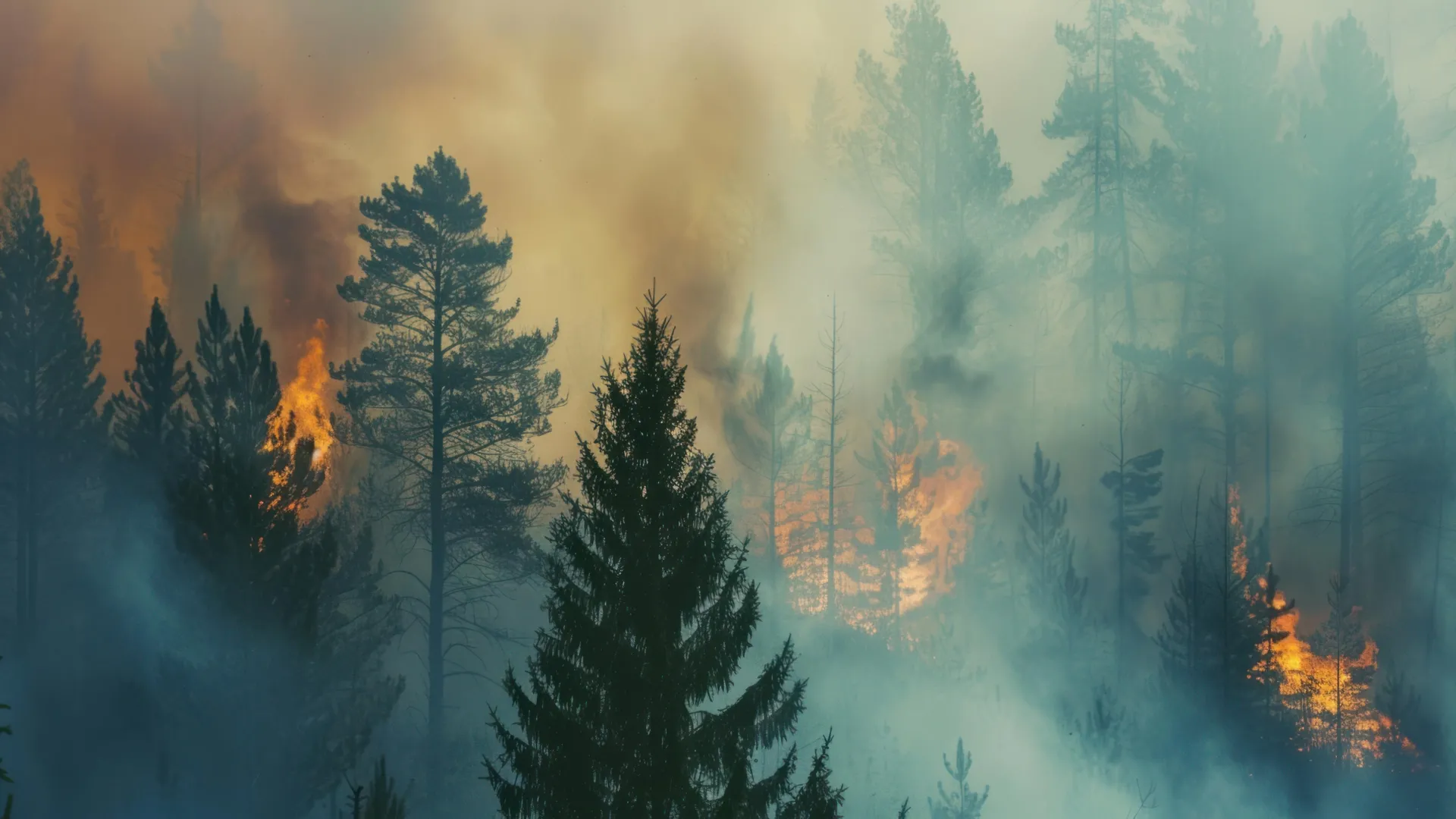
A groundbreaking scientific investigation has revealed that the atmospheric impact of wildfires, a phenomenon increasingly dominating global environmental discourse, has been substantially understated in previous estimations. Researchers have meticulously re-evaluated the gaseous and particulate matter released during the combustion of terrestrial biomass, including forests, grasslands, and peatlands, concluding that the scale of air pollution generated is considerably larger than previously quantified. This comprehensive analysis, published in the esteemed journal Environmental Science & Technology, suggests that both uncontrolled wildfires and carefully managed prescribed burns contribute a far greater volume of air-polluting gases to the atmosphere than earlier scientific inventories had accounted for. Furthermore, the study meticulously maps out geographical areas where the detrimental effects of fire-induced pollution converge with emissions stemming from human industrial and domestic activities, creating acute and complex air quality challenges in these critical regions.
Lyuyin Huang, the lead author of the study, articulated the magnitude of their findings, stating, "Our refined estimations indicate an increase of approximately 21% in the emission of organic compounds originating from wildland fires." This significant upward revision, according to Huang, provides a crucial bedrock for more sophisticated atmospheric modeling, enabling more accurate assessments of public health risks associated with air pollution and informing more effective policy decisions related to climate change mitigation and adaptation. The implications of this enhanced understanding are far-reaching, impacting everything from public health advisories to international environmental agreements.
Annually, immense tracts of natural landscapes succumb to the ravages of wildfires, dispersing an intricate cocktail of water vapor, ash, and a diverse array of carbon-based chemical compounds into the Earth’s atmosphere. Among these constituents are volatile organic compounds (VOCs), substances that readily exist in a gaseous state at ambient temperatures. However, a significant portion of the chemical output from fires comprises intermediate- and semi-volatile organic compounds (IVOCs and SVOCs, respectively). These compounds possess a lower volatility, meaning they transition into the gaseous phase only at elevated temperatures. Once released into the atmosphere, these less volatile chemicals exhibit a greater propensity to coalesce and form fine particulate matter, often referred to as PM2.5. This fine particulate matter, when inhaled, poses a more significant threat to respiratory and cardiovascular health than the more volatile VOCs, due to its ability to penetrate deeper into the lungs.
The Hidden Contributors: IVOCs and SVOCs in Smoke
Historically, the scientific community has faced considerable challenges in accurately quantifying the contribution of IVOCs and SVOCs to wildfire emissions. The sheer diversity of these compounds, coupled with their complex chemical structures, has made comprehensive measurement and categorization an arduous task. Consequently, many prior air quality assessments and emission inventories have predominantly focused on the more readily measurable VOCs, inadvertently overlooking or underestimating the impact of their less volatile counterparts. Recognizing this critical data gap, a research team, spearheaded by Shuxiao Wang, embarked on a mission to systematically incorporate IVOCs and SVOCs into their analysis, alongside VOCs, to achieve a more holistic understanding of the multifaceted ways in which wildland fires influence atmospheric composition, human well-being, and global climate patterns.
To achieve this ambitious goal, the research consortium meticulously compiled data from an extensive global database that tracks land burned by forest, grassland, and peatland fires spanning a period from 1997 to 2023. Concurrently, they gathered detailed information concerning the specific VOCs, IVOCs, SVOCs, and even more recalcitrant extremely low volatility organic compounds (ELVOCs) that are released during the combustion of various types of vegetation. In instances where direct, on-site field measurements were not feasible or available, the researchers ingeniously employed controlled laboratory experiments to meticulously estimate the chemical profiles of emissions. This multi-pronged approach, integrating extensive observational data with sophisticated experimental simulations, allowed for the calculation of annual global wildfire emissions with unprecedented detail and accuracy.
Global Emission Totals and Critical Pollution Convergence Zones
Employing their innovative methodology, the research team calculated that wildland fires globally released an average of 143 million metric tons of airborne organic compounds each year throughout the study period. This figure represents a substantial upward revision, approximately 21% higher, than previously accepted estimates. This finding underscores the significant and often underestimated role of wildfire emissions, particularly IVOCs and SVOCs, as contributors to the overall burden of air pollution affecting communities worldwide. The enhanced understanding of these emissions is vital for developing accurate air quality forecasts and implementing effective public health protective measures.
A critical facet of the study involved a comparative analysis of wildfire-generated emissions with established estimates of pollution originating from anthropogenic sources, such as industrial activities, transportation, and energy production. While the aggregate volume of airborne compounds released by human activities remained higher overall, the comparison revealed a striking parity in the quantities of IVOCs and SVOCs emitted by both wildfires and human endeavors. This finding is particularly significant, as these less volatile compounds are known to play a crucial role in the formation of secondary organic aerosols, a major component of fine particulate matter. The research also pinpointed several geographical "hotspots" where emissions from fires and human activities converge, creating particularly challenging air quality scenarios. These high-impact regions include Equatorial Asia, parts of Northern Hemisphere Africa, and Southeast Asia. The researchers emphasize that addressing the complex air pollution issues in these areas will necessitate the implementation of integrated strategies that target emission reductions from both natural fire events and ongoing human-related activities. The interconnectedness of these emission sources demands a holistic approach to environmental management and policy-making.
The research team gratefully acknowledges the financial support provided by various institutions that enabled this critical work. These include the National Natural Science Foundation of China, the National Key R&D Program of China, the Samsung Advanced Institute of Technology, and the Center of High Performance Computing at Tsinghua University. Their contributions have been instrumental in advancing our understanding of global atmospheric processes.
About the Author