Navigating the physiological shifts that accompany middle age often brings new challenges, particularly concerning body composition and core strength. Many individuals over 45 observe a noticeable recalibration in how their body stores fat, frequently manifesting as increased adipose tissue around the midsection—a phenomenon colloquially termed "love handles." This isn’t merely an aesthetic concern; it signals deeper changes in metabolic function, hormonal balance, and muscular efficiency. While conventional fitness advice might suggest an increase in abdominal crunches or prolonged cardiovascular sessions, these approaches often prove insufficient for addressing the root causes of midlife waistline changes. A more sophisticated understanding of core mechanics and age-specific physiological responses necessitates a targeted training methodology that emphasizes multi-planar stability, rotational power, and sustained muscle engagement through bodyweight exercises.
The human body undergoes several transformations as it progresses past its fourth decade. Hormonal fluctuations play a significant role; for women, declining estrogen levels during perimenopause and menopause can redistribute fat from the hips and thighs to the abdomen. Similarly, men experience a gradual decrease in testosterone, which can contribute to increased central adiposity and a reduction in lean muscle mass. Beyond hormonal influences, metabolic rate naturally decelerates with age, and a condition known as sarcopenia—the age-related loss of muscle mass and strength—further compounds the challenge. Reduced muscle tissue means a lower resting metabolic rate, making fat accumulation easier and fat loss more arduous. Furthermore, years of sedentary habits or reliance on limited movement patterns can lead to a decline in the activation of deep core stabilizers, diminishing the body’s natural capacity for robust rotational strength and lateral stability.
Traditional core exercises, such as sit-ups and standard crunches, predominantly target the rectus abdominis, the superficial muscle responsible for spinal flexion. While important for general abdominal strength, these movements largely neglect the intricate network of muscles that contribute to a truly functional and resilient core. The obliques (internal and external), transverse abdominis, multifidus, and quadratus lumborum are crucial for stabilizing the spine, preventing unwanted rotation, and supporting dynamic movement. After 45, the efficiency of these deeper stabilizing muscles often wanes, leading to compromised posture, increased susceptibility to back pain, and a less defined midsection. Therefore, an effective regimen must move beyond simple flexion and actively challenge the core to resist and produce movement across all three planes of motion: sagittal (forward/backward), frontal (side-to-side), and transverse (rotational).
This is where precisely engineered bodyweight training emerges as a highly effective solution. By leveraging the body’s own mass for resistance, these exercises inherently promote functional strength, enhance proprioception (the body’s awareness in space), and improve neuromuscular control. They demand continuous engagement of stabilizing muscles, often through isometric holds or controlled dynamic movements, thereby increasing "time under tension" – a critical factor for muscle adaptation and metabolic expenditure. Unlike exercises that rely on external weights or machines, bodyweight movements integrate seamlessly into daily life, fostering practical strength that translates directly into improved balance, agility, and injury prevention. The absence of heavy impact also makes them particularly joint-friendly, a significant advantage for individuals in middle age who may be experiencing increased joint sensitivity. A focused commitment to such a regimen, even for a relatively short period like 30 days, can initiate profound changes in core control, muscular tone, and overall midsection contour.
Here are five strategically selected bodyweight exercises designed to specifically target the multi-faceted demands of core strength and definition in individuals over 45:
1. Standing Cross-Body Knee Drive:
This dynamic exercise masterfully integrates both rotational power generation and anti-rotational stability within a single movement, a functional skill often diminished with age. As one knee drives diagonally across the body towards the opposite elbow, the core muscles, particularly the obliques, are forced into a complex dance of bracing and contracting. This creates a powerful shearing force across the sides of the waist, precisely targeting the areas where lateral abdominal fat tends to accumulate. Unlike many floor-based core exercises, the standing posture introduces an additional demand for balance and coordination, further enhancing neural recruitment and engaging deeper stabilizing muscles throughout the entire kinetic chain. Executing this movement with deliberate, controlled tempo is paramount; rushing through repetitions diminishes the critical time under tension and compromises the deep muscle activation required for optimal results. Consistent practice refines core control, improves posture, and visibly tightens the abdominal flanks.
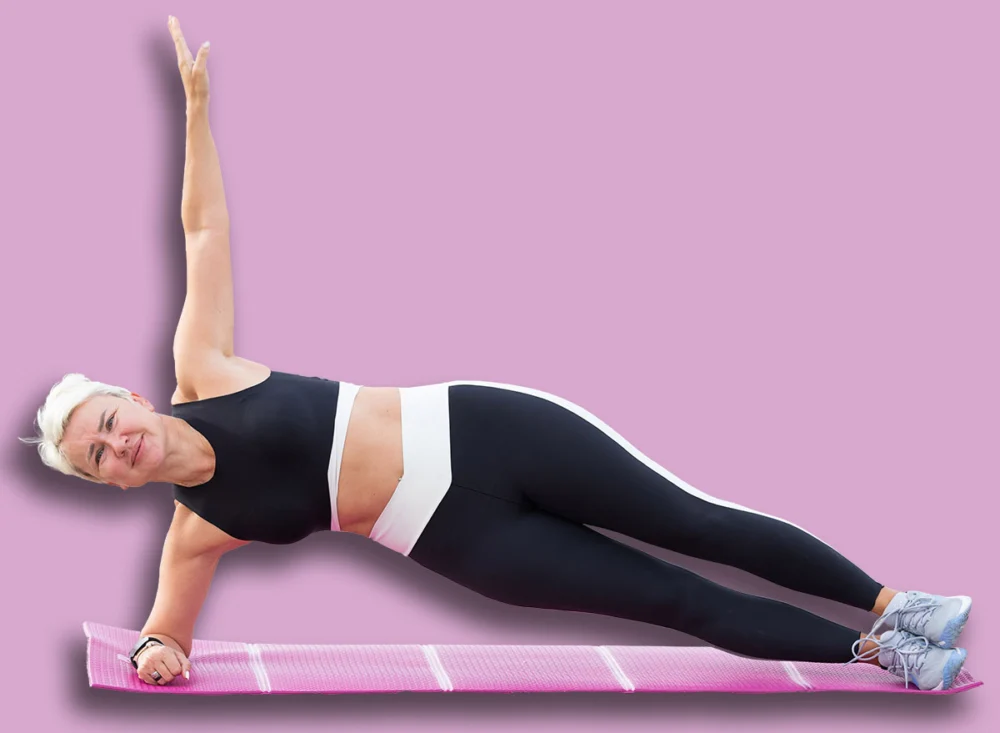
2. Side Plank Reach-Through:
The foundational side plank is an indispensable exercise for cultivating robust lateral core strength, an attribute crucial for spinal health and preventing unwanted side-bending. The "reach-through" variation elevates this fundamental movement by introducing a controlled rotational component under isometric load. From a stable side plank position, the upper arm reaches underneath the torso, creating a dynamic twist. This action compels the obliques and transverse abdominis to engage intensely, decelerating the rotational movement, stabilizing the spine against torsion, and then reversing the motion. This combination of isometric hold and controlled rotation sparks significant muscle engagement along the entire lateral aspect of the waist. Furthermore, maintaining the side plank position for a prescribed duration cultivates muscular endurance, a vital factor for sustaining core tone and stability as one ages. Prioritizing short, focused sets with impeccable form consistently outperforms longer, sloppy attempts.
3. Reverse Lunge with Torso Rotation:
This compound movement effectively marries lower-body power with upper-body rotational stability, generating a comprehensive core challenge that isolated abdominal drills cannot replicate. As one leg steps backward into a lunge, the torso simultaneously rotates towards the front knee. This synergy demands that the deep core muscles act as a crucial stabilizing bridge, connecting the moving lower body with the rotating upper body. This integrated approach not only elevates heart rate, contributing to a greater caloric expenditure, but also strengthens the midsection in a highly functional manner. The reverse lunge component itself is particularly knee-friendly, reducing stress on the patellar joint compared to forward lunges, while simultaneously enhancing gluteal and hip engagement. The addition of torso rotation exponentially increases the demand on the obliques and other core stabilizers, transforming a simple leg exercise into a potent tool for waistline reshaping.
4. Bear Plank Shoulder Taps:
The bear plank position, characterized by knees hovering just inches off the ground, inherently removes momentum and forces continuous, intense core engagement. In this low, quadrupedal stance, the body’s center of gravity is challenged. When one hand lifts off the ground to tap the opposite shoulder, the core must instantly and powerfully brace to prevent any compensatory rotation or shifting of the hips. This constant stabilization effort drives profound activation through the deep transverse abdominis, obliques, and multifidus muscles, which are critical for maintaining spinal neutrality and overall core integrity. Unlike static planks, the shoulder tap introduces controlled movement, enhancing neuromuscular coordination without compromising the core’s primary role in stability. The slower and more deliberate each tap, the greater the demand on the core and the more pronounced the waistline response, fostering both strength and definition while promoting joint-friendly mechanics.
5. Standing Oblique Crunch Hold:
Shifting away from the pursuit of endless repetitions, this exercise strategically locks the lateral core muscles under sustained isometric tension. By actively contracting and holding a standing oblique crunch position, the obliques are compelled to remain intensely active without momentary relief. This strategy is particularly effective for accelerating muscle adaptation and enhancing muscular endurance, especially in older adults where muscle fiber recruitment patterns may benefit from sustained holds. The standing posture further integrates balance demands, requiring greater overall engagement from the core and supporting musculature to maintain stability. This exercise serves as an excellent finisher for a core workout, safely and effectively exhausting the side abdominal muscles. Consistent, short holds within this movement pattern contribute significantly to noticeable waistline reshaping and improved postural control.
Incorporating these bodyweight exercises into a consistent fitness routine represents a strategic investment in not just aesthetic improvement, but also in functional longevity. For optimal results, attention to proper form, mindful execution, and listening to the body’s signals are paramount. While a 30-day period can certainly yield noticeable improvements in core control and initial definition, true and lasting transformation stems from integrating these principles into a sustainable lifestyle that also includes balanced nutrition and adequate rest. By embracing this holistic approach to core training, individuals over 45 can effectively counter age-related physiological changes, cultivate a stronger, more stable midsection, and enhance their overall quality of life.
About the Author