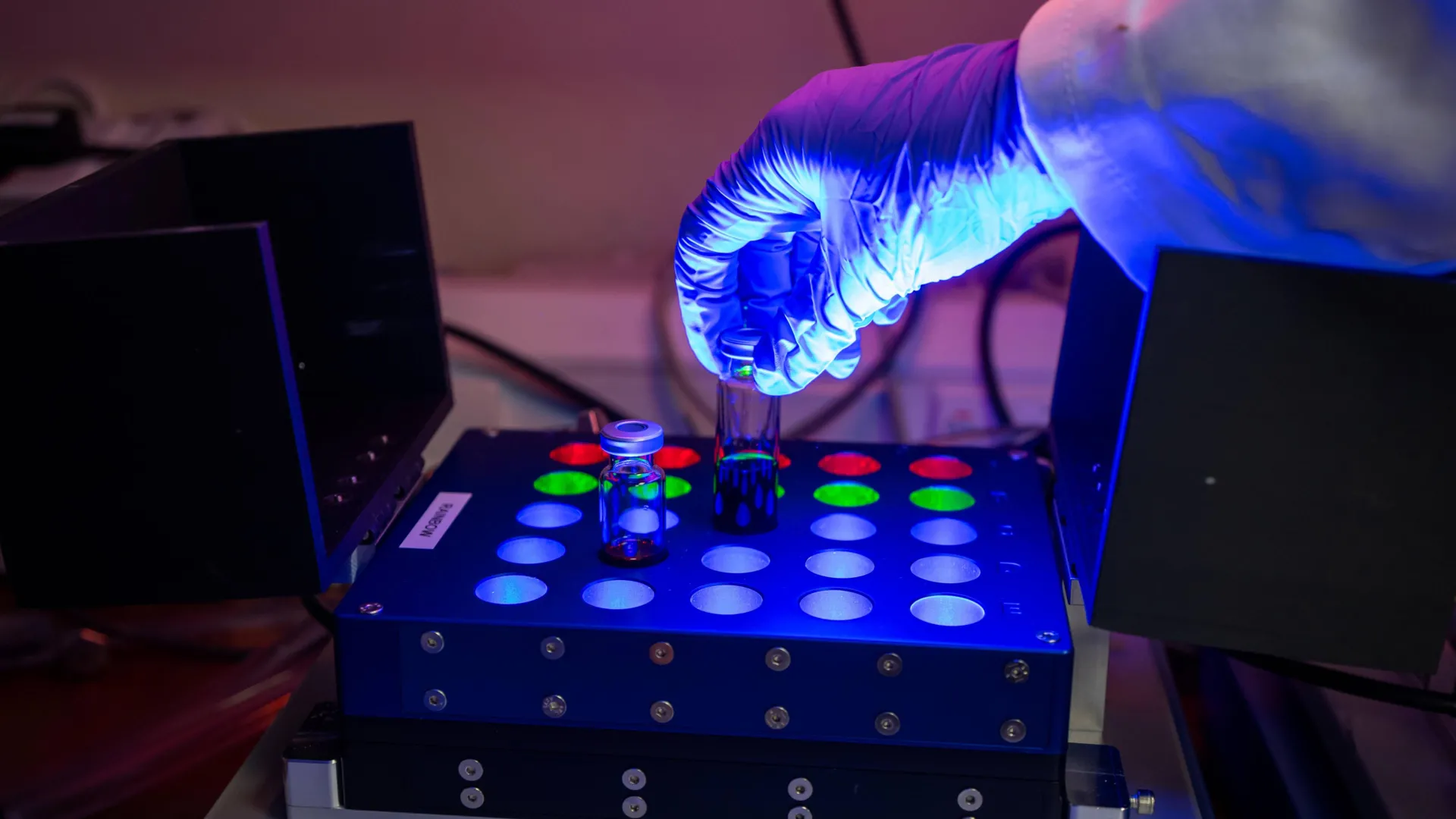
Researchers at the University of Cambridge have pioneered a novel photochemical strategy, leveraging the power of light to precisely modify complex pharmaceutical compounds, a development poised to significantly accelerate drug discovery and enhance the efficiency of medicinal chemistry workflows. This groundbreaking technique sidesteps the need for harsh chemicals or metal catalysts traditionally associated with altering intricate molecular structures, offering a cleaner and more adaptable approach. The research, detailed in the March 12th edition of the esteemed journal Nature Synthesis, introduces a paradigm shift in chemical synthesis by enabling modifications to drug molecules at later stages of their development, a departure from conventional methods that typically mandate these alterations much earlier in the manufacturing pipeline.
At the heart of this innovation lies what the Cambridge team has termed an "anti-Friedel-Crafts" reaction. The established Friedel-Crafts reaction, a cornerstone of organic chemistry for decades, often necessitates potent reagents and rigorous laboratory conditions, limiting its application to the initial phases of drug synthesis, followed by numerous subsequent steps to arrive at the final therapeutic agent. In stark contrast, the Cambridge group’s photochemical approach, activated by a simple LED lamp and operating at ambient temperature, initiates a self-propagating chain reaction. This process efficiently forges critical carbon-carbon bonds, the fundamental building blocks of countless organic substances, under remarkably mild conditions and without the employment of toxic or expensive raw materials.
This "LED-powered reaction" fundamentally reorients the drug development process. Instead of requiring chemists to meticulously dismantle and reconstruct large portions of a molecule to test a minor structural variation – a process that can consume months of effort – this new methodology permits targeted adjustments to be made late in the synthesis. David Vahey, a doctoral researcher at St. John’s College, Cambridge, and the lead author of the study, emphasized the transformative potential, stating, "We’ve uncovered a novel mechanism for introducing precise alterations into sophisticated drug molecules, particularly those that have historically presented formidable challenges for modification." He further elaborated on the practical implications: "Scientists have historically dedicated months to rebuilding substantial segments of a molecule solely to evaluate a singular, minor modification. Now, rather than undertaking a multi-step synthesis for hundreds of candidate molecules, researchers can begin with a promising lead compound and implement subtle adjustments at a much later juncture." This capability, Vahey noted, "unlocks chemical territories that have previously been difficult to access, furnishing medicinal chemists with a more environmentally sound and efficient instrument for investigating novel drug variants."
The streamlined synthesis enabled by this light-driven reaction translates directly into tangible benefits for drug discovery and manufacturing. By reducing the overall number of chemical transformations required, the process diminishes the consumption of reagents, lowers energy expenditure, and consequently, shrinks the environmental footprint associated with pharmaceutical production. This not only conserves valuable research time but also contributes to more sustainable chemical practices. A key attribute of this new reaction is its exceptional selectivity, a feature that allows chemists to modify a specific site within a complex molecule without inadvertently affecting other sensitive functional groups. This precision is paramount, as even minute structural changes can profoundly influence a drug’s efficacy, its pharmacokinetic profile within the body, or its potential to elicit adverse side effects.
The breakthrough tackles a foundational challenge in chemistry: the formation of carbon-carbon bonds. These bonds form the structural backbone of an immense array of materials, from basic fuels and everyday plastics to the intricate architectures of biological molecules essential for life. The technique’s capacity for "high functional-group tolerance" further enhances its utility, meaning it can selectively target one part of a molecule while leaving other reactive centers undisturbed. This characteristic is particularly advantageous during the late-stage optimization phase of drug discovery, where medicinal chemists meticulously refine molecular structures to enhance their therapeutic performance. Beyond its efficiency and precision, the avoidance of heavy metals, aggressive reaction conditions, and lengthy synthetic routes promises to significantly reduce toxic waste generation and energy demands within the pharmaceutical industry, aligning with the growing imperative for the sector to minimize its environmental impact.
The genesis of this discovery can be traced to research conducted within Professor Erwin Reisner’s group at Cambridge, a team renowned for its innovative chemical systems inspired by the principles of photosynthesis. Their prior work has focused on harnessing solar energy to convert waste products, water, and atmospheric carbon dioxide into valuable chemicals and fuels. Professor Reisner, who leads the Energy and Sustainability research initiative within the Yusuf Hamied Department of Chemistry and is a senior author on the study, underscored the significance of this latest achievement, highlighting its role in expanding the practical capabilities of chemists while simultaneously advancing the pursuit of greener manufacturing methodologies. "This represents a novel pathway for constructing a fundamental carbon-carbon bond, which is why its potential impact is so substantial," Reisner commented. "It also liberates chemists from an undesirable and inefficient process of drug modification."
The researchers rigorously tested the reaction across a diverse spectrum of drug-like molecules, demonstrating its adaptability for continuous flow systems, a common configuration in industrial chemical production. Collaborative efforts with AstraZeneca were instrumental in assessing the technique’s viability for meeting the stringent practical and environmental standards of large-scale pharmaceutical manufacturing. "Transitioning the chemical industry towards sustainability is arguably one of the most formidable aspects of the broader energy transition," Professor Reisner observed.
Remarkably, this significant advancement emerged from an unexpected laboratory outcome, a scenario reminiscent of many celebrated scientific discoveries throughout history, including X-rays, penicillin, and advancements in pharmaceuticals for erectile dysfunction and weight management. "There were numerous instances of failure after failure, and then, amidst the perceived chaos, we stumbled upon something entirely unforeseen – a true gem hidden in plain sight," Vahey recounted. "It all stemmed from a control experiment that, in retrospect, went wrong." While investigating a photocatalyst, Vahey conducted a control experiment where he intentionally omitted the catalyst. To his surprise, the reaction proceeded effectively, and in some instances, even more efficiently without the catalyst.
Initially, this anomalous result was suspected to be an experimental error. However, the researchers’ decision to delve deeper into this unexpected observation proved pivotal. Professor Reisner noted that the ability to recognize the potential significance of unanticipated results is a crucial hallmark of scientific inquiry. "The capacity to discern value in the unexpected is perhaps one of the defining characteristics of a successful scientist," he remarked.
The integration of artificial intelligence played a role in understanding and extending the reach of this discovery. The research team generates extensive datasets from their experiments, and increasingly employs AI tools for analysis. An algorithm developed within the group can predict chemical reactivity, accelerating the discovery process by reducing the need for exhaustive trial-and-error experimentation. However, as Reisner pointed out, "An algorithm is constrained by the rules it has been given. It still requires a human intellect to scrutinize an anomaly, an outcome that appears incorrect, and to question whether it might, in fact, represent something entirely new." In this instance, Vahey’s keen observation and decision to investigate the unexpected result were critical. "David could have easily dismissed it as a failed control," Reisner stated. "Instead, he paused and contemplated what he was observing. That precise moment, the choice to investigate rather than ignore, is where genuine discovery takes place."
Following the elucidation of the underlying chemistry, the team collaborated with researchers at Trinity College Dublin to develop machine learning models. These AI systems were trained on existing chemical reaction data and subsequently used to predict the reaction’s behavior on entirely novel molecules that had never been subjected to laboratory testing. By identifying patterns within known chemical transformations, the AI can simulate potential outcomes before conducting experiments, enabling researchers to identify promising molecular candidates with greater speed and significantly reduced experimental iteration.
For Vahey, this discovery represents the provision of a powerful new capability for the scientific community engaged in drug discovery and development. He concluded, "The ultimate impact will be determined by how industry and other researchers leverage this tool. For us, the laboratory experience is typically a series of average to challenging days, punctuated by truly exceptional moments." Professor Reisner echoed this sentiment, adding, "As a chemist, experiencing one or two truly groundbreaking days per year is immensely rewarding, and sometimes, those moments arise from an experiment that didn’t go as planned."
About the Author