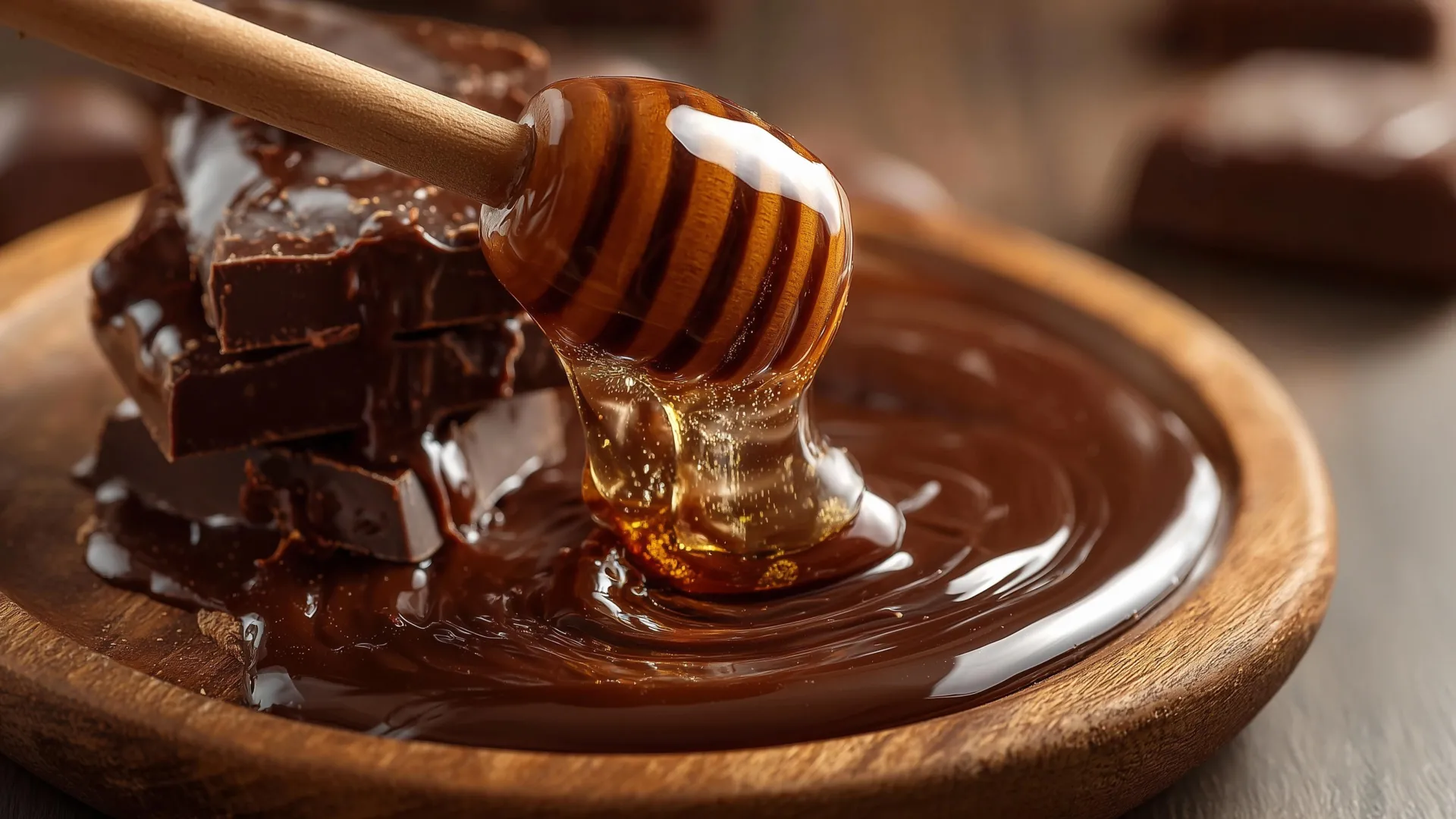
Researchers at Brazil’s State University of Campinas (UNICAMP) have successfully developed a novel food product by synergistically combining the natural sweetness of native bee honey with the rich flavor compounds found in discarded cocoa bean shells. This innovative creation, detailed in a recent publication in the esteemed journal ACS Sustainable Chemistry & Engineering, which also featured the study on its cover, presents a versatile ingredient suitable for direct consumption, culinary applications, and even integration into cosmetic formulations.
The ingenious methodology employed by the research team involved utilizing honey from indigenous Brazilian bee species as an effective and edible solvent to draw out valuable phytonutrients from cocoa shells. These shells, a common byproduct of the burgeoning chocolate industry, are frequently relegated to waste streams; however, this research repurposes them into a source of beneficial bioactive compounds. The extraction process, enhanced by ultrasonic technology, proved instrumental in liberating key substances such as theobromine and caffeine, both of which have been previously associated with positive cardiovascular health outcomes. Furthermore, the ultrasound-assisted treatment significantly elevated the concentration of phenolic compounds within the honey, bestowing upon it enhanced antioxidant and anti-inflammatory properties, thereby transforming a simple sweetener into a functional food ingredient.
Initial sensory evaluations conducted by the research participants revealed a distinct and appealing chocolate essence within the infused honey. The intensity and nuance of this chocolate flavor were observed to be directly proportional to the ratio of cocoa shells incorporated into the honey. Further comprehensive analyses are presently underway to meticulously assess the taste profile and a wider spectrum of sensory characteristics, aiming to optimize the product for broader consumer appeal.
Felipe Sanchez Bragagnolo, the lead author of the study, emphasized the dual appeal of this novel product. "While the public will undoubtedly be drawn to its delightful flavor profile, our in-depth analyses have uncovered a rich array of bioactive compounds that render it exceptionally compelling from both a nutritional and cosmetic standpoint," Bragagnolo remarked. His groundbreaking research was conducted during his postdoctoral tenure at UNICAMP’s Faculty of Applied Sciences (FCA) in Limeira, with significant financial backing from the São Paulo Research Foundation (FAPESP).
In a strategic move towards commercialization, the UNICAMP team has collaborated with INOVA UNICAMP, the university’s dedicated innovation arm, to secure a commercial partner. This partnership will facilitate the licensing of the patented extraction process, paving the way for the introduction of this unique honey-based product into the market.
The project extends beyond mere waste valorization, actively promoting the sustainable utilization of local biodiversity. The deliberate selection of honey from native Brazilian bees was rooted in their distinct biological characteristics. These bees produce honey that typically possesses a higher water content and lower viscosity compared to honey from European honeybees (Apis mellifera). This inherent fluidity makes it a more efficient medium for dissolving and extracting the desired compounds from the cocoa shells, streamlining the overall process.
The researchers meticulously investigated honey sourced from five distinct Brazilian native bee species: borá (Tetragona clavipes), jataí (Tetragonisca angustula), mandaçia (Melipona quadrifasciata), mandaguari (Scaptotrigona postica), and moça-branca (Frieseomelitta varia). The cocoa shells utilized in the experiments were generously provided by the Comprehensive Technical Assistance Coordination Office (CATI) unit of the São Paulo State Department of Agriculture and Supply, located in São José do Rio Preto.
For the initial refinement of the extraction methodology, honey from the mandaguari bee was chosen as the test subject. Its moderate water content and viscosity offered a balanced starting point for optimizing the process. Once the optimal parameters were established using mandaguari honey, the identical extraction procedure was systematically applied to the honey samples from the other native bee species. Bragagnolo further elaborated on the adaptability of the method, noting that honey’s chemical composition is inherently sensitive to a multitude of environmental influences, including climatic conditions, storage practices, and ambient temperatures. Consequently, he stated, "The process can be readily adapted to accommodate locally sourced honey varieties, not necessarily limited to mandaguari honey."
The cornerstone of the extraction methodology is its reliance on advanced ultrasound technology, a technique firmly rooted in the principles of green chemistry. The process involves immersing a probe, which bears a resemblance to a metallic pen, into a mixture of honey and cocoa shells. This probe generates high-frequency sound waves, which create cavitation – the rapid formation and collapse of microscopic bubbles. This phenomenon imparts localized energy bursts, effectively disrupting the cellular structure of the cocoa shells and facilitating the release of their valuable constituents into the honey. The ultrasound-assisted extraction is increasingly recognized within the food industry as an environmentally conscious approach due to its inherent speed and superior efficiency compared to many traditional extraction techniques.
The environmental sustainability of the entire process underwent rigorous formal evaluation through the utilization of Path2Green software. This analytical tool, developed by a dedicated team supervised by Professor Mauricio Ariel Rostagno of FCA-UNICAMP, who also provided oversight for Bragagnolo’s postdoctoral research and coordinated the overarching project, assessed the process against the twelve guiding principles of green chemistry. The evaluation encompassed critical factors such as transportation logistics, post-extraction treatment protocols, purification efficiency, and the ultimate application of the final product. A particularly significant advantage highlighted was the use of a readily available, locally sourced, edible, and directly applicable solvent. The comprehensive sustainability assessment yielded a commendable score of +0.118 on a scale ranging from -1 to +1. Professor Rostagno expressed optimism about the commercial potential, suggesting, "We envision that with the deployment of such technology within cooperatives or small enterprises already involved in cocoa production and native bee honey harvesting, it would be feasible to expand their product offerings with a high-value-added item, suitable even for the realm of haute cuisine."
Looking towards future applications, the research team is actively planning a series of investigations focused on understanding the precise impact of ultrasound on the microbiological profile of honey. Just as ultrasound effectively breaks down plant cell walls to liberate beneficial compounds, it possesses the capability to disrupt the cellular membranes of microorganisms, such as bacteria, that could potentially compromise the product’s shelf stability. Bragagnolo explained, "Honey derived from native bees typically requires specific preservation measures like refrigeration, maturation, dehumidification, or pasteurization, unlike honey from European bees which can often be stored at ambient temperatures. Our hypothesis is that exposure to ultrasound might intrinsically eliminate many of the contained microorganisms, thereby significantly enhancing the product’s stability and extending its shelf life without the need for additional processing."
The researchers’ forward-looking agenda includes exploring the broader utility of native bee honey as a versatile solvent in ultrasound-assisted extraction processes. This includes investigating its potential for processing a diverse range of other plant-based residues, further unlocking the potential of this natural resource. The multifaceted research initiative received substantial financial support through various postdoctoral fellowships, an international research internship for Bragagnolo, and numerous scholarships and grants from FAPESP, underscoring the project’s significance and the collaborative scientific environment fostered by the foundation.
About the Author